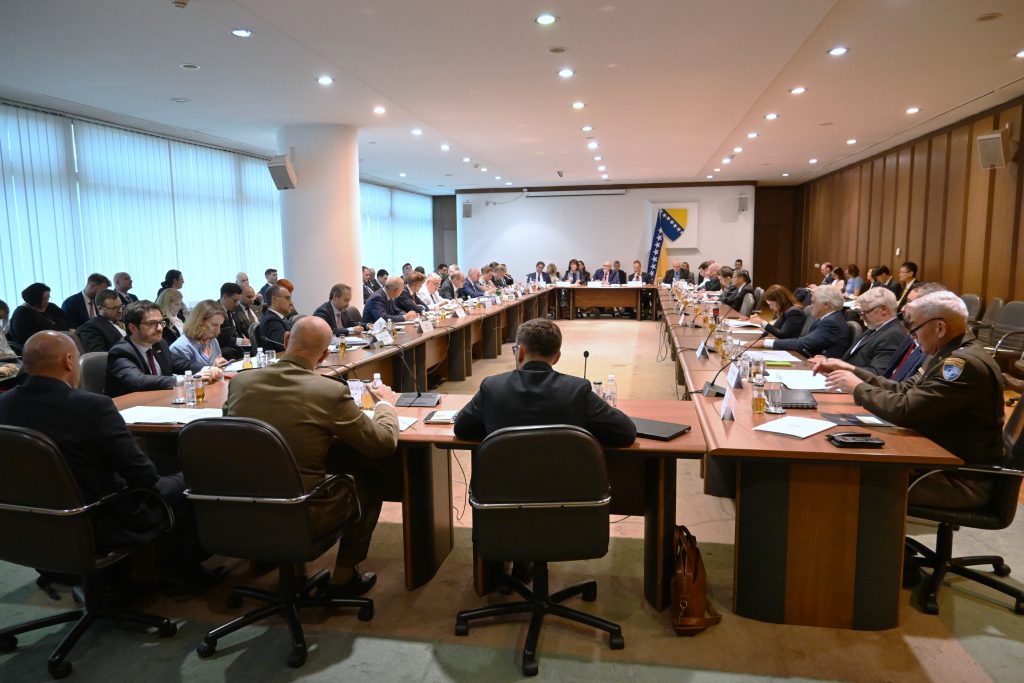
SARAJEVO – The United States stated that it will reconsider its role in the international presence in Bosnia and Herzegovina following the failure to elect a new High Representative. The US State Department and US Embassy in Sarajevo expressed strong disappointment that European divisions prevented the Peace Implementation Council (PIC) from fulfilling its task to choose a successor to Christian Schmidt.
“It was publicly and widely expected that at the June 3-4 meeting, the Peace Implementation Council (PIC) would select a new High Representative to provide stability for Bosnia and Hercegovina (BiH). The U.S. delegation strove to achieve a consensus around a commonly shared vision and Italy’s well-qualified candidate, the experienced diplomat Ambassador Antonio Zanardi Landi. Secretary Rubio described Italy’s candidate to Congress as a ‘gentleman that we think would do a good job of helping provide some stability to that position’”, the press release reads.
It stresses that the “the United States takes note of the European failure to reach consensus around a European candidate and is disappointed these divisions prevented the PIC from fulfilling its task to elect a new High Representative”.
“European indecisiveness, and the PIC’s abdication of its own duty toward BiH, is forcing the United States to reconsider our role in the current international presence in Bosnia and Herzegovina”, the press release remarks.
The Peace Implementation Council Steering Board, comprising the US, UK, France, Germany, Italy, Japan, Canada, Russia, and the EU, is responsible for selecting a new High Representative in BiH. While the PIC Steering Board selects the appointee, the appointment is, in practice, usually confirmed or supported by a UN Security Council resolution.
Christian Schmidt resigned from the post on 11 May. Schmidt, a German diplomat, served as the High Representative since August 2021. His tenure was marked by the use of far-reaching “Bonn powers” and political standoffs with the leadership of BiH’s entity, Republika Srpska, particularly with Milorad Dodik.
Schmidt cited “personal reasons” for stepping down from the post, while the media indicated that Washington was seeking Schmidt’s departure to install a successor who was more aligned with American policies. Following his resignation announcement, the search for a new High Representative is underway.
Media outlets in BiH reported that in addition to Antonio Zanardi Landi, a former Italian ambassador to Serbia and Montenegro, French diplomat René Troccaz has been put forward as a potential successor to Schmidt.
It is claimed that Troccaz, who serves as France’s special envoy to the Western Balkans, enjoys support from the United Kingdom and Germany.
Also, the US and European countries over the future mandate of the OHR, as Washington has advocated for transferring more responsibility to local Bosnian institutions, while European countries generally push to preserve the High Representative’s traditional executive authority.
The PIC is aiming to reach a consensus by the end of June to allow for a smooth transition of responsibilities. During the selection process, Schmidt continues to carry out his full duties and mandate to avoid any power vacuum.
Established under the Dayton Peace Agreement, the Office of the High Representative was designed to oversee the implementation of the civilian aspects of the peace settlement in BiH.
The High Representative serves as the final authority regarding the interpretation of the civilian aspects of the peace agreement, a mandate significantly expanded by the 1997 Peace Implementation Council (PIC) in Bonn, which granted the office the “Bonn Powers”. These powers allow the High Representative to impose legislation and remove public officials who violate the Dayton Agreement or obstruct the peace process.