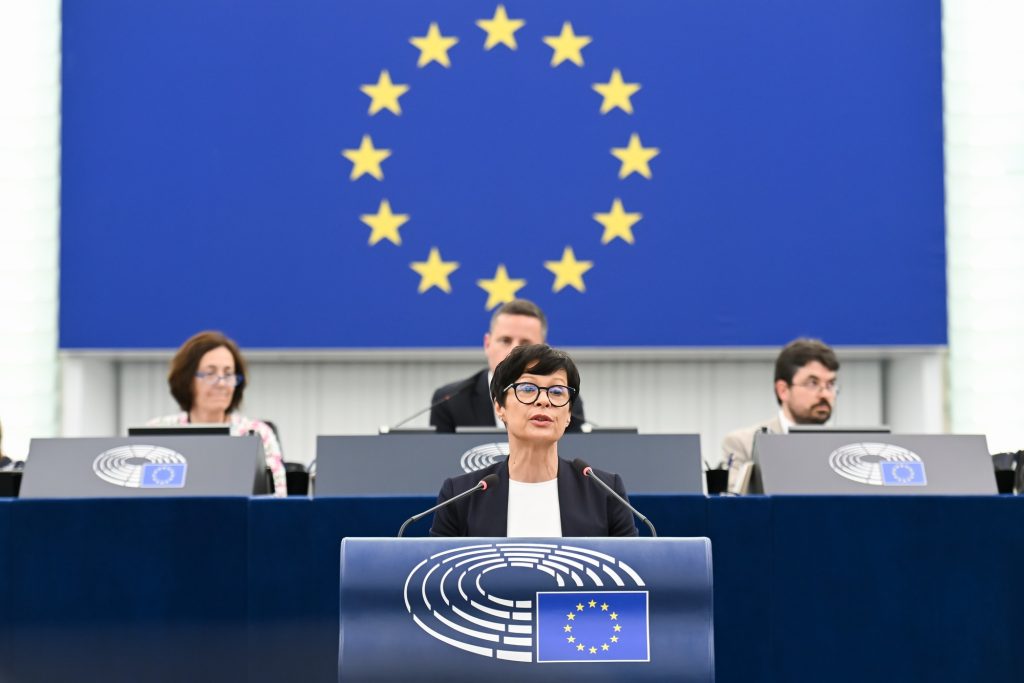
STRASBOURG – The European Parliament adopted today annual reports on five Western Balkan countries: Montenegro, Albania, North Macedonia, Bosnia and Herzegovina and Kosovo. The reports were jointly debated by the MEPs on Tuesday.
During the debate, titled “An EU future for the Western Balkans”, the MEPs supported the membership prospects of candidate countries, especially Montenegro and Albania, while also highlighting ongoing problems and challenges in each of them.
The reports were previously adopted by the Committee on Foreign Affairs (AFET). The report on Serbia is expected to be on the agenda of the Parliament in July.
Addressing the Parliament on Tuesday, European Commissioner for Enlargement Marta Kos commended the progress made by Montenegro and Albania and said that this movement is expected by all countries in the Western Balkans.
“There is today a window of opportunity to advance towards membership, and we are encouraging all Western Balkans countries to seize it”, Kos said.
According to her, at the EU-Western Balkans summit in Tivat in Montenegro, there were clear commitments from all Western Balkans leaders that the EU path is their strategic priority.
“The European Commission is eager to move forward with all of them, if they fulfil their reform commitments and show sufficient alignment on the EU’s Common Foreign and Security Policy and with visa policy”, Kos said.
European Parliament Rapporteur for Montenegro, Marjan Šarec, said during the debate on Tuesday that the goal of concluding the negotiations by the end of 2026 is ambitious but achievable.
“Implementation will be the most important factor. This applies especially to Chapters 23 and 24, which remain the backbone of the entire accession process”, he said.
At present, he said, politics faces the challenge of constitutional amendments, which require a two-thirds majority in parliament.
“Therefore, reaching an agreement will be essential. In my view, the platform presented by the opposition provides a good basis for further dialogue”, Šarec said.
During the debate, Andreas Schieder, Rapporteur for Albania, called the country “the second frontrunner in the enlargement process”, highlighting strong support for EU membership in Albania and assessing that the goal of concluding accession negotiations by the end of 2027 “no longer appears to be a dream but rather a realistic prospect”.
Addressing the current situation in Albania, Schieder said that “tourism creates jobs and drives economic growth, but only in the long term if nature and the environment are not sacrificed in the process”.
“The European Union has established clear standards in this area, which provides yet another strong argument for Albania’s accession to the EU. In this context, I am also confident that all of these European legal instruments – from environmental impact assessments designed to protect natural habitats to legislation safeguarding birds and other wildlife – will be fully respected”, Schieder said.
Rapporteur for North Macedonia Thomas Waitz said that on Tuesday the aim of the EU should be to offer full membership to all six Western Balkan states.
“First Montenegro, then comes Albania and I think the next one on the list should be North Macedonia”, Waitz said.
According to Waitz, it has to be acknowledged that many countries in the region, but clearly also North Macedonia, have shown progress, which needs to be awarded.
“We need to reward progress in the region to keep the motivation up and to keep the motivation up in North Macedonia”, Waitz said, adding that there needs to be an alliance in the country between the position and opposition to bring the needed reforms forward.
Ondřej Kolář, rapporteur on Bosnia and Herzegovina, on the other hand, highlighted multiple problems the country is facing.
“When I was speaking about the slow approach to reforms, when I was speaking about maybe even the lack of will of some officials to deliver what is needed, that is something that we cannot do for them. We can offer them help, we can offer them guidance, we can maybe show them the path, but they are the ones who need to deliver”, he said during the debate on Tuesday.
“Honestly speaking, the judicial system is very weak, reforms are slow, media freedom is on a very low level and the civil society is vegetating”, Kolář said.
He added that it was disturbing that citizens of BiH who want to live in the EU are doing so by leaving the country, since they do not see their future in it.
Riho Terras, Rapporteur for Kosovo, said that it was very important to him that Kosovo gains the EU candidate status.
“The last years have been politically extremely difficult for Kosovo: in just over a year, three parliamentarian elections and the local elections have been taking place. The country has been in permanent election campaign mode. Although this is a clear sign of vibrant democracy operating in Kosovo, it is obviously difficult to exercise legislative and executive power in such a constant campaigning regime”, Terras said.
He added that his there has been progress on several important issues, including the Reform and Growth Facility, but that in other areas the reforms have not been sufficient. This includes the Belgrade-Pristina dialogue, which has been stalled for a long time due to the political stalemate.