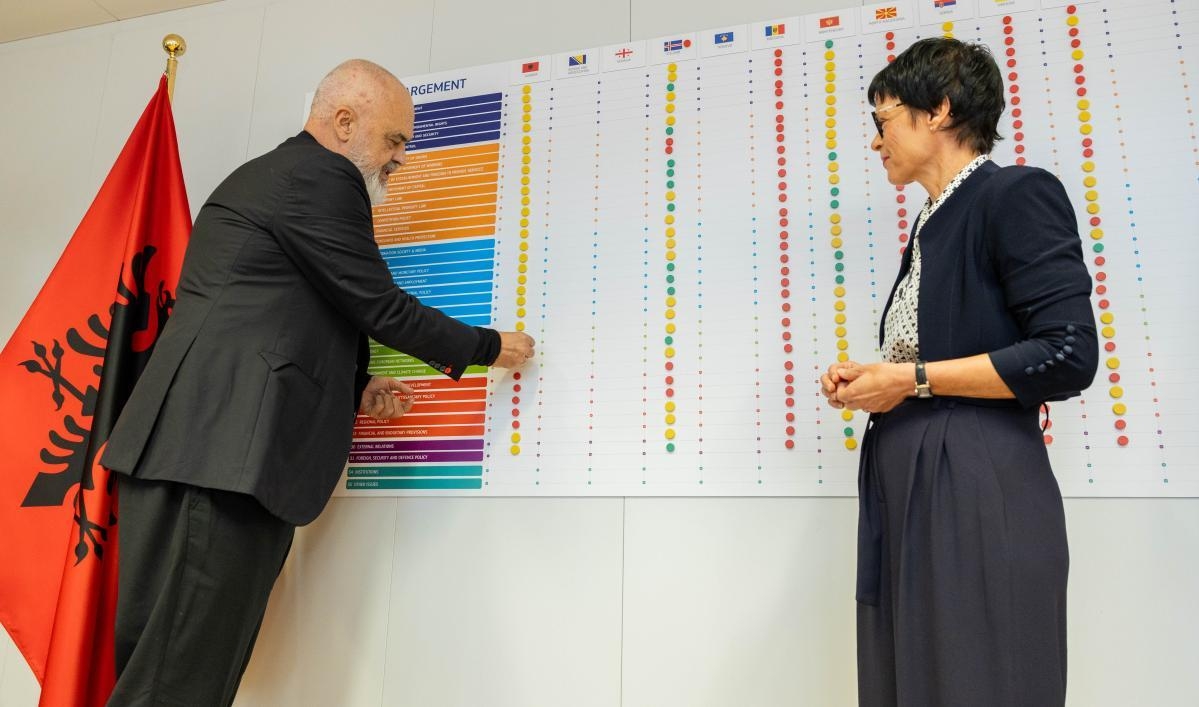
European Commission published its annual enlargement reports yesterday. We report the key findings of the Report on Albania in the areas of democracy, rule of law and economic criteria:
The legal and institutional framework regarding elections is generally adequate. However, several longstanding recommendations from the Organization for Security and Co-operation in Europe (OSCE) / Office for Democratic Institutions and Human Rights (ODIHR) and the Venice Commission remain unaddressed. A comprehensive electoral reform is urgently needed, in particular ahead of the 2027 municipal elections.
Daily protests have been taking place since May 2026. The protests were triggered by environmental concerns around construction works in the protected landscape of Pishë Poro–Narta and developed into a broader movement calling for transparency, accountability, anti-corruption efforts and good governance. This is the largest civic mobilisation in Albania since the country’s democratic transition, with tens of thousands of participants joining the protest at its peak. Building on the civic movement, student-led protests took place in October 2026, during which violent incidents occurred between protestors and the Albanian State Police. No dialogue has taken place so far. All sides should make genuine attempts to engage in constructive dialogue.
Parliament can exercise its powers, including control of the executive and involvement in the legislative process, in a partially effective way. The lack of genuine political dialogue and public consultation activities as well as clashes between the ruling majority and the opposition continued to limit its effectiveness. Parliament further failed to implement some Constitutional Court rulings. The adoption by consensus of amended rules of procedure was a positive development. However, the frequent tabling of legislative initiatives by the Council of Ministers, the systematic rejection of the opposition’s requests to set up inquiry committees, and the politicisation of appointments to constitutional bodies or independent institutions all contributed to limiting Parliament’s oversight of the government.
The government continued to show its commitment to EU integration. A substantial government reshuffle took place in February 2026, and further changes were announced in September 2026. Civil society, including human rights defenders, operate in a partly enabling environment, despite continued negative narratives. Civil society organisations (CSOs) and human rights defenders working on gender and LGBTIQ+ rights were particularly targeted.
Albania remains moderately prepared on public administration reform. Some progress was made, especially with the adoption of the amendments to the Law on the organisation and functioning of the State Administration. However, the government continued to adopt budget revisions through normative acts, without parliamentary scrutiny. Public consultations were not conducted efficiently on a regular basis or followed by appropriate follow-up actions.
Albania is between a moderate and a good level of preparation and has made good progress on the functioning of the judiciary. Albania continued to implement the 2016 justice reform. The vetting process for all judges and prosecutors was fully completed following the finalisation of the appeal phase, further strengthening independence accountability and integrity in the justice sector. Rules on the appointment of non-magistrate members to the High Judicial Council (HJC) and High Prosecutorial Council (HPC) were aligned with those applicable to magistrate members regarding asset and background verifications. The new Chief Special Prosecutor at the Special Prosecution’s Office was appointed through a competitive and transparent process. Challenges remain in conducting timely and qualitative evaluations of magistrates. The lack of human resources, including magistrates as well as legal and administrative support staff, continues to affect the quality of justice. Attempts by public officials or politicians to exert undue influence on the judicial system, including on SPAK, and personal attacks on magistrates continued during the reporting period. While the backlog of cases has been partly reduced, pressing issues on judicial efficiency, quality and integrity – including court infrastructure, security and the delayed establishment of an electronic case management system – remain to be addressed.
Albania is between a moderate and a good level of preparation in the fight against corruption and has shown good progress overall. The 2024-2030 Anti-Corruption Strategy and its 2024-2026 action plan are being implemented. The Specialised Structure Against Organised Crime and Corruption (SPAK) has continued to demonstrate independence and deliver positive results in fighting high-level corruption, making tangible progress towards a solid track record in the fight against corruption. However, corruption remains a real challenge. Legislation to prevent corruption was further aligned with European standards, including on conflicts of interest and lobbying. Further alignment was achieved on whistleblower protection. Sector-based corruption risk assessments have been initiated and high-level asset declarations published. The actual impact of these and other preventive measures on corruption remains to be demonstrated, considering ongoing high-level corruption investigations.
Albania’s legal framework sets out a generally good basis for the protection of fundamental rights. Progress was made with the adoption of the new gender equality and alternative care laws, amendments to the Law on the prevention and protection from violence against women and domestic violence, the remaining pieces of implementing legislation to the Law on personal data protection. Amendments to the Law on protection from discrimination, were also adopted, although full alignment with the acquis is still expected. The pace of progress in advancing prison reform has not matched the ambition required and the conditions within correctional institutions continue to warrant careful attention. The enjoyment of the right to property and of the rights of persons belonging to minorities need to improve. An overall increase in implementation efforts is needed.
Albania is between having some and a moderate level of preparation in the area of freedom of expression and made some progress during the reporting period, especially as regards aligning its legislative framework with the EU acquis and European standards. Albania provides insufficient legal guarantees on the freedom of expression while the enabling environment needs to improve for media to operate freely, independently and professionally. Albania exempted registered journalists from criminal provisions on defamation under certain conditions, though full decriminalisation of defamation is yet to be achieved. Media independence and pluralism continue to be affected by economic penetration of the media market by business groups with political links and the overlap of political, business and other interests, the lack of transparency of financing sources, a high concentration of media ownership, as well as intimidation and smear campaigns, strategic lawsuits against public participation (SLAPPs), and the precarious working conditions for journalists. Concerns continued to be voiced about political influence impacting appointments of both the media regulatory authority and the public broadcaster.
Albania is between a moderate and a good level of preparation in the fight against organised crime and has made good progress. The capacity and effectiveness of the prosecution system (both specialised and general, including at district level) to investigate criminal groups and its use of financial investigations continued to develop. The fight against money laundering and the seizure of assets linked to organised crime were strengthened. SPAK has also further consolidated cooperation with its international counterparts, in particular with EU Member States and EU agencies, to investigate high-risk criminal groups with initial tangible results. Albania reinforced its capacities and cooperation with Member States on cybercrime. Albania also adopted amendments to its Criminal Code, further aligning with the EU acquis on the criminalisation of money laundering, trafficking in human beings, online and offline child sexual abuse and exploitation, as well as drug trafficking and combating terrorism.
Albania has a good level of preparation in developing a functioning market economy and made some progress in this area. The economy maintained strong growth momentum in 2025 thanks to robust domestic demand and tourism. Sustained growth in tourism helped bring down the current account deficit to a historic low in 2025. Inflation remained below the central bank’s target amid the continued appreciation of the lek. The fiscal deficit widened but stayed below target, and the public debt ratio continued to decline. Despite recent increases, government revenue as a share of GDP remains low, while spending on public investment is repeatedly under-executed. The labour market situation continued to improve, but structural problems, such as emigration, persist. The banking sector remained sound, while lending to the private sector increased. The business environment remains affected by a weak rule of law, limited access to finance for small- and medium-sized enterprises, and shortcomings in the oversight and governance of state-owned enterprises.
Albania has between some and a moderate level of preparation to cope with competitive pressure and market forces within the EU and made some progress in this area. Despite efforts to reduce barriers in accessing education for children with disabilities and those from disadvantaged backgrounds, the education system still faces numerous challenges. Skills gaps persist, and the youth NEET rate (those not in education, employment or training) remains a concern. Transport and digital infrastructure improved, but infrastructure gaps persist. Albania continues to benefit from strong tourism growth, but industry and agriculture remain low-productivity sectors that have been contracting. Manufacturing exports fell for the third consecutive year, reflecting weak external demand, lek appreciation and businesses’ limited pricing power.