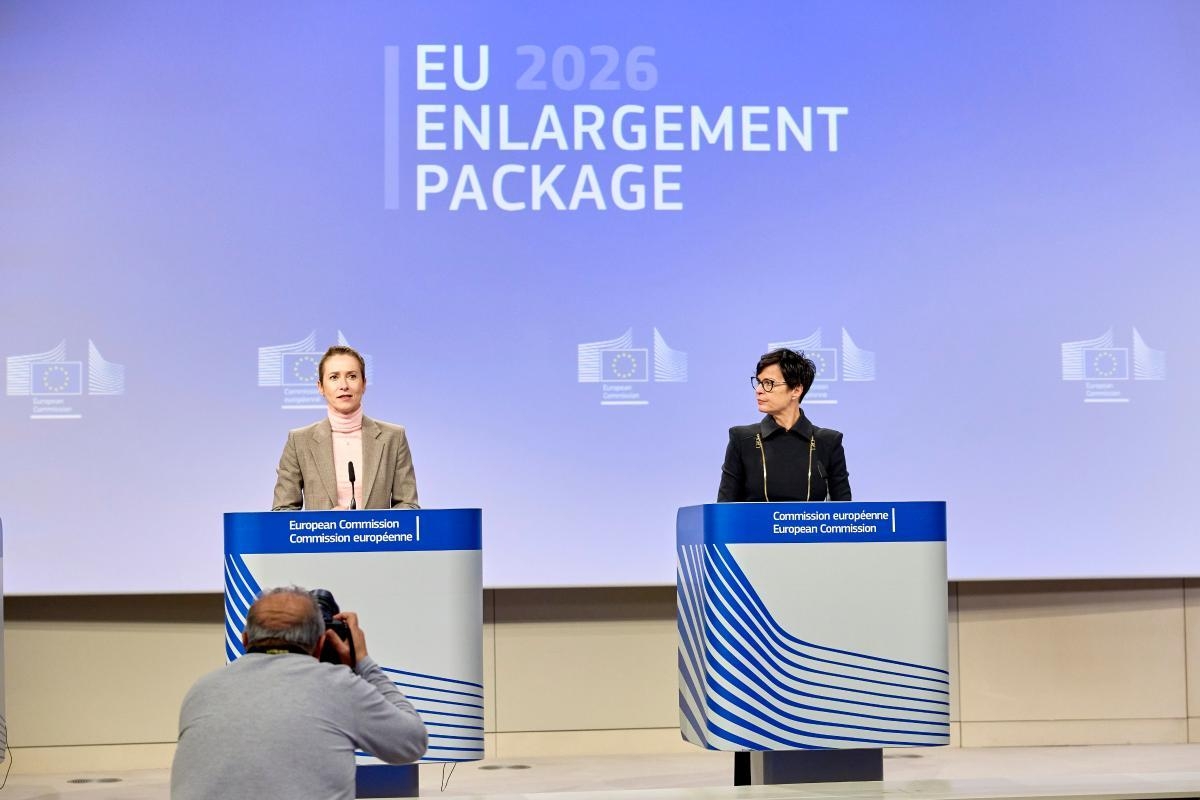
European Commission published its annual enlargement reports yesterday. We report the key findings of the Report on Bosnia and Herzegovina in the areas of democracy, rule of law and economic criteria:
The legal and institutional framework regarding elections requires substantial reforms. Constitutional and electoral reforms are needed to ensure political equality and nondiscrimination of all citizens. Issues of electoral integrity remain, in line with findings from international bodies. All political stakeholders must respect the independence of the Central Electoral Commission (CEC).
Parliament can exercise its powers in a partially effective way. Legislative output remained low and parliamentary sessions of the House of Peoples were regularly disrupted. Oversight over the executives remained weak.
The institutions in charge of the EU integration process are broadly in place but need to be strengthened, and key appointments need to be made. The Council of Ministers needs to: (i) strengthen the role of the Directorate for European Integration (DEI); (ii) develop and adopt a national programme for the adoption of the EU acquis; (iii) facilitate policy dialogue within the Stabilisation and Association Agreement (SAA) bodies; (iv) urgently appoint the National Instrument for Pre-Accession Assistance Coordinator (NIPAC) under IPA III and (v) urgently appoint a Reform and Growth Facility Coordinator and establish a related monitoring and reporting structure. Following the European Council decision to open accession negotiations in March 2024, the country needs to appoint an operational chief negotiator.
Governance is increasingly unsatisfactory. The functioning of the executive and legislature was hindered by political fragmentation, and key EU-related reforms still need to be adopted. Independent institutions remain weak. All levels of government show signs of state capture. The period following the conviction of Milorad Dodik was marked by legal uncertainty. The Republika Srpska entity assembly appointed three governments during the reporting period, two of which resigned amid disputes over their legitimacy. Constitutional Court decisions must be fully recognised and enforced by the Republika Srpska entity, and judicial vacancies filled swiftly.
Civil society, including human rights defenders, operate in a constrained environment. No significant actions were taken towards ensuring an enabling environment for civil society. Financial constraints overall, and restrictive legislation in the Republika Srpska entity in particular, restricted the space for civil society. Bosnia and Herzegovina should establish meaningful and systematic consultations with civil society and introduce a transparent funding framework for civil society organisations (CSOs).
Bosnia and Herzegovina is between an early stage of preparation and having some level of preparation in public administration reform. There was limited progress in this area during the reporting period. Steps were taken to improve the country’s revenue administration and performance by establishing an IT system for programme budgeting and fiscal planning, which has supported the preparation of the 2026 programme budgeting at some levels. The adoption of the 2023-2027 revised countrywide action plan on public administration reform is pending at state level and in the Republika Srpska entity. The validity of the 2021-2025 public financial management (PFM) strategy was prolonged by state-level institutions until the end of 2026, following its expiration at the end of 2025. The adoptions of individual PFM strategies at other levels of government are not yet completed and the new comprehensive 2027-2031 PFM strategy is not yet finalised. On the civil service, progress is uneven and the regulatory framework is not aligned with merit principles. Bosnia and Herzegovina needs to complete essential steps to improve the overall functioning of its public administration by ensuring a professional and depoliticised civil service and a coordinated countrywide approach to policymaking.
Bosnia and Herzegovina is between an early stage of preparation and having some level of preparation on the functioning of the judiciary. No progress was made during the reporting period with negative developments in ensuring the credibility and integrity of asset declarations and the verifications process through external monitoring. There were no positive developments in relation to other aspects, including addressing the findings of the expert report on rule of law issues (the ’Priebe Report’). Serious shortcomings in the functioning of the judicial system continued to undermine citizens’ rights and the fight against corruption. Legislative reforms and integrity checks are key to rebuilding public trust in the justice system.
Bosnia and Herzegovina is between an early stage of preparation and having some level of preparation in the fight against corruption. No progress was made. The political authorities continuously failed to tackle widespread corruption and instead actively obstructed progress, leading to extended stagnation and continued signs of state capture. The 2024 state-level Law on the prevention of conflict of interest has still not been implemented effectively. The Federation entity failed to adopt new legislation on the prevention of conflict of interest, even though it has not had enforceable legislation on the matter since 2013. The Federation entity’s special departments for fighting corruption, organised crime and inter-cantonal crime, set up in 2025 after an 11-year delay, still have not achieved operational efficiency or ensured effective implementation of the law. No efforts were made to harmonise anti-corruption legislation across the country or to remedy operational inefficiency and political interference (including pressure and intimidation). This continued to result in selective and opaque judicial follow-up to corruption cases of public resonance. The track record on fighting corruption remains weak, with very few convictions, in particular in high-level cases. Gaps remain regarding rules on conflicts of interest, verification of asset declarations and protection of whistle-blowers. The Sarajevo Canton continued to demonstrate tangible results in these areas. Targeted risk assessments and dedicated measures are needed to address corruption in the most vulnerable sectors.
The general framework for fundamental rights needs to be improved, as the continued absence of legal and strategic documents increasingly impairs the authorities’ ability to uphold fundamental rights. The country did not adopt constitutional and electoral reforms to ensure that all citizens are able to effectively exercise their political rights, notably to bring the country’s Constitution into line with the Sejdić-Finci case law of the European Court of Human Rights (ECtHR), as well as implement relevant decisions of the Constitutional Court. Some bylaws on the Federation entity’s Law on protection from domestic violence and violence against women were adopted, but there is a lack of data on implementation. The legal framework on procedural rights for suspects and accused persons and on the rights of victims of crime remains incomplete.
There is some level of preparation in the area of freedom of expression. No progress was achieved during the reporting period, including in guaranteeing freedom of expression and of the media and the protection of journalists. Media freedom continues to experience deep stagnation, with worrying signs of deterioration. The challenges faced by public broadcasters continue, and the authorities failed to ensure their sustainable and stable financing, impacting also editorial independence. In particular, the situation of the state public broadcaster Radiotelevizija Bosne i Hercegovine (BHRT) further deteriorated, and it remains at serious risk of shutting down. The legal disputes between the three public broadcasters continue. Further steps are needed to ensure the full implementation of the countrywide network of contact points for the safety of journalists.
Bosnia and Herzegovina is between an early stage of preparation and having some level of preparation in the fight against serious and organised crime. Some progress was made, in particular with the adoption of: (i) a list of criminalised psychoactive substances; (ii) the new Serious and Organised Crime Threat Assessment (SOCTA), in line with Europol methodology; and (iii) the rulebook on the implementation of the Law on anti-money laundering and countering the financing of terrorism (AML/CFT). Systemic shortcomings continue to hinder the operational cooperation and investigative capacity of law enforcement agencies due to fragmented criminal legislation, poor institutional coordination and insufficient resources. Financial investigations and asset seizures and confiscations remain insufficient. A proactive approach is essential to stop criminal infiltration in the political, legal and economic systems and to tackle the political capture of law enforcement institutions.
Bosnia and Herzegovina is at an early stage of preparation and made no progress during the reporting period in establishing a functioning market economy. GDP growth remained relatively resilient despite external headwinds, such as weaker international demand and the Middle East crisis, but slowed from 2.1% in 2025 to 1.7% in the first quarter of 2026. Output growth was supported mainly by domestic demand. Employment growth decelerated further, while the continued outflow of workers contributed to labour shortages and upward pressure on wages. Higher energy prices and wages drove inflation up in 2025 and the first half of 2026. Financial markets and the currency remained stable, although delays in aligning with international norms resulted in the country’s grey-listing by the Financial Action Task Force (FATF). The authorities’ commitment to EU accession-related reforms remained partial. Economic governance suffered from a very short-term policy approach and insufficient cooperation between key stakeholders at entity level. The business environment continued to be negatively affected by a highly fragmented internal market, reduced predictability of official policies, and long-standing weaknesses in the rule of law framework.
Bosnia and Herzegovina is between an early stage of preparation and having some level of preparation and made no progress in coping with competitive pressure and market forces within the EU. The overall quality of education remains inadequate, and no significant progress has been made in improving the situation. The country continues to lag behind in the energy and digital transitions. Economic integration with the EU remains high, but overall trade with the EU is still below potential. Labour shortages contribute to wage increases that exceed productivity growth, which could negatively affect the country’s external price competitiveness.