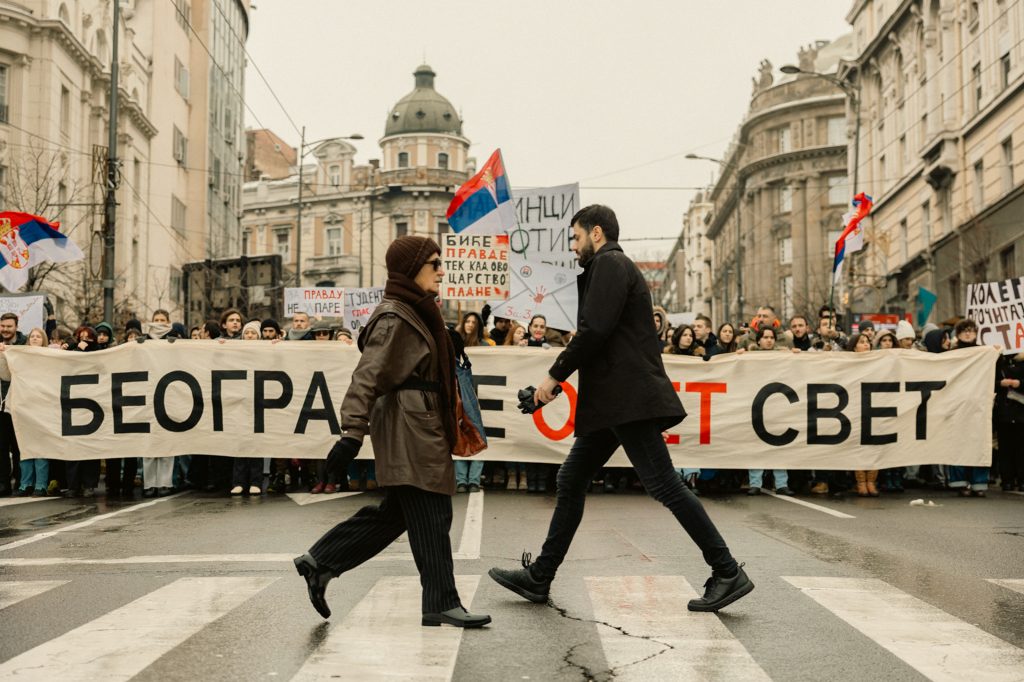
For a year now, citizens of Serbia, led by students, have been taking to the streets. Students from all parts of the country have been marching for days toward Novi Sad, where on 1 November a commemorative gathering will be held to mark one year since the collapse of the railway station canopy that claimed 16 lives.
Although the largest protests in Serbia’s modern history have been ongoing for a full year, the government continues to refuse to call early parliamentary elections – the key demand of students and citizens.
President Aleksandar Vučić has been hesitant to announce a vote, occasionally hinting that it could take place sometime next year, but without specifying a date.
This article highlights ten key phenomena that have shaped Serbia’s political landscape over the past year, developments that have at the same time irreversibly changed Serbian society.
1. The “bloody hands” emerge as grief turns into anger
The canopy of the newly renovated railway station in Novi Sad collapsed on November 1 at 11:52 a.m. While rescuers were still pulling out an unknown number of people trapped beneath tons of concrete, pro-government tabloids rushed to absolve the authorities of responsibility, claiming the canopy had not actually been part of the renovation.
That same evening, President Vučić said that the entire station building had been renovated except for the canopy.
The day after the collapse, more than a thousand citizens gathered to block the intersection near the railway station, lighting candles and laying flowers in memory of the victims.
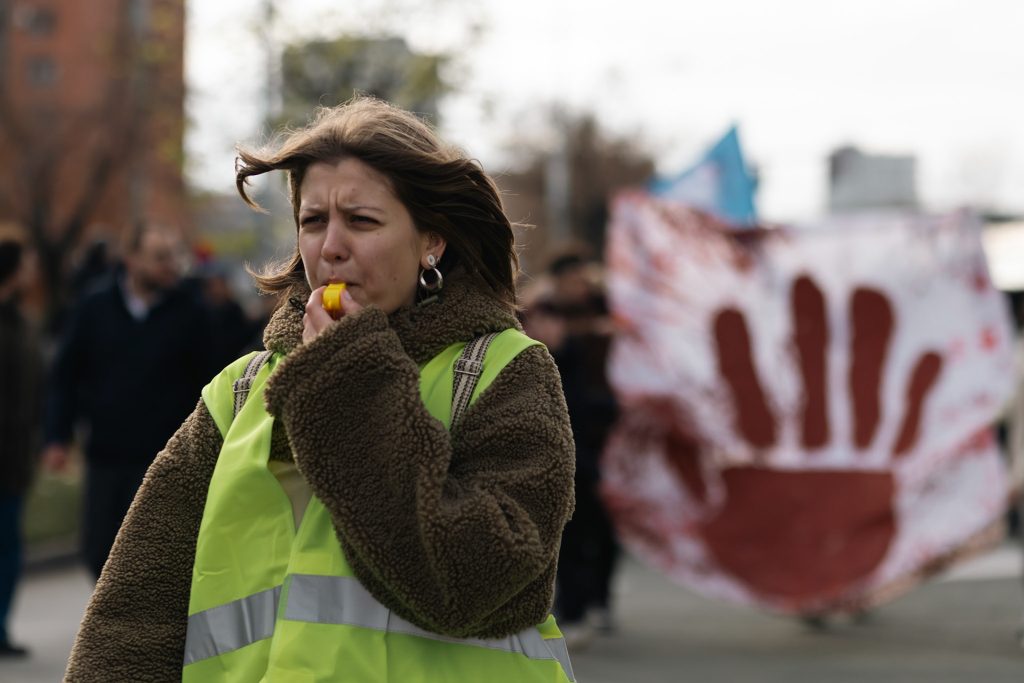
On 3 November, the first protests began in Belgrade, with demonstrators demanding the resignation of Minister of Construction and Infrastructure Goran Vesić. Some protesters painted their hands red, declaring that the authorities had “blood on their hands.” The red hand would soon become the defining symbol of the protests.
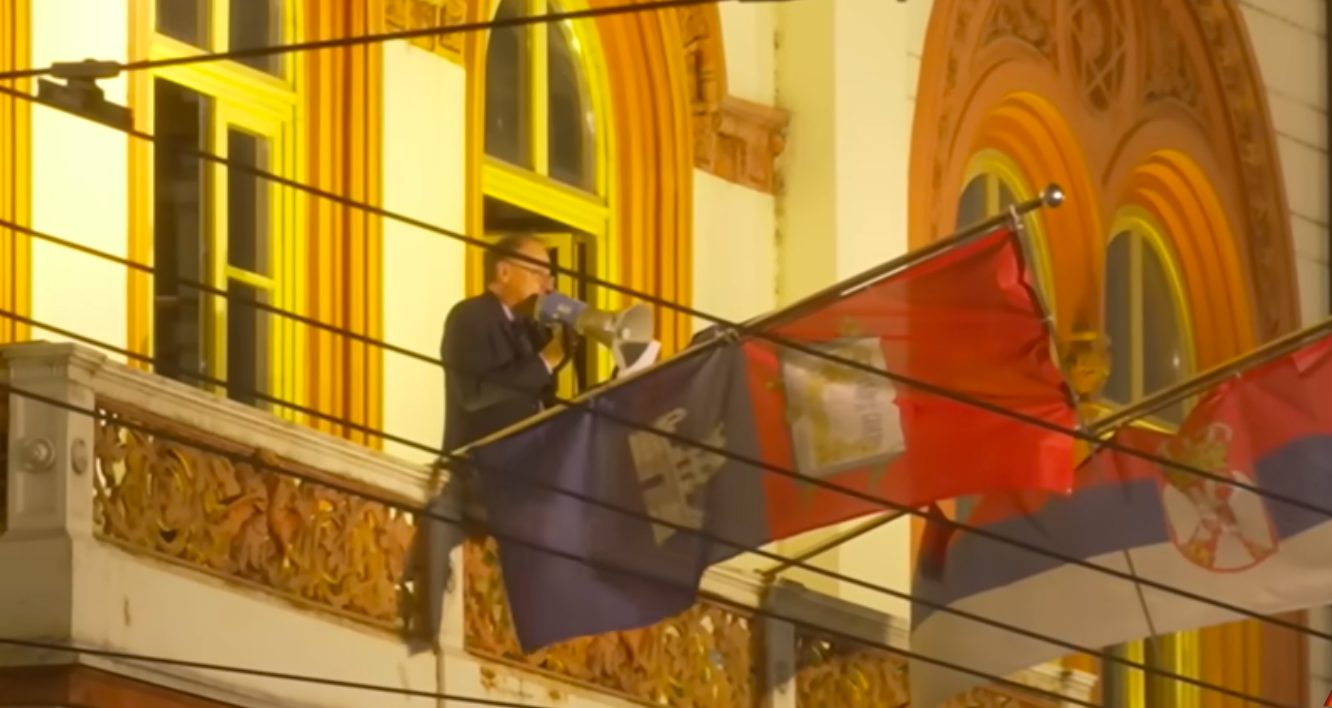
Just two days later, the first major protest took place in Novi Sad. After the rally, stones, torches, and red paint were thrown toward City Hall. Riot police responded with tear gas and arrests.
2. Students mobilize the society on a massive scale
By mid-November, citizens in Novi Sad launched the campaign of blocking main roads for 14 minutes to pay tribute to the 14 victims. Very soon similar actions began spreading across the country.
During one such action on 22 November, students from the Faculty of Dramatic Arts were attacked, and the media later reported that some of the assailants were officials of the Serbian Progressive Party (SNS). Since the authorities failed to prosecute those responsible, the Faculty of Dramatic Arts went into blockade.
In the following days, their call was joined by faculties from all universities across Serbia. At that point, students took over the protest, organizing daily road blockades throughout the country. Reports of attacks on students and citizens participating in these actions soon followed, along with the first arrests and detentions of students.
The students soon articulated four key demands: the publication of all documentation related to the reconstruction of the railway station, the identification of all individuals who physically assaulted students, the dismissal of all proceedings against students, and a 20% increase in state funding for public universities.
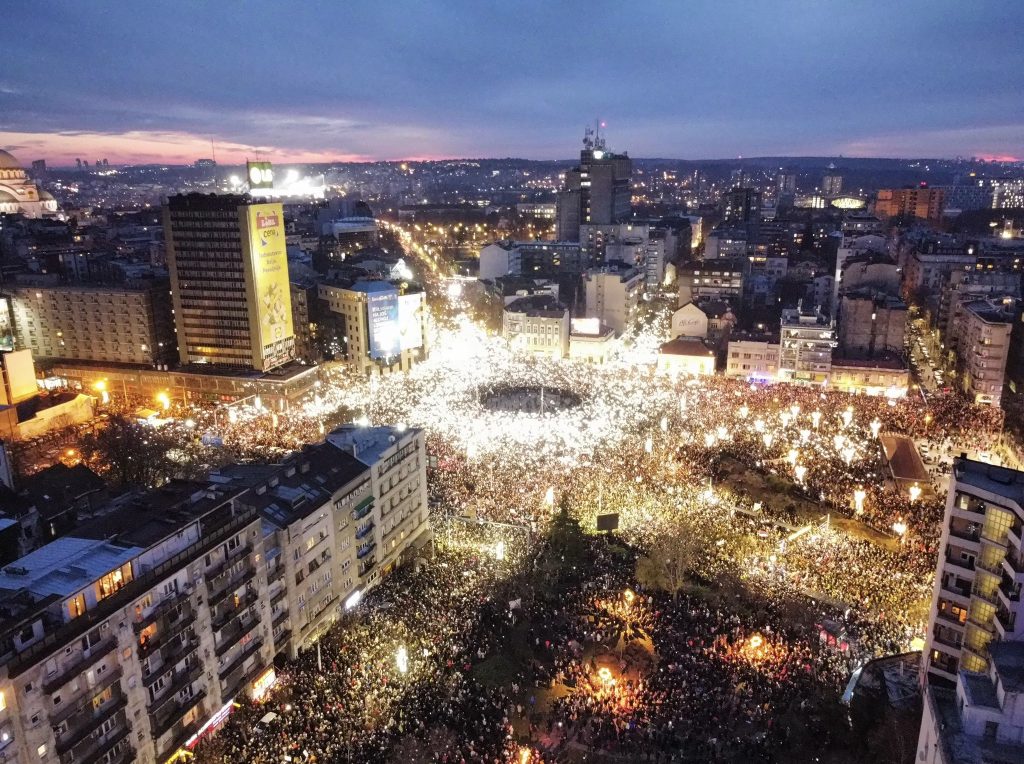
That these protests were unlike any before became evident on 22 December, when the first mass student protest was held at Slavija Square.
According to the Archive of Public Gatherings, around 100,000 people attended – making it, by their data, a larger gathering than the one on 5 October 2000, when the regime of Slobodan Milošević was overthrown.
While the authorities hoped the momentum of the student movement would fade during the New Year and Christmas holidays, the opposite occurred.
Citizens overwhelmingly supported the students, who continued to blockade their faculties during the holidays and organized several large protests, such as the one in front of the Constitutional Court on 12 January, when thousands demanded that the students’ requests be met and that both political and criminal responsibility be established for the collapse of the station canopy.
In January, the students and faculty were joined by a segment of education workers who launched a strike in elementary and secondary schools.
3. The fall of the government
Since the beginning of the student protests, pro-government media and senior state officials have accused the students of organizing a “colour revolution” in Serbia. Students have been monitored and targeted daily, with their personal information published and their names linked to Croatian and other foreign intelligence services.
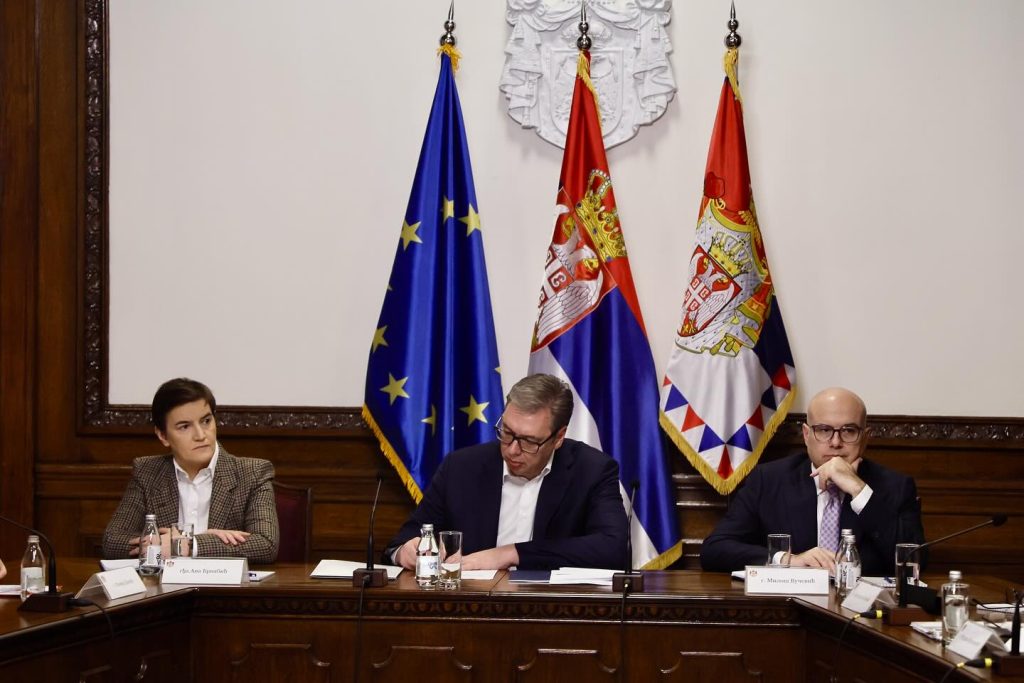
On 28 January, a group of men armed with baseball bats attacked students in Novi Sad while they were putting up stickers on the street. The attackers came from the premises of the Serbian Progressive Party (SNS), and one female student sustained a broken jaw. The attack occurred just hours after President Aleksandar Vučić, Prime Minister Miloš Vučević, and Speaker of Parliament Ana Brnabić issued a joint statement inviting students to dialogue and expressing the government’s willingness to meet their demands.
The morning after the attack, Prime Minister and SNS leader Miloš Vučević resigned, as did the mayor of Novi Sad. However, the National Assembly did not formally acknowledge Vučević’s resignation for another 50 days, a delay widely interpreted as an attempt by the regime to calm the ongoing daily protests.
A new government was finally appointed on 16 April, when the National Assembly elected Professor Đuro Macut as Prime Minister, a non-partisan figure previously unknown to the broader public. Macut made his first public appearance shortly before his nomination, at a ruling party rally in Jagodina, where he publicly expressed support for the President of Serbia.
Although the authorities presented Macut as a “man of dialogue,” no dialogue with anti-government groups ever took place.
4. Historical protest on 15 March: The day the sound weapon roared
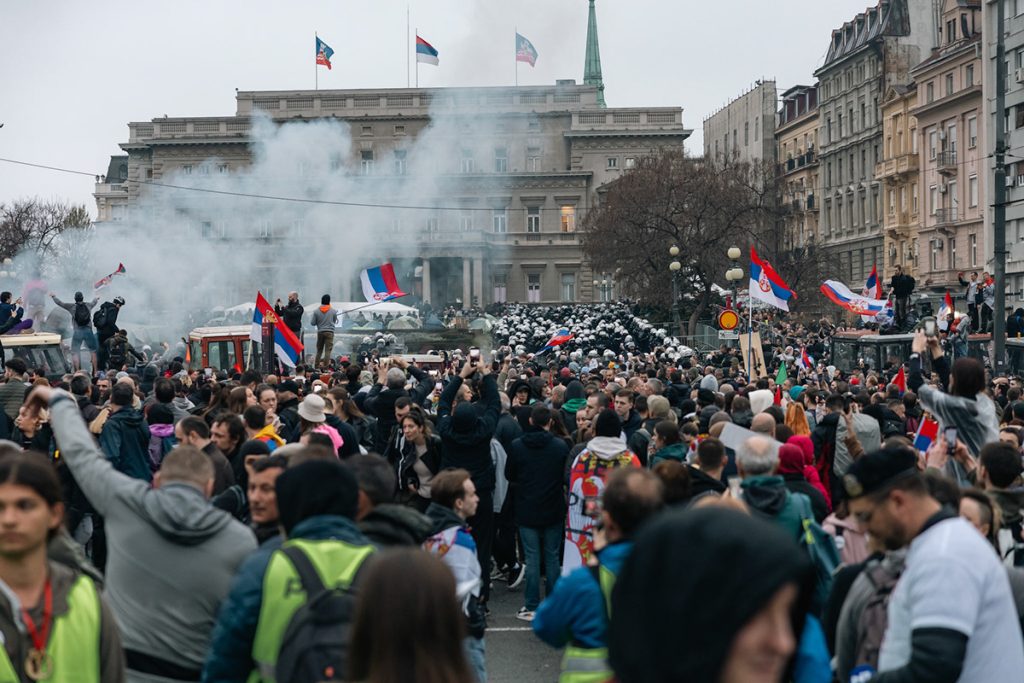
The events leading up to the massive student and citizen protest in Belgrade on 15 March marked one of the most significant moments of the past year.
While pro-government media accused the students in blockade of planning a coup and a “colour revolution” for 15 March, the group “Students Who Want to Study” occupied a section of Pioneer Park, known as “Ćacilend.”
It was clear that this group enjoyed the backing and logistical support of the ruling party, as the park was mostly filled not with students, but with activists of the Serbian Progressive Party (SNS).
Ahead of the 15 March protest, activists from the Movement of Free Citizens (PSG) and the STAV group from Novi Sad were arrested after national television networks broadcast an audio recording allegedly capturing their plans to blockade the Radio Television of Serbia.
At the time, both the media and the highest state officials, including the President of Serbia, claimed the recording had been made by a participant at the meeting. However, in October it was revealed that the conversation had in fact been recorded by the Security Information Agency (BIA), which had wiretapped the party’s premises for three and a half months.
The 15 March protest, even larger than the one at Slavija Square in December, will be remembered for the use of a type of sonic weapon, an incident which has not been investigated to this day.
An unknown device was suddenly activated, scattering peaceful protesters in one of the main streets. The students accused the authorities of deploying a “sonic cannon,” a long-range acoustic device that experts say is illegal.
In the days that followed, hundreds of people reported symptoms such as headaches and dizziness, typical consequences of exposure to such crowd-control weapons.
5. A new dominant actor emerges: The students enter the political arena
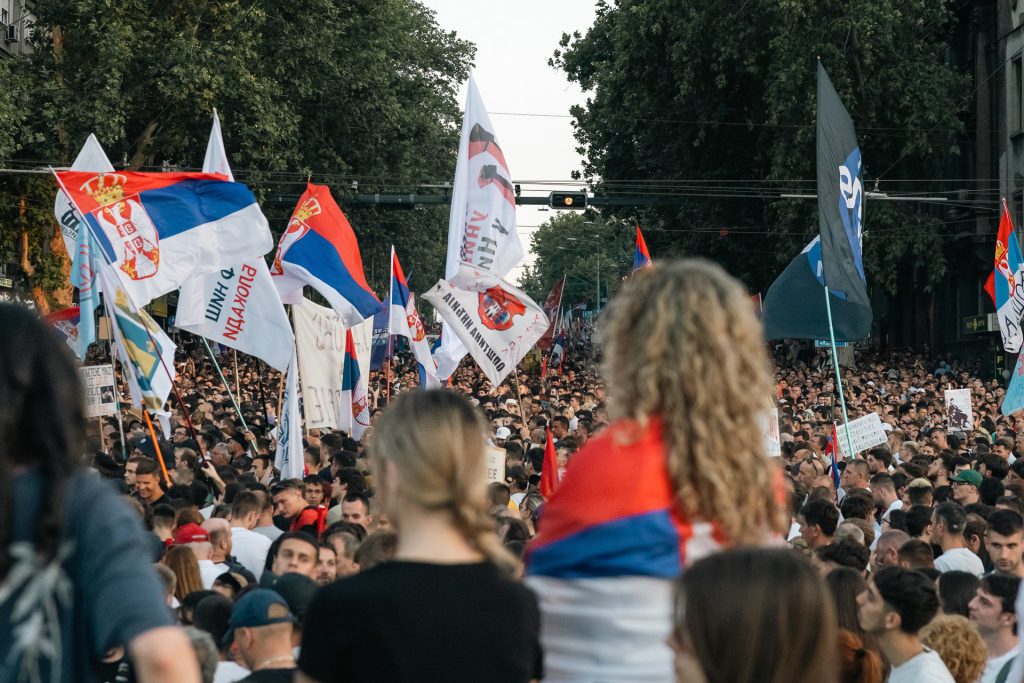
The student movement began as an anti-political initiative. After six months of continuous protests, faculty blockades, and walking and cycling tours across Serbia and Europe aimed at fulfilling their demands, the students united around a new goal – calling for early parliamentary elections.
Thus, the student movement evolved into one of the most significant political actors in the country. In the following months, it was announced that the students would take part in the upcoming elections by forming their own list of non-partisan candidates.
According to research published by the organization CRTA in October, nearly two-thirds of citizens viewed the calling of early elections as a way out of the current crisis. The same survey showed that the student list enjoyed greater public support than the bloc led by Aleksandar Vučić.
The authorities have occasionally released their own public opinion polls, but notably, these surveys do not include the student list as an option, therefore continuing to show a dominant lead for the ruling party.
Opposition parties remain caught in the gap between the ruling authorities and the new political actor – the students, who have successfully mobilized the anti-government electorate. The students have announced that they do not want representatives of opposition parties on their lists, presenting a test for the opposition: whether to use their resources to support the student list and stay out of the electoral race, or to participate directly in the upcoming parliamentary elections.
6. Repression reaches its peak
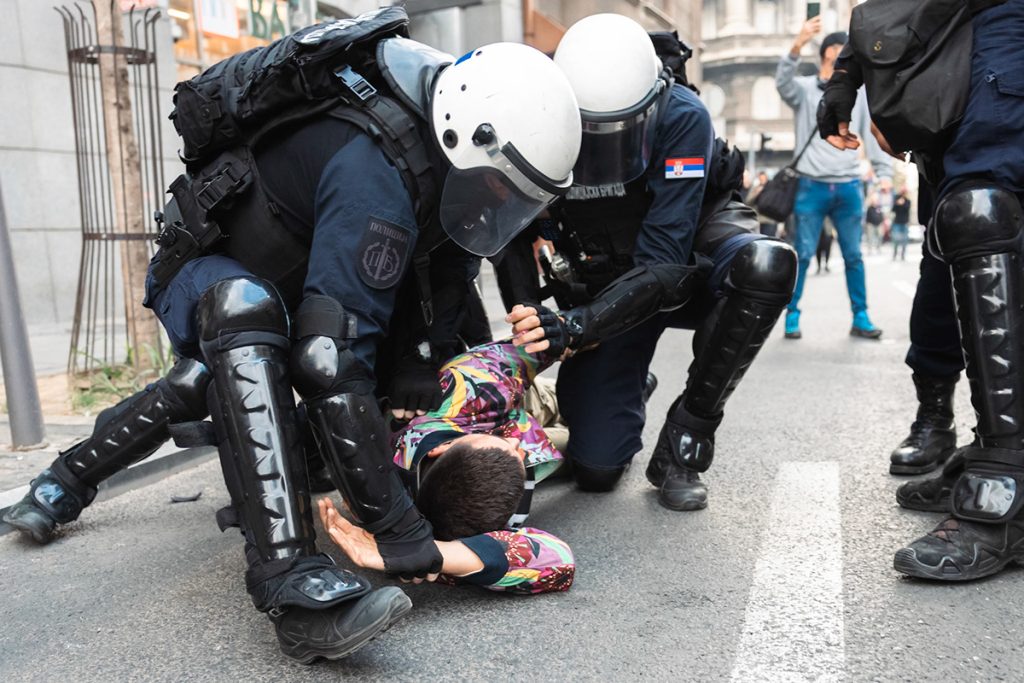
According to data published by the students involved in the blockades, over 3,000 people have been arrested, beaten, detained, targeted, or dismissed since the beginning of the student protests.
Over the past year, instances of police brutality and violence have been recorded that were unprecedented during the 13-year rule of Aleksandar Vučić and the Serbian Progressive Party (SNS).
Although numerous cases of disproportionate use of police force were documented throughout the year, the violence during August will remain particularly memorable.
In October, the European Parliament adopted a resolution on polarization and increased repression, in which Members of the European Parliament assessed that, since August 2025, violence has escalated further. This includes police brutality, torture, and sexual violence against students; threats by the police protection service (JZO), politically motivated prosecutions by the Higher Public Prosecutor’s Office, and smear campaigns by pro-government media.
Universities and academic freedoms also came under attack due to the role the Universities and the academic staff had in the students’ protests.
“The autonomy of universities has been grossly violated”- this was a phrase frequently heard over the past year, voiced by both students and professors.
Throughout the year, the authorities exerted pressure on university professors in various ways. Professors were left without salaries, faculties were deprived of funding, deans were removed from office, and on multiple occasions, the gendarmerie entered university premises and forcibly removed students participating in blockades.
Primary and secondary school teachers were also placed under particular pressure, continuing to face dismissals for supporting students and pupils.
7. Stalled justice and conspiracy theories
Two investigations, one indictment, no defendants in custody, and no verdicts – this is the legal situation one year after the collapse of the station canopy in Novi Sad.
The indictment in the criminal liability investigation, which aims to determine what caused the canopy to collapse and includes, among others, former Minister of Infrastructure Goran Vesić, is currently with the Higher Court in Novi Sad, which must either confirm or reject it. Trial proceedings can only begin after that.
The indictment was filed by the Higher Public Prosecutor’s Office in Novi Sad on 30 December 2024. In addition to Vesić, the accused include his former assistant Anita Dimoski, the former director of Serbian Railways Infrastructure Jelena Tanasković, and her predecessor as head of the state enterprise, Nebojša Šurlan. By decision of the Higher Court in Novi Sad, none of the accused are currently in custody.
Vesić, along with another former Minister of Infrastructure, Tomislav Momirović, is also under investigation for possible corruption during the reconstruction of the Belgrade–Budapest railway, which includes the Novi Sad railway station. This investigation, targeting 14 individuals, has been conducted since August by the Public Prosecutor’s Office for Organized Crime in Belgrade.
In addition to allegations that they caused damage to the state budget amounting to 115 million dollars through corrupt practices, the Prosecutor’s Office accuses the suspects of granting a consortium of Chinese companies, contractors for the railway reconstruction, including the Novi Sad station building, an “undue financial benefit” valued at at least 18.7 million dollars.
While citizens and students take to the streets demanding accountability for the collapse of the canopy, state officials and pro-government media continue to spread conspiracy theories framing the collapse as an act of sabotage or terrorism.
These claims about alleged “sabotage” or a “terrorist act” are undermined by the fact that indictments have been filed against 16 individuals, and criminal proceedings are ongoing before the Higher Courts in Novi Sad and Belgrade. The police had already ruled out terrorism as a cause within the first hours after the incident.
8. Media freedom on the brink
The past year has been marked by the deterioration of media freedom, with journalists reporting on events subjected to attacks, threats, and violence. According to data from Reporters Without Borders (RSF), at least 89 physical assaults on media workers were recorded, representing the highest number since 2008.
In 2025 alone, 82 cases were registered, with nearly half of the incidents attributed to police officers. In many cases, RSF notes, law enforcement failed to respond when attacks were carried out by government supporters.
“These figures demonstrate that journalists in Serbia operate in an environment where violence has become systemic and impunity the rule,” RSF states.
In a resolution adopted on 22 October 2025, the European Parliament criticized the Serbian authorities more sharply than ever, calling for an end to the campaign of hatred against journalists and demonstrators. The document notes that “numerous journalists have been attacked or denied protection while reporting,” while President Aleksandar Vučić portrays the protests as “color revolutions funded by Western services.”
In recent months, the future of media outlets operating under United Group (N1, Nova S) has been called into question following a series of dismissals within the company. Evidence that the Serbian authorities were involved in these executive changes was revealed in an audio recording of a conversation between United Group CEO Stan Miller and the director of the state-owned company Telekom Srbija, Vladimir Lučić. Back in February, President Aleksandar Vučić stated that United Group had failed to secure financing and that journalists would be dismissed in November. In response, journalists at N1 and Nova S proposed the purchase of United Group on market terms, with financial support from credible investors, in order to safeguard editorial independence.