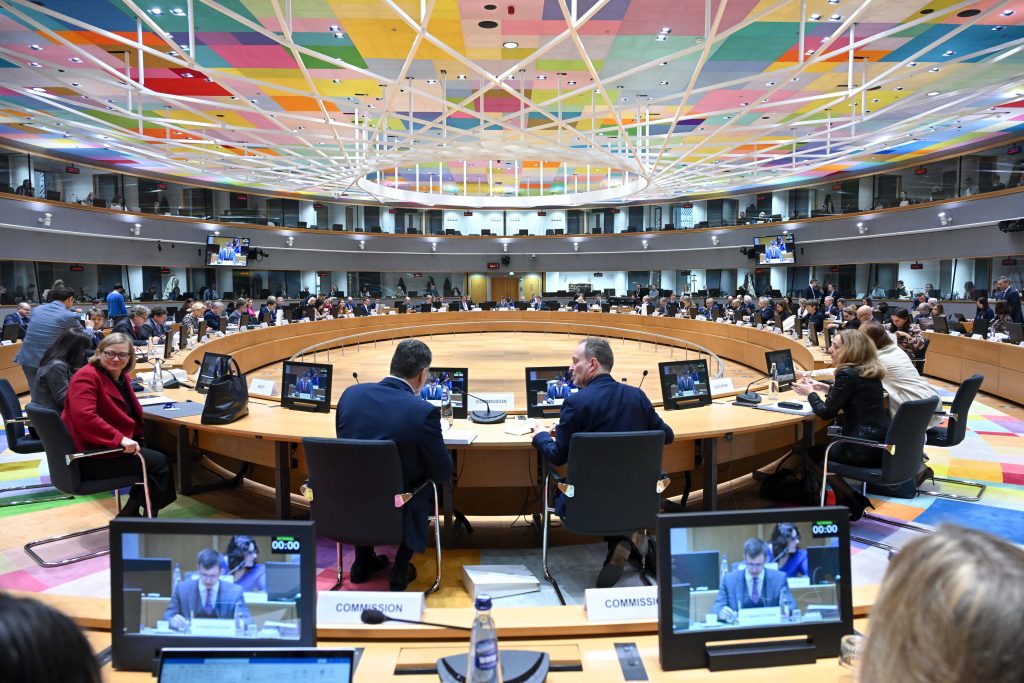
BRUSSELS – Changing the decision-making rules of the European Union could make accepting new member states more viable, but this should be done even without the enlargement. To persuade EU citizens that enlargement is in their interest, the bar for accession must not be lowered, stated the participants of the second panel of today’s EU Enlargement Forum.
Marie Bjerre, Minister of European Affairs of Denmark, reiterated the point also heard during the previous panel, that the EU enlargement is a geopolitical necessity.
“Europe needs to be stronger. We have to be a great power on our own. And one of the ways to be stronger is to move forward on enlargement”, she said.
Benjamin Haddad, Minister Delegate for European Affairs of France, also pointed out that the previous waves of enlargement made the EU stronger. He said that, in France, for a long time, there has been scepticism about enlargement because it was seen as diluting the decision-making process.
“And this is why we need to move with the reform of the decision-making process to make the EU more agile. These processes need to go together hand in hand”, Haddad said.
Asked about the recent proposals of introducing a “probation period” for future member states, which would potentially limit their voting rights, Haddad said that the current rules were quite clear and that there was no discussion on changing the rules.
According to Haddad, there should, in any case, be a deeper reform that would make the decision-making rules quicker and enable deeper cooperation between member states, but this is not something that is exclusively tied to enlargement. Marie Bjerre supported this view.
Thomas Byrne, Minister of State at the Department of the Taoiseach, Ireland, said that, in his country, it is relatively easy to pitch the argument based on its own transformation after becoming an EU member. He added that there are other arguments, including trade benefits for Ireland as well as security.
“With our Presidency of the Council in the second half of next year, there is an ambition, working with Marta Kos, for Montenegro to conclude negotiations, which requires work from us. If we finish the negotiations and start preparing an accession treaty, it sends a powerful signal to others”, Byrne said.
He said Ireland would also want to continue working with Albania during its presidency, and also facilitate resolving bilateral issues faced by Ukraine and North Macedonia.
According to Alexandra Papadopoulou, Deputy Foreign Minister of Greece, average EU citizens need to understand why enlargement is useful to them.
“This is a challenge we have not addressed. People should not feel threatened”, Papadopoulou said, adding that this is why governments of the EU member states should work more closely with their own civil societies on these issues.
Marie Bjerre followed up on this point, stressing that this is why the bar for candidate countries cannot be lowered.
“We have to stick to these being merit-based processes. Otherwise, we cannot win the support of our citizens”, Bjerre said.
She added that a question she gets every time at a public political event on enlargement – do we want another Hungary in the EU?
Stefan Lehne, Senior Fellow at Carnegie Europe, said that enlargement now takes place in a different geopolitical environment, which has made the stakes much higher. In his view, this is why more ambitious gradual integration is desirable, not as an alternative to membership, but as a safeguard against situations in which a consensus on admitting new members would be harder to reach.
“Accession treaties used to take an average of 14 months to get ratified, and now it could last longer. Gradual integration would limit the damage”, Lehne said.