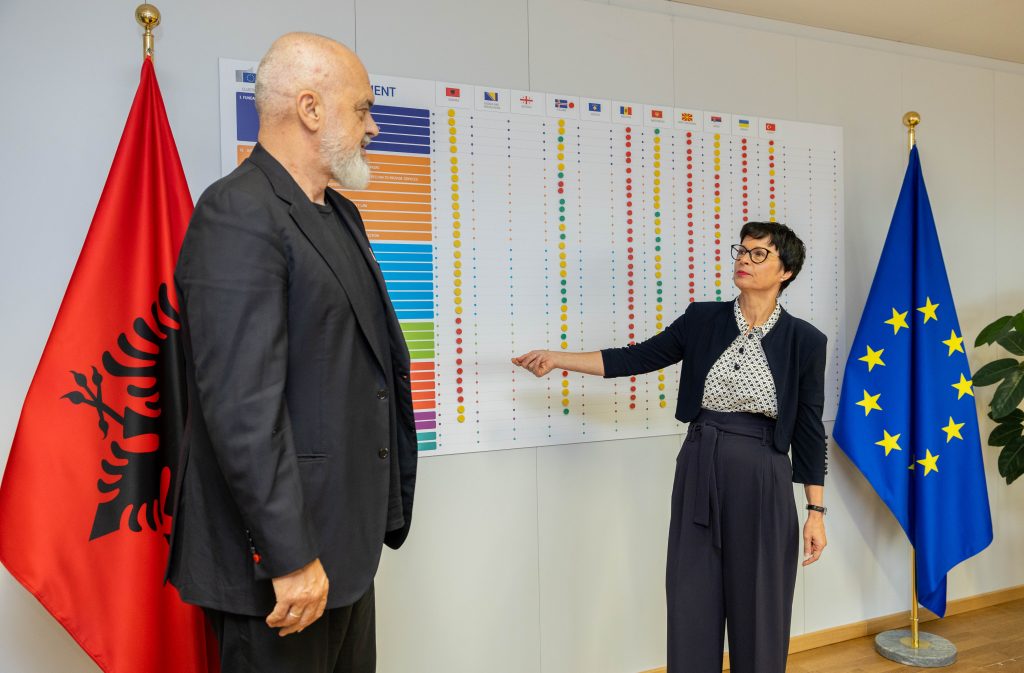
Albania’s EU accession process in 2025 saw significant acceleration, with the country opening all six negotiation clusters within just over a year. The analysts state for the European Western Balkans that the next key step on the European path refers to the meeting of the interim benchmarks under Cluster 1 (Fundamentals), so that a positive Interim Benchmark Assessment Report (IBAR) can be obtained, without which no negotiating chapter can be closed.
Nevertheless, they stress that it is hard to predict whether Albania will conclude the accession negotiations by the end of 2027 and become an EU member state by 2030, as it has been envisioned by its authorities.
To this end, it is clarified that the tangible reforms should be implemented in the crucial areas like the functioning of the judiciary, the fight against corruption, fundamental rights, public administration reform, and the economic criteria.
“Many interim benchmarks must be met in Chapters 23 and 24”
Speaking about the continuation of the EU path of Albania, Fjona Merkaj, a project officer at European Liberal Forum, notes for EWB that “now, the main focus is on closing the chapters”.
“The top priority is to fully carry out reforms in Cluster 1. This cluster covers the rule of law, the judiciary, and anti-corruption efforts, and Albania needs to meet many interim benchmarks in Chapters 23 and 24. The focus has shifted, because instead of merely passing laws, Albania must deliver real, ongoing results in practice”, Merkaj remarks for EWB.
She adds that the “priority number 2” is “acquis alignment”.
“For the other clusters, Albania must act quickly. The goal is to bring its national laws in line with all EU laws”, Merkaj says.
In its 2025 annual report, the European Commission stated that Albania made significant progress in justice reform, fighting organised crime, and its commitment to EU integration.
However, the report notes that the persistent challenges remain, including political polarisation, corruption, and public administration weaknesses, with the need for deeper reforms to consolidate democratic institutions and strengthen the judiciary and anti-corruption bodies like Special Structure against Corruption and Organized Crime (SPAK).
Will Albania get the IBAR by the end of 2026?
If Albania meets the interim benchmarks in Chapters 23 and 24, it will get a positive Interim Benchmark Assessment Report from the EU.
According to the revised accession methodology, no negotiating chapter can be closed until the IBAR is received. In June 2024, Montenegro became the first EU candidate country to receive the IBAR, after which it started closing negotiating chapters.
Gjergji Vurmo, a founder of Elevate Consulting Albania and a member of the Balkans in Europe Policy Advisory Group (BiEPAG), states for EWB that the Albanian government “expects the close provisionally the first batch of chapters (the usual ones which are easier to close) already in the first half of 2026”.
“This means that the Interim Benchmark Assessment Report should come by end of the year or early 2026. However, the normal pace of accession negotiations (steps and deadlines) as we knew is gone, so at this point I really wouldn’t like to predict a date”, Vurmo underlines.
Similarly, Fjona Merkaj assesses that the IBAR is the next key political milestone.
“It will check if Albania has met the rule-of-law benchmarks. If so, Albania can start closing the remaining chapters. Given the current geopolitical situation and Albania’s strong political will, the earliest a positive IBAR could occur is late 2026”, Merkaj says.
In Merkaj’s opinion, this timeline is ambitious but possible if Albania stays focused.