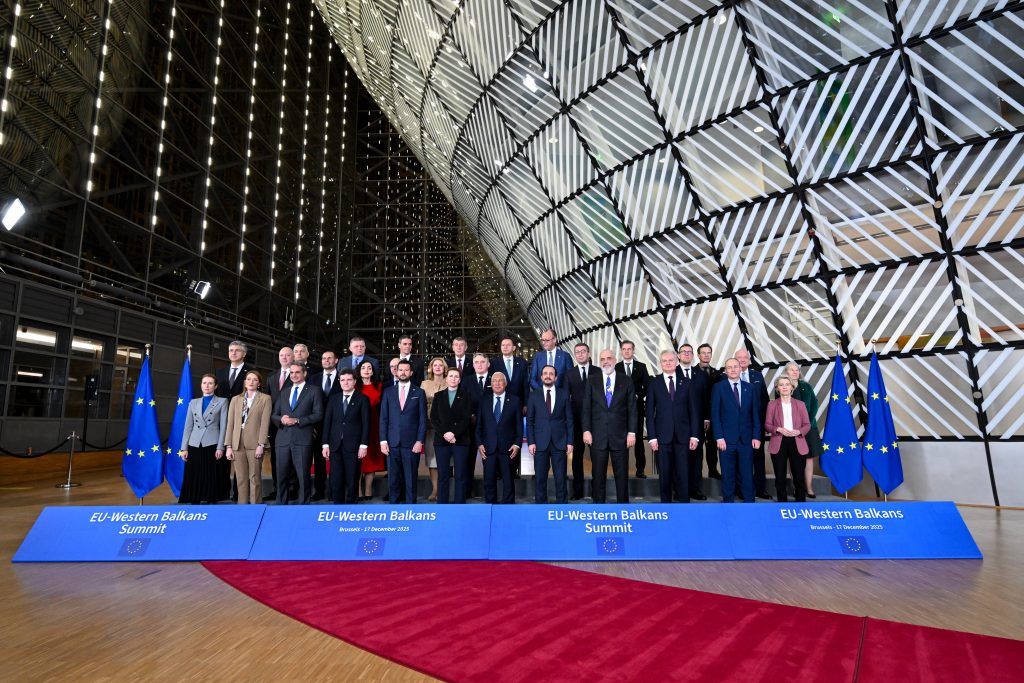
BRUSSELS – In his statement following the EU-Western Balkans Summit held on Wednesday evening, the President of the European Council António Costa said that the event had shown clear support for the Western Balkans’ future in the European Union. He added that he looked forward to the next Summit in Montenegro in June 2026.
A day ahead of the Summit, President Aleksandar Vučić announced that Serbia would not have a representative at the gathering. The country expressed its dissatisfaction that there was once again no consensus on moving the accession negotiations forward by opening the long-awaited Cluster 3.
Not many leaders addressed the fact that Serbia was absent. One of those who did was Croatian Prime Minister Andrej Plenković, who said that “Mr Vučić and Serbia must explain their absence themselves”. Prime Minister of Hungary Viktor Orbán said that Serbia was a “key country” of the region, and that the EU was treating it “unacceptably”.
In his post-Summit statement, António Costa said that the enlargement remains central to the shared objectives of the EU and the Western Balkans. It is the right choice, he added, for three reasons – from a geopolitical perspective, because it strengthens the shared prosperity and because the European Union remains an attractive and credible project.
The President of the European Council praised the progress made by Montenegro and Albania in the past 12 months. He added that he hoped for real progress from North Macedonia in 2026 and that “their authorities know what they need to do”.
Regarding Bosnia and Herzegovina, Costa welcomed the adoption of their Reform Agenda, a necessary step to access the Growth Plan. He said that the upcoming parliamentary elections in Kosovo can be a crucial moment for consolidating the reforms and engaging constructively in the European accession path.
“Let’s be clear, beyond the technicalities of the process, there is a fundamental political choice to make: a choice between staying trapped in the past, or moving forward towards a joint future in the European Union, a choice between division or reconciliation and cooperation, which are the very pillars of the European Union”, Costa said.
Brussels Declaration: Enlargement is a possibility which should be seized
The 20-point Declaration adopted at the summit stressed that “Russia’s war of aggression against Ukraine and rising geopolitical challenges underscore the need for ever-stronger ties between the EU and the Western Balkans”.
“The future of the Western Balkans is in our Union. Enlargement is a realistic possibility, which should be seized”, the document reads.
Serbia did not align with the declaration.
The document states that the EU welcomed the Western Balkans partners’ commitment to uphold European values and principles, in line with international law, the primacy of democracy, fundamental rights and values and the rule of law, and expected them to demonstrate this in both words and action.
“Alignment with the EU’s Common Foreign and Security Policy (CFSP), including the implementation and enforcing of the EU’s restrictive measures and countering circumvention, remains a strong expression of a partner’s strategic choice”, the document adds.
It also states that gradual integration, carried out in a reversible and merit-based manner, is ongoing in several policy areas, front-loading concrete benefits for citizens and preparing the ground for accession.
The Declaration also stressed the importance of good neighbourly relations and added that the absence of a normalisation of relations between Pristina and Belgrade continues to hold back both partners on their European path.