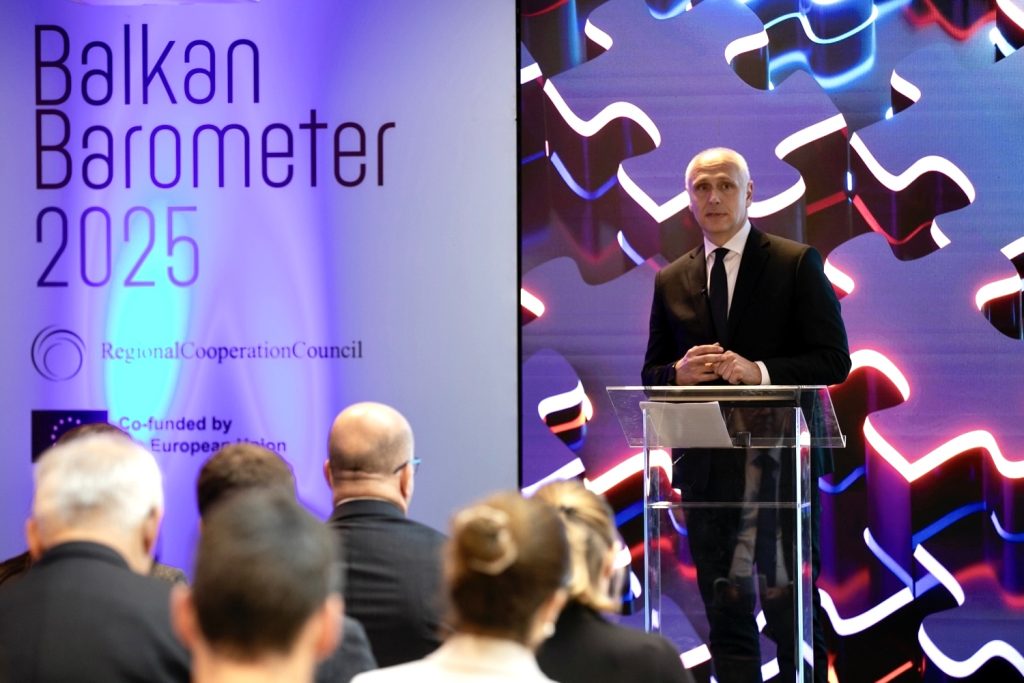
BRUSSELS – On average, 64% of Western Balkan citizens support EU membership, the highest level recorded since 2015, and an increase of 10% compared to last year, shows the Balkan Barometer 2025, a survey of public opinion and business sentiments in six Western Balkans economies, commissioned by the Regional Cooperation Council (RCC).
Balkan Barometer is conducted each year by an independent agency among more than 6,000 citizens and 1,200 companies throughout the region. The latest survey was presented by the RCC earlier this month in Brussels. It was conducted in May and June 2025 across the region.
According to the Balkan Barometer 2025, as many as 86% of citizens of Albania think that the EU membership would be good for the country, followed by 78% of citizens in Kosovo.
When it comes to other WB Six countries, the accession process is supported by 62% of people in North Macedonia, while the level of support is the same in Montenegro and Bosnia and Herzegovina (59%). On the other hand, only 42% of citizens in Serbia are in favour of EU membership.
Slightly more optimistic expectations for EU accession
In addition, the survey finds that the expectations for EU accession in the region have become slightly more optimistic in 2025, as a growing share of respondents now perceive accession could happen by 2030 (26%, up from 20% in 2024) or by 2035 (25%, up from 23%).
At the same time, fewer expect it to take place after 2040 (9%, down from 11%) or believe it will never happen (17%, down from 18%), while views that accession will occur around 2040 remain broadly stable (13% vs. 14%). For instance, 43% of citizens in Albania believe that the country will become an EU member by 2030, followed by 39% of citizens in Montenegro and Kosovo, whereas 33% of Serbia think that the country will never be a part of the Union.
According to the Balkan Barometer 2025, citizens in the region increasingly associate EU membership with benefits, particularly economic gains and mobility. Economic prosperity remains the leading expectation, cited by 47% of respondents (up from 43% in 2024), followed by freedom to travel, which has risen to 36% (from 27% in 2024). Freedom to study and work in the EU, as well as lasting peace and stability, are each mentioned by 28% of respondents (compared to 35% and 27% respectively in 2024).
The higher trust in the EU than in domestic politics
At the same time, the results show higher trust in the EU and other external institutions than in domestic politics. Religious organisations are viewed most positively, with 69% of respondents reporting ‘quite a lot’ or ‘a great deal’ of confidence, followed by the armed forces (62%) and the European Union (60%).
Political parties attract the highest levels of distrust, with 77% expressing little or no confidence, followed by parliaments (70%) and social media (69%).
In addition, rising prices and inflation continue to top the list of public concerns, cited by 66% of respondents, and the general economic situation remains the second most frequently mentioned issue at 44%. Corruption is still seen as a key challenge, identified by 35% of citizens in the region in 2025.
At the same time, citizens across the Western Balkans Six continue to view regional cooperation as a powerful driver of progress. Overall, 64% of people are confident that it can improve the economic situation.