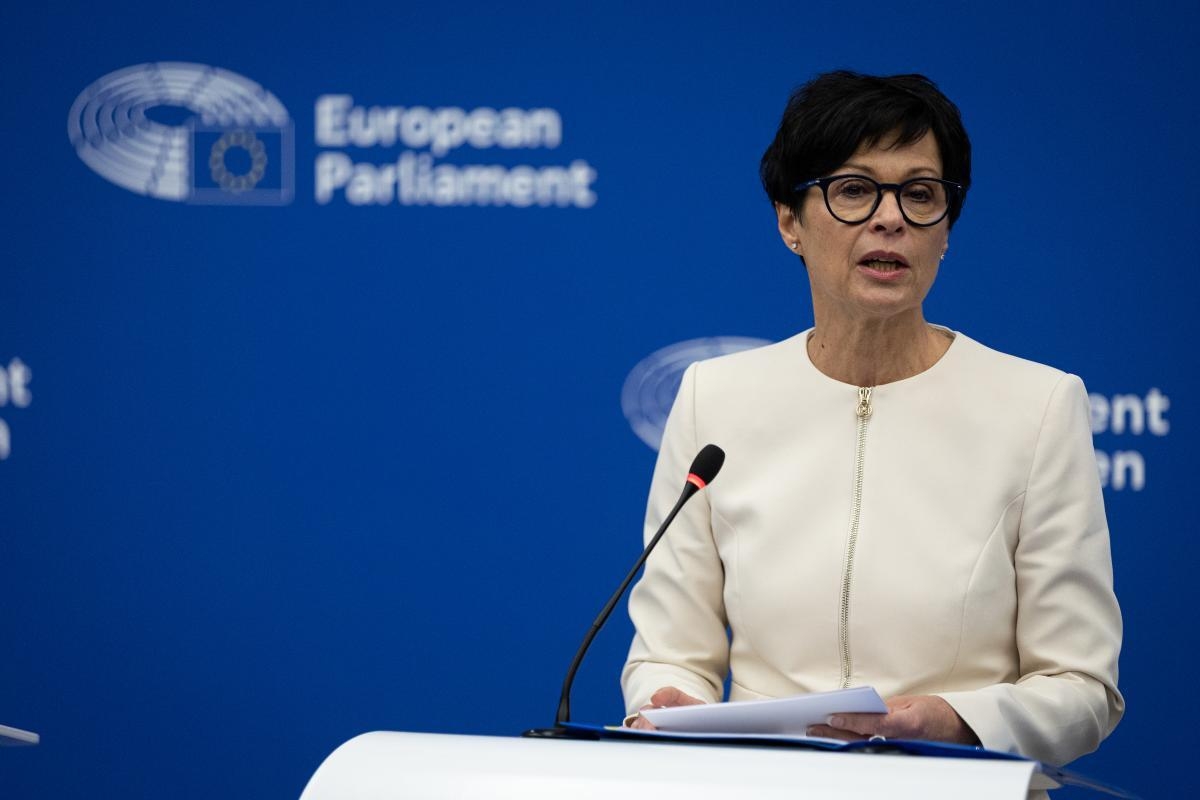
Last Monday, the European Parliament’s Committee on Foreign Affairs (AFET) held a meeting attended by Commissioner for Enlargement Marta Kos. While the discussion focused on enlargement and the perspectives of candidate countries, Commissioner addressed Serbia in the context of a lack progress in key areas related to the rule of law, electoral conditions and media freedom. She announced that the European Commission is assessing whether Serbia meets the criteria for the continuation of financial disbursements, adding the the EU expects all promised reforms to be fully implemented.
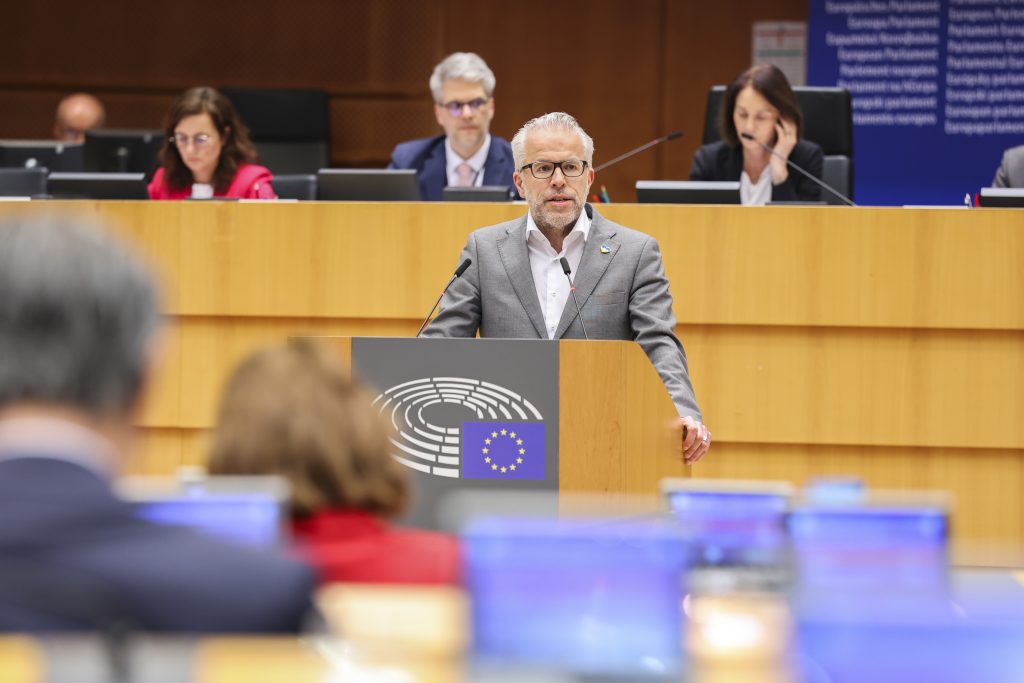
About the Commissioner’s messages, the way the European Parliament views the current political crisis, and the state of the EU enlargement on the Western Balkans, we spoke in Brussels with Thijs Reuten, Member of the European Parliament from the Socialists and Democrats Group (S&D).
European Western Balkans: Commissioner for Enlargement Marta Kos stated during the AFET meeting that the European Commission is assessing whether Serbia meets the conditions for the continuation of EU financial disbursements. How do you view this announcement? Do you have the impression that the European Commission is ready to take concrete steps in practice and set red lines for the authorities in Serbia?
Thijs Reuten: First of all, I appreciate the effort and dedication of Commissioner Kos, but she clearly still needs to convince all of her colleagues and member states.
And that is taking too long, because in my opinion we are well past the point of continued evaluation, discussions, and meetings. We need to see action.
I think the funds for Serbia are genuinely at risk now. The message to President Vučić is that this is becoming very serious. But I also hope that we will soon see a serious decision from the Commission, which I believe can easily be justified with solid arguments.
EWB: Members of the European Parliament have previously called for a review of EU funding allocated to Serbia. Why do you believe such a review is necessary in Serbia’s case, and which funds are being discussed? The authorities’ narrative suggests that the EU intends to deprive Serbian citizens of financial support – how do you respond to this claim?
TR: But where are you reading that? In Serbian newspapers, of course. And that is exactly the narrative the Serbian government is promoting.
The reality is that this is also a consequence of democratic backsliding in Serbia, a lot of these funds, because of mismanagement and lack of respect for the conditions attached to this funding, are not ending up where they should. They are not being used to improve the living conditions of Serbian citizens in the way they should be.
So, from that perspective, I actually think that many people in Serbia, perhaps not openly, would support some kind of measure at this point, because they are simply not seeing the effects of these funds.
EWB: Commissioner Kos also referred to the media situation. Do you see what is currently happening as a crackdown by the authorities on independent media, or as a matter concerning private companies, as the Serbian government portrays it? What can the EU do to protect independent media in Serbia?
TR: Yes, of course. But that is exactly the argument that Orbán used in Hungary when he captured the entire media landscape by allowing it to be bought up by his friends. So that is not a convincing argument.
The reality is very grim. And especially if we know that elections may be approaching at some point, it is very telling that at this moment the Vučić government is also trying to gain control over N1.
N1 and Nova are, as everyone knows, among the last remaining independent media outlets. It is crucial that they remain independent, and that their journalists can do their work safely.
It is also extremely problematic that journalists are being attacked, intimidated, and pressured. So this is really deeply concerning.
As for what the European Union can do, of course, it must make the political case and clearly say that this is not compatible with the ambition of becoming an EU member state. It should also publicly support journalists and independent media. That is not difficult. In fact, that is the very least I expect from the Commission.
That is not interference. It is simply a matter of stating clearly that you stand with independent media and that you denounce attempts to disguise political pressure as a purely commercial matter. Because of course it is not. This is a deliberate attempt to gain control over media freedom.
And we need to make this point especially ahead of any possible elections, because media freedom is a crucial element of free and fair elections.
It was already problematic in the elections in 2023, when I led the monitoring mission. We made clear comments then about media bias in favor of the incumbent. The elections were not fair, despite the existence of REM and everything else. And I think the situation now, ahead of the next elections, may be even worse.
EWB: While messages from the EU indicate that the country is backsliding, particularly due to the recently adopted judicial laws, the government has established a new Operational Team, led by the chief negotiator Apolostolović, with the task of accelerating the accession process. Do you have impression that Serbia is genuinely working to speed up negotiations, as portrayed in Serbian media?
TR: What I would actually like is to have more direct contact with Serbian citizens, to have media spaces where we can genuinely discuss what is going on.
This new operational team is, to me, simply a repetition of what we already saw last year. I remember that at the beginning of 2025 the same ambassador, the same representative of the Serbian government, came to the European Parliament saying that this year everything would finally happen, and that Serbia would do everything required.
My answer then was very simple, and it is still the same today: show me. No more talk. I want to see real results.
I do not mean the adoption of one or two laws, as we saw at the end of 2025, which seemed designed more to make sure that the Commission would step back and become quiet again. I mean actual improvements on the ground.
EWB: You supported the appeal by the Rector of the University of Belgrade, Vladan Đokić, which was recently addressed to the international community. This week Đokić met with Commissioner Kos…. How do you assess this meeting and state of academic freedom in Serbia?
TR: What I really admired about the rector’s statement was that he was simply standing up for his students. Nothing more, nothing less. He stood up for academic freedom, for safety, and for the basic right of students to be safe in the place where they are supposed to receive their education.
And as he himself explained, people were being filmed and recorded. It was clearly not a safe environment, neither for the students nor for the professors. So, the fact that he stood up for his students and for academic freedom is essential for any vibrant and functioning society.
Let me also be very clear on a broader point because I take every opportunity to say this when speaking about Serbia: we are on the side of the Serbian people. There is no question about that. We want the Serbian people to be part of the European family.
I fully understand why there is skepticism in Serbia towards the European Union now. If for years your own government has been speaking negatively about the EU, why would people feel warmly towards it? And if, at the same time, they see that same EU embracing the regime that is making their daily life so difficult, then of course skepticism grows.
So, I understand why people are not especially enthusiastic about the EU right now. But I believe that will change once people start seeing real change on the ground. I am convinced of that. We do not need to be nervous about it, but it will take time.
EWB: Do you think that could change after elections?
TR: Yes, but step by step. First let there be elections, first let there be a real change in the political landscape. Then, gradually, we may see a shift in public mood.
Why? Because over time, people will gain access to more independent media, they will receive more reliable information about what has been done and what still needs to be done in terms of reforms. They will understand implementation better, and they will understand what reforms really mean in practice.
And there is another important point here. In my view, it is completely unjustified to continue hoping that appeasing Vučić will somehow keep him as a so-called factor of stability in the region. This stabilocracy logic is the opposite of stability. Once we start to see real change in Serbia, and once Serbia begins moving in the right direction, I am convinced that the region as a whole will begin to look more positive as well.
Now, we are seeing the opposite. Things are not going well in Serbia, and that instability and uncertainty spread through the region, as we have seen many times before.
EWB: During the AFET discussion with Commissioner for Enlargement Marta Kos, the future of the enlargement policy in the region was also addressed. How do you assess the current state of the process? Do you think the pace seen in 2025 will continue into 2026?
TR: I am a very strong supporter of enlargement. I believe we need to strengthen our bloc. We have urgent issues to address with Ukraine and Moldova, but for me it is also very clear that whatever we do with Ukraine and Moldova, we cannot leave the countries of Western Balkans behind. We have to move forward with them as well.
But there is also a responsibility on the side of the region. There have been countries that came very far, very close to meeting all the requirements, and then for different reasons fell victim again to destabilization from outside or to domestic backsliding.
My appeal is very simple: every country that can make it under the current methodology should be allowed to do so.
In my view, Montenegro and Albania are the clearest examples. Let us bring them in as soon as possible, because that would send a strong signal to everyone that this process is real and that we are serious about finishing it.
EWB: Some argue that the enlargement methodology itself should be revised. You have said you are not in favour of that. Do you think EU Member States are ready for such a debate?
TR: I am not in favour of that, precisely because we do not have time for it.
My position is: everyone who can move ahead under the current procedure should do so. And for the others, we need maximum creativity. That applies to Ukraine and Moldova, but also to the remaining countries in the region.
At the same time, something is required from within the region itself. We keep seeing the same pattern: a country moves forward, progress begins to threaten the interests of certain entrenched political elites, and then we see backsliding again. That is unacceptable. It is unfair to the people in those countries, and it must be countered.
We promised, after the wars in the former Yugoslavia, that there would be a European perspective for this region. Now we have another war on our continent, which we all hope will end with a sustainable and just peace. But what happens after that? Are we going to keep dragging this process indefinitely?
Too many Member States, and too many colleagues as well, keep using the argument that the EU first needs internal reform. And my response is very simple: if you use that argument, then you are also obliged to work on those reforms.
But what we often see instead is that the same people who refuse to carry out reforms, especially reforms that would make decision-making easier, then turn around and use the lack of reform as an excuse to say that the EU cannot accept new members.
Albania and Montenegro can clearly be accommodated within the existing EU structure. There is no real institutional obstacle there. They are relatively small countries, and they would not make the Union function any worse than it already does.
So when people use that argument, what they often really mean is that they are afraid of enlargement. And that is something we also need to confront honestly within the EU. We need to speak directly to our own citizens and say: look, this is in our own interest.
You do not have to fall in love with candidate countries. You do not have to idealize them. You simply have to recognize that it is in our own strategic interest to make the European bloc stronger. It is in our interest to bring Ukraine into the EU, because that strengthens us in terms of security and defence. It is also in our interest to bring in the Western Balkan countries.