Leaders of the European Union and the Western Balkans are gathering in Tivat today for the EU-Western Balkans Summit. The Summit is expected to focus on the progress of accession negotiations, the implementations of the Growth Plan for the Western Balkans, proposals for gradual integration of candidate countries, and regional cooperation.
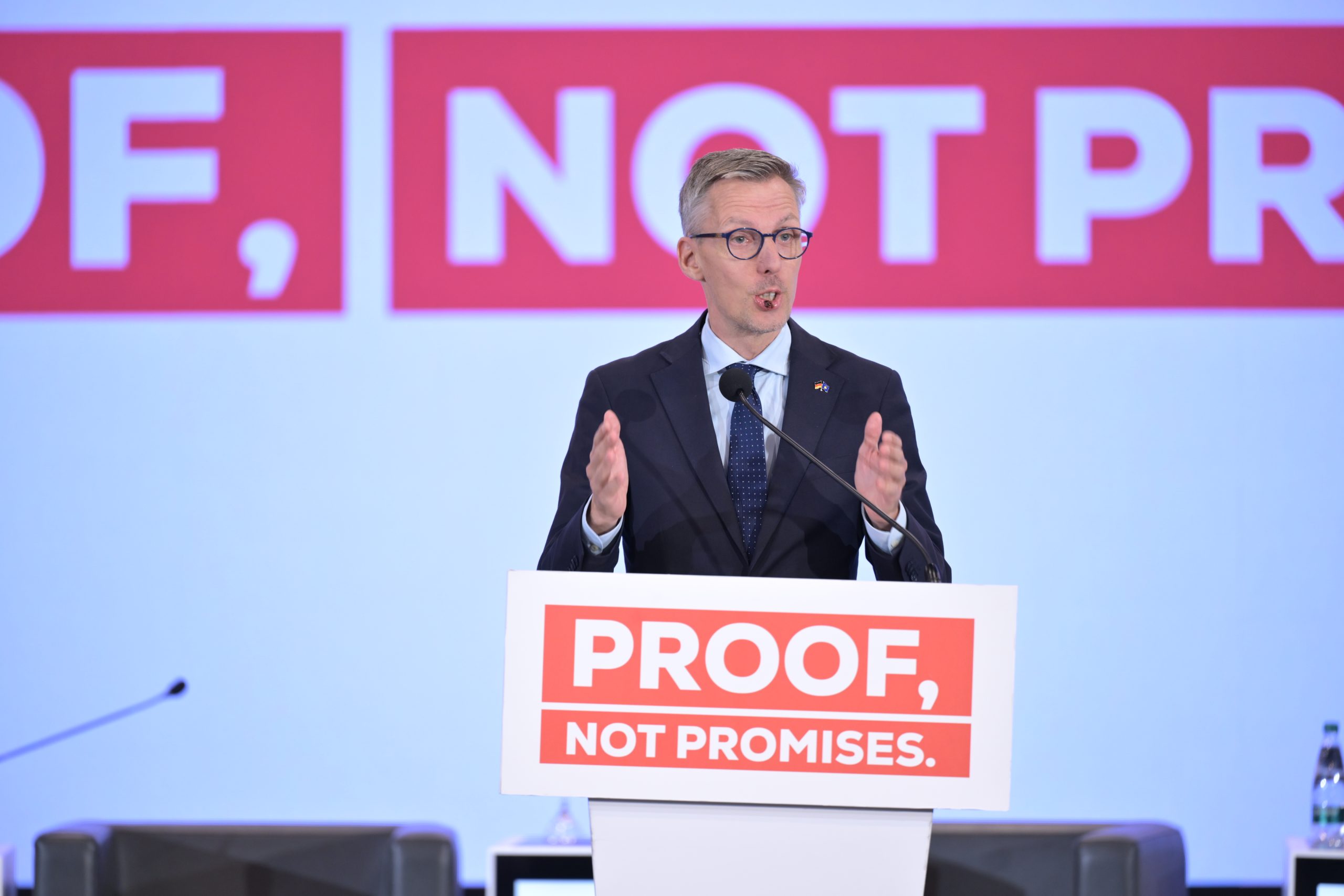
Ahead of the summit, European Western Balkans bring interview with European Commissioner for Enlargement Marta Kos on the future of the enlargement process, new ideas for gradual integration, as well as current state of the accession process in the Western Balkans.
European Western Balkans: The EU-Western Balkans Summit is being held in Tivat at a time of intense discussions about the future of enlargement. Which topics, in your opinion, will be key in the talks with the leaders, and what do you expect to be the most important message for the citizens of the region?
Marta Kos: Since there is a new government in Hungary, there is a new dynamic in the enlargement process at all levels. The most important message for the countries of the Western Balkans from the EU is that we are progressing and things are moving forward.
We see that in Montenegro and Albania we are clearly moving into the next phases of their accession process. There’s a lot of positive energy around what is being done right now, and I highly expect that to be seen during the summit in Tivat.
EWB: In recent weeks, several EU Member States have come forward with different proposals on new models of integration before full membership. How do you view the models proposed so far? Do you think reform in this direction is necessary, and will there be official discussion on this topic in the foreseeable future?
MK: These proposals bring a new dynamic to the discussion and that’s very welcome. We are using the methodology which is like the one we were using 40 years back, when Spain and Portugal joined the EU. There is a necessity to see what we can do differently to be able to answer to the geopolitical situation which is completely different today than it has been in the previous enlargement processes.
I can’t say what the result of this discussion will be, but gradual integration is one of the areas where we could really go deeper. So, what we know from the discussion is that the member states want to stick to the merit-based principle, which is important.
They say that we should really take care about the fundamentals – rule of law, anti-corruption, human rights and media pluralism – and I agree with this. With gradual integration we could show much earlier to citizens how their country is benefiting from already going to the EU right now, not just while waiting for full EU membership.
EWB: In the letter you recently sent to the countries of the region, you warned about the slow pace of reform implementation and the risk of losing funds from the Growth Plan. What is causing this slow pace – is the Plan too ambitious, or are the governments not committed enough to implement the reforms?
MK: The situation for the Growth Plans is different in each country. With the Growth Plan and the Reform Growth Facility we have more than doubled the financial assistance for the Western Balkans and provided financial incentives for reforms which the countries need to make on their EU path. Candidates set their own ambitions and are in the driving seat, however delivery is low.
The letters were sent to inform the countries of where they stand regarding the grace periods of meeting targets by June. The Growth Plan is performance-based, meaning funds are released on delivery. They were designed to add support and encouragement, and they are serving that purpose well. We know that because we see many reforms being implemented.
EWB: What will happen to the funds that countries are not able to withdraw within the prescribed deadlines? Is the European Commission already considering reallocating funds to those countries that are implementing reforms, such as Montenegro and Albania, which have so far received the highest number of tranches?
MK: Reforms must remain a priority for the beneficiaries, so they make the most of what the Growth Plan can offer to them.
The Reform and Growth Facility is a performance-based instrument where funds are released only when reforms are fully implemented. Our focus is on supporting the countries to do the reforms so that they can get the money.
EWB: You recently also spoke about Serbia in the context of the Growth Plan. What are the main obstacles to further disbursements of funds for Serbia? Is it only the judicial laws which the European Commission assessed as a step backwards?
MK: The amendments to the judicial laws need to be in line with EU standards, and the Venice Commission’s opinion recommendations need to be fully implemented.
The Commission is continuously assessing whether the relevant conditions for support under the EU’s financial instruments are met. This is part of the normal implementation of these instruments and applies throughout the process at the stage of each payment request.
We continue to support Serbia on its EU path and at the same time, we expect the authorities to uphold and respect effective democratic mechanisms, the rule of law and human rights.
EWB: Your praise for the adoption of a set of electoral laws in the National Assembly of Serbia provoked numerous reactions in Serbia. The expert community is of the opinion that the adopted laws are cosmetic changes and insufficient to improve electoral conditions. Does European Commission believe that it is realistic the next elections in Serbia will be free and fair, and what will be its reaction if this is not the case?
MK: I called the adoption of the electoral laws a “first important step” to support free and fair elections. This was not a judgement on how well the laws will operate but rather support for the direction of movement that they indicate.
We continue to work closely with Serbian authorities in view of the adoption of two key outstanding laws on anti-corruption and financing of political activities, in line with Office for Democratic Institutions and Human Rights (ODIHR) recommendations.
On the elections, the proper functioning of Serbia’s democratic institutions is at the core of Serbia’s EU accession process. Serbia should guarantee adequate conditions for citizen observers to the elections to conduct their activities in an environment free from pressure and intimidation.
EWB: Last month, an agreement was reached to establish a working group for drafting Montenegro’s Accession Treaty. What will the drafting process look like in the near future? Is there currently a legal framework for defining stricter safeguard clauses on which a number of Member States insist?
MK: The drafting takes place within the ad hoc working group of the council – the EU’s member states. This is where Montenegro’s place inside the European Union will take shape.
The working group was agreed only at the end of April so it’s in its early stages.
Safeguards are not new in this process and will be decided during the process of drafting, so what they look like will become clearer as the drafting process continues.
EWB: Given that preparations for Montenegro’s Accession Treaty have begun, can we speak more concretely about the date for the conclusion of negotiations?
MK: The enlargement process doesn’t work on fixed timelines because there are multiple factors which come into play. The first of those is the speed at which the countries implement the necessary reforms.
The drafting of the accession treaty for Montenegro is a hugely positive step at the end of the process, but it doesn’t set out an end date.
Montenegro still has important work left to do in the ‘fundamentals’ cluster on rule of law and the judiciary and that will take significant effort before the conclusion of the negotiations. Montenegro’s hard work is paying off and that momentum should be carried forward now into the final stages.
EWB: Albania is another country in the region that has made significant progress. An agreement on the IBAR has also been reached. What was decisive for the acceleration of Albania’s process, and do you expect the country to begin closing any negotiating chapters by the end of the year?
MK: Member states and the Commission assessed that Albania had fulfilled the interim rule-of-law requirements. Once a country delivers, we in the EU must be decisive, uphold our side of the agreement, and deliver in return.
Albania became the second candidate country, after Montenegro, to reach this crucial stage in the accession process. The IBARs are far from the end of the process, however. In fact, they mark the start of the most demanding phase of the negotiations which is to close chapters. With this, we don’t work on timelines but on results as we work with Albania to prepare for it to join the Union.
EWB: The European Commission always says that enlargement must remain a merit-based process. However, the case of North Macedonia shows that bilateral disputes continue to hold back the process. Do you expect progress in resolving North Macedonia’s deadlock?
MK: Good neighbourly relations and regional cooperation form an essential part of candidates’ European integration process.
In the case of North Macedonia, we are ready to complete the opening phase of the accession negotiations with North Macedonia as soon as it has implemented its commitment to complete the constitutional changes, as outlined by EU leaders after their summit back in July 2022.
It is also very important that Bulgaria and North Macedonia rebuild mutual confidence and restore trust, and we remain ready to facilitate those discussions.