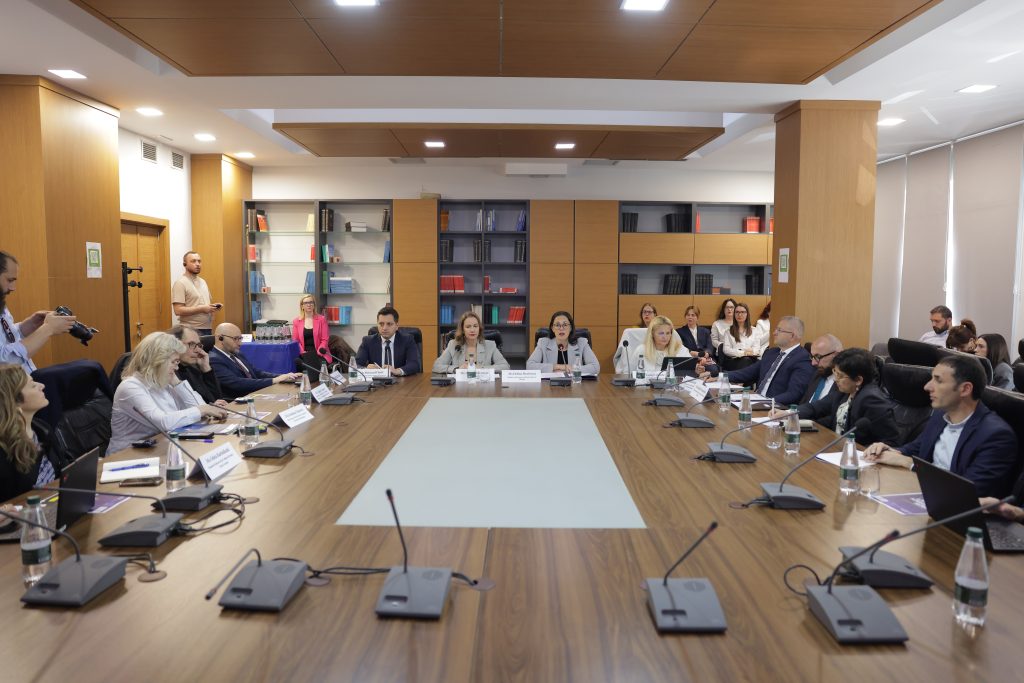
TIRANA – The Central European Free Trade Agreement (CEFTA) officially launched its Academic Network, presenting the initiative as a mechanism for strengthening cooperation between academia and policymakers as the Western Balkans advances toward gradual integration into the EU Single Market.
Presented in Tirana during Albania’s chairmanship of CEFTA, the initiative aims to create an open platform connecting universities, researchers and policymakers working on the implementation of the Common Regional Market (CRM) and the EU Growth Plan for the Western Balkans.
Participants at the event argued that stronger cooperation between academia and institutions is becoming increasingly important as CEFTA evolves from a regional trade agreement into a framework preparing the region’s economies for deeper integration with the EU market.
The initiative was formally presented by Pranvera Kastrati, Director of the CEFTA Secretariat.
She described the Academic Network as a response to the increasingly complex demands created by the region’s gradual integration into the EU Single Market.
“CEFTA today is not only an agreement that facilitates trade among the Parties. It is increasingly becoming a platform through which the CEFTA Parties prepare for gradual integration with the EU Single Market,” Kastrati said.
She stressed that this process requires strong analytical foundations and more practical research focused on concrete trade barriers, regulatory alignment and implementation challenges.
“These are not abstract topics. They are directly linked to the cost of doing business, the time needed to move goods, the ability of service providers to work across markets, the trust in electronic transactions and, ultimately, the credibility of our gradual integration with the EU Single Market,” Kastrati noted.
The CEFTA Academic Network builds on previous forms of cooperation between CEFTA and academia dating back to 2012, but adapts them to a new political and economic context shaped by the EU Growth Plan and the Common Regional Market Action Plan 2025–2028.
The Network is conceived as a voluntary and open structure without formal membership procedures. Instead, it is intended to serve as a flexible mechanism through which universities, think tanks, professors and young researchers can contribute expertise and policy-oriented analysis to CEFTA bodies and working groups.
Particular emphasis will be placed on young researchers, PhD students and master’s candidates through the newly announced CEFTA Research Award. The competition will invite students to submit research proposals focused on practical issues linked to CEFTA priorities and gradual integration into the EU Single Market.
“The CEFTA Academic Network and Research Award are not intended to replace existing academic initiatives, nor to centralise research cooperation. On the contrary, we hope it will connect, support and give visibility to expertise that exists across universities and research institutions. Our role as the Secretariat is to create a practical link between that expertise and the policy needs emerging from CEFTA’s work,” Kastrati said.
Valentina Superti, Director for the Western Balkans at the European Commission’s Directorate-General for Enlargement and Eastern Neighbourhood (DG ENEST), said the initiative comes at a crucial moment for the region, as the EU seeks to accelerate the Western Balkans’ gradual integration into the EU Single Market through the Growth Plan and the Common Regional Market (CRM).
She added that the CEFTA Academic Network could help provide innovative approaches and fresh ideas needed for increasingly complex reform and integration processes.
Speaking at the launch, Minister of Economy and Innovation of Albania, Delina Ibrahimaj, stated the region had already seen tangible results through CEFTA cooperation, including progress in border procedures and digitalisation.
“We have seen concrete steps that all our economies can benefit from – from green lanes to more transparent digital procedures,” Ibrahimaj said, stressing that universities and research institutions could help policymakers better assess challenges facing businesses and regional markets.
She added that evidence-based policies were necessary for improving competitiveness and supporting the private sector, particularly as the region seeks to align with EU standards.
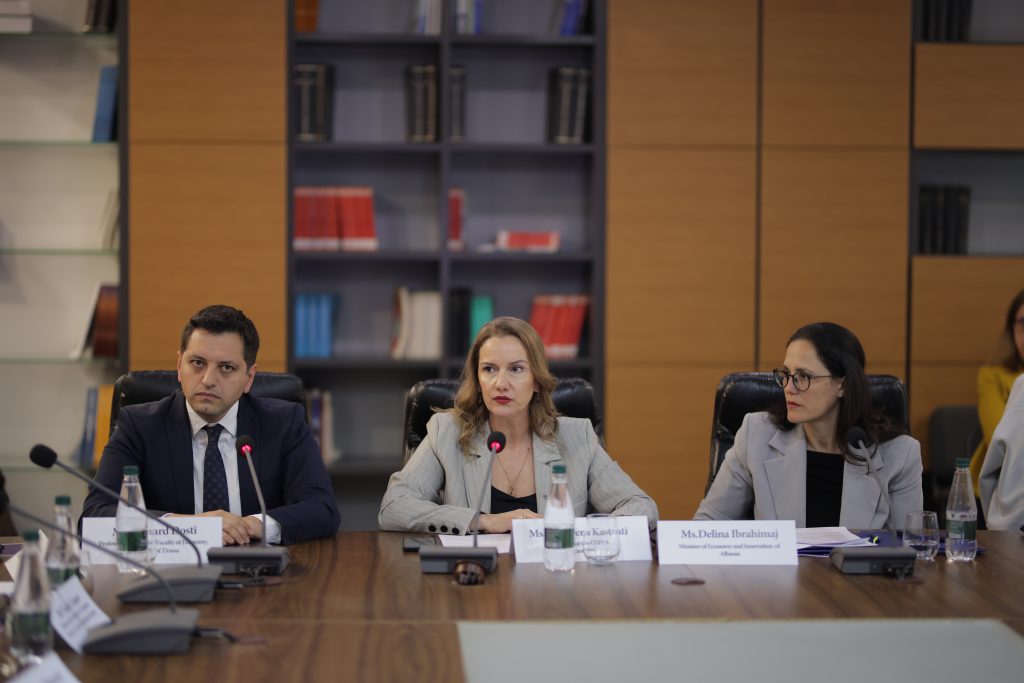
Tanja Miščević, Professor at the Faculty of Political Science at the University of Belgrade, said the initiative represented a unique opportunity to move closer to analytically based policymaking.
She assessed that policymaking grounded in data and analysis is one of the key elements of a developed democratic society.
CEFTA Research Award for the best papers
A central part of the initiative is the newly announced CEFTA Research Award, which is designed as an open competitive call for young researchers.
The award will invite PhD students and candidates writing their master’s theses to submit concept notes dealing with practical obstacles and policy solutions linked to CEFTA priorities.
The open call for concept notes will be published next Monday, 11 May, on the CEFTA website.
Shortlisted candidates will later develop full research papers containing actionable policy recommendations.
Six researchers in total – two per thematic area – will be shortlisted to prepare full papers between August and October 2026. One winning paper will then be selected in each category and presented during CEFTA Week 2026.
The winning paper in each thematic area will receive an award of EUR 4,000, while runners-up will receive EUR 1,000.
The awarded papers are also expected to be presented during CEFTA policy discussions in 2027, with the aim of ensuring that the research contributes directly to policymaking processes.
“The purpose is not to produce papers that remain within academic circles only, but to generate analysis that can inform CEFTA Committees, Subcommittees, Working Groups and other relevant formats,” Kastrati said while presenting the initiative’s guiding principles.
The Secretariat identified three broad thematic areas for the first call: trade in agri-food products, trade in industrial products, and trade in services.
The topics are expected to focus on practical challenges affecting regional trade and economic integration, including sanitary and phytosanitary procedures, customs formalities, conformity assessment systems, recognition of professional qualifications, e-commerce, labour mobility and digital services. Digitalisation is expected to serve as a cross-cutting principle across all three areas.
The initiative is supported by the Open Society Foundations for the Western Balkans and implemented by the CEFTA Secretariat under the 2026 Albanian CEFTA Chairmanship and facilitated by the Cooperation and Development Institute (CDI).