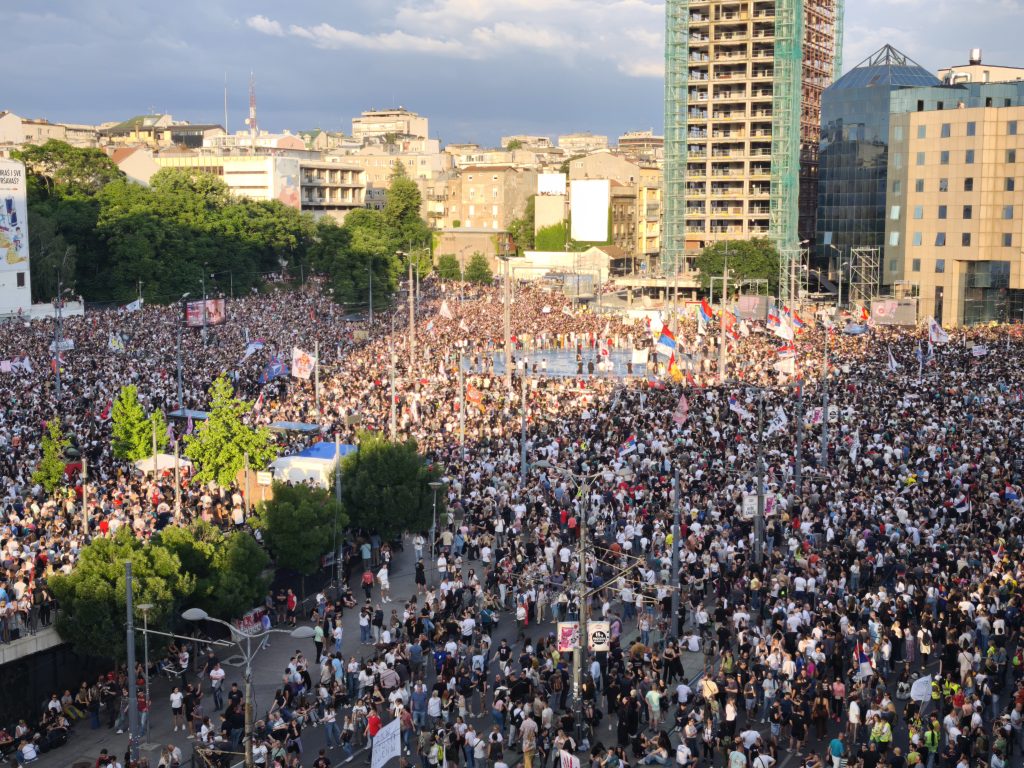
BELGRADE – Up to 190 thousand people gathered at Belgrade’s Slavija Square on 23 May in the second largest protest in Serbia since the fall of Slobodan Milošević in October 2000, underscoring the scale and persistence of the student-led movement that emerged as a political actor last year.
The rally, organized under the slogan „You and I, Slavija “, by the students, drew participants from across Serbia after weeks of mobilization campaings.
The Archive of Public Gatherings, an NGO, estimated attendance at between 180.000 and 190.000 people, while Serbia’s Interior Ministry claimed that only around 34.000 citizens attended.
Ahead of the rally, students organized a series of promotional actions across the country. In the days before the gathering, stickers carrying slogans „Students are winning” appeared throughout the capital.
The sticker campaign was followed by a counter-campaign from the government, during which numerous hate graffiti targeting students, professors and the academic community appeared across Belgrade. Some of these messages accused students of being „Ustaše“, while some negatively linked the protest movement to Members of the European Parliament.
The Saturday rally was the latest in the wave of anti-government protests triggered by the collapse of a railway station canopy in Novi Sad in November 2024, which killed 16 people and fuelled public anger over corruption, impunity and the condition of the state institutions.
The speakers accused the authorities of ignoring months of public demands and framed the protest as part of a broader political struggle ahead of possible elections.
“We are sending a message to all the people of Serbia, from the north to the south, from the east to the west of our beautiful country. Whether you are on the left or the right, know that the students are winning. The elections ahead of us are our chance to finally fulfil our promise: an honest government, freedom and a dignified life,” student representative Andrej Tanko said.
Prosecutor Bojana Savović also addressed the crowd, criticizing police violence and selective application of the law.
“The use of force against people who have been deprived of their liberty or who are offering no resistance is a crime. No uniform should be above the law,” Savović said.
“A state in which laws are not applied, or are applied selectively, ceases to be a state and becomes a mafia organization. What we are living through today, bombs, extortion, mafia-style killings, this is not a state, this is anarchy,” she added.
The protest unfolded amid mounting tensions between the authorities and the student movement. In the days leading up to the rally, Serbian President Aleksandar Vučić and pro-government tabloids repeatedly accused organizers of attempting to destabilize the country and provoke unrest.
At the same time, government supporters gathered near the Presidency building and in Pioneer Park, where tents and stands were set up last year. The area was mockingly dubbed “Ćacilend” by protesters and social media users.
Opposition politicians and activists also accused authorities of attempting to obstruct attendance at the rally after several train lines toward Belgrade were suspended ahead of the protest.
Despite repeated warnings from officials about possible violence, the main part of the rally passed peacefully. Student activists formed security corridors around the stage and repeatedly appealed to demonstrators to avoid provocations.
Tensions escalated only later in the evening, after the official programme had ended, near government buildings and the area where pro-government supporters had gathered.
Groups of masked men were seen throwing stones, bottles and pyrotechnics at riot police. Several Serbian media outlets reported that some of the attackers appeared organised and operated separately from the main body of demonstrators.
The incidents quickly triggered speculation among opposition figures, activists and protesters that the clashes may have been provoked by “inserted elements” seeking to discredit the movement and justify a police crackdown.
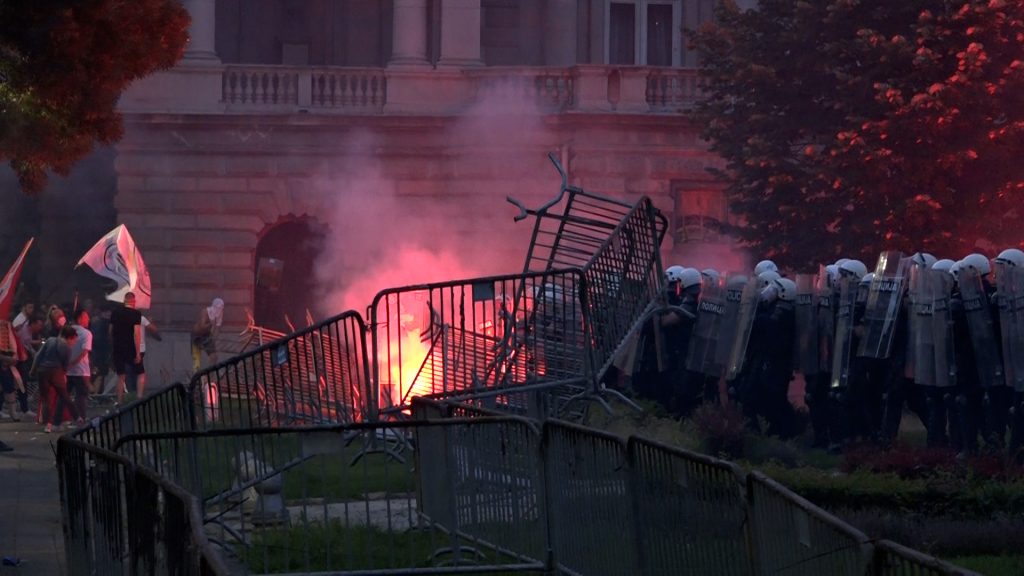
No evidence supporting those claims has been publicly presented, but footage of small, masked groups confronting heavily deployed police units fuelled widespread debate on Serbian social media.
Police cordons were pushing back the protesters, while loud explosions from stun grenades could be heard continuously.
Interior Minister Ivica Dačić later said that 23 people had been detained and accused protesters of attacking police officers.
Dačić’s late-night appearance at a press conference drew additional attention because he had largely remained silent in recent days following the arrest of former Belgrade police chief Veselin Milić in connection with an investigation tied to alleged organized crime figures.
Since May last year, students and protesters have been demanding early parliamentary elections, arguing that the current institutions no longer have the legitimacy to address the country’s political crisis.
Although President Aleksandar Vučić has repeatedly hinted that elections could be held before the regular deadline, the authorities have so far avoided announcing a date, fuelling accusations from protesters and opposition party that the government is deliberately prolonging the process while attempting to weaken the movement through political pressure and media campaigns.