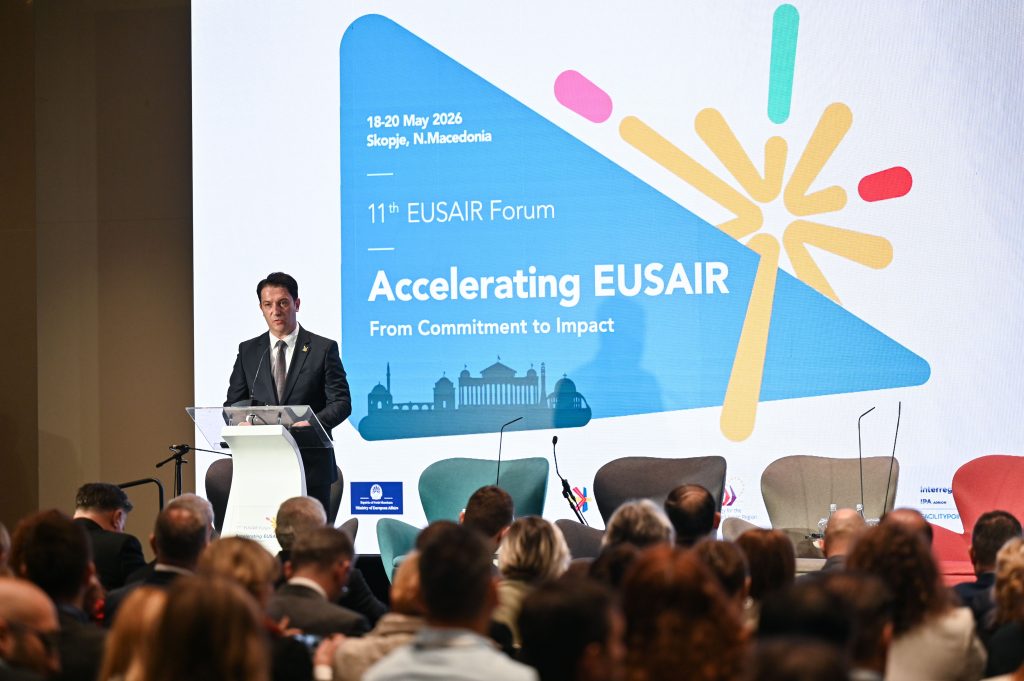
SKOPJE – “At a time of major geopolitical and economic challenges, the region needs more coordination, stronger connectivity and more joint investments”, stated Bekim Sali, First Deputy Prime Minister and Minister for European Affairs of North Macedonia, in his opening remarks at the 11th Annual Forum of the European Union Strategy for the Adriatic and Ionian Region (EUSAIR), which is held in Skopje from 18 to 20 May.
Held under the motto “Accelerating EUSAIR: From Commitment to Impact”, this event gathers ministers, representatives of the European Commission, regional institutions, local authorities, international organisations, civil society representatives and youth from participating countries across the Adriatic-Ionian region.
According to Sali, “EUSAIR is not only a regional cooperation platform, but also a concrete bridge towards gradual European integration”. At the same time, the EU enlargement “remains a strategic investment in peace, stability and prosperity for Europe”.
“A current enlargement momentum creates a great chance for our region… We need a stronger operational support, more coordinated regional planning, and stronger political cooperation. The countries of the Western Balkans should continue advancing on their European path through credible reforms and stronger cooperation”, he remarked.
Sali added that given the current geopolitical challenges that Europe is faced with, “cooperation is no longer a political option, but a necessity”, and the EUSAIR represents a platform that connects both EU member and candidate countries, thereby promoting the “gradual integration” into the Union.
He clarified that this macroregional initiative “helps EU candidate countries to strengthen their administrative capacities, and to better coordinate regional responses” to the challenges, including the economic and demographic ones.
The EUSAIR covers ten countries: four EU Member States (Croatia, Greece, Italy, Slovenia) and six non-EU countries (Albania, Bosnia and Herzegovina, Montenegro, North Macedonia, San Marino, Serbia). The general objective of the EUSAIR is to promote economic and social prosperity and growth in the region by improving its attractiveness, competitiveness and connectivity. With four EU members and four non-EU countries, the strategy will contribute to the further integration of the Western Balkans.
During the forum in Skopje, the rotating EUSAIR presidency was handed over from North Macedonia to Italy.
The Skopje Declaration: “Acceleration of EU enlargement must remain a strategic priority”
Within the framework of the Forum in Skopje, the Adriatic-Ionian Council/EUSAIR Ministerial Meeting was also held, where participating countries adopted the Skopje Declaration, reaffirming their commitment to strengthening regional cooperation, supporting the enlargement process and advancing shared European priorities.
The Skopje Declaration underlines that the acceleration of the European Union enlargement process “must remain a strategic priority and a geostrategic investment in peace, security, stability and prosperity in the Adriatic Ionian region and Europe”.
To that end, it emphasises the “importance of a credible, predictable and merit-based process, based on tangible reform progress and the fulfilment of established criteria by each candidate country”.
In addition, it calls on EU member states to maintain their continued focus on the accession process of the candidate countries, and acknowledges “the momentum achieved in the ongoing EU accession negotiations and encourages the continuation of this positive dynamic”.
“We welcome the progress made by EU candidate countries in 2025-2026 as assessed by the European Commission Enlargement Package, highlight he steadfast commitment of the non-EU AII/EUSAIR participating countries to the European perspective, and look forward to more opportunities to advance on their accession path include through further gradual integration measures, by leveraging existing tools, in particular the Growth Plan for the Western Balkans”, the Declaration notes.
Also, the EU member states are called on “to deliver on the accession process of the candidate countries, providing them a clear and predictable path to EU membership”, and the European Commission’s initiative to include the Western Balkans in the “Roam-Like-At-Home” framework.
Finally, the Declaration acknowledges the issue of professional truck drivers in the context of implementation of the Entry/Exit System “as a challenge affecting the entire Adriatic-Ionian region”, and calls for “a prompt and mutually beneficial solution to be found in the common interest of both the European Union and the Western Balkans, i.e. participating countries from the EUSAIR”.