BELGRADE – It is still too early to determine the long-term outcomes of the US-Serbia Strategic Dialogue, which was launched recently. According to analysts, the high-level meetings do not automatically guarantee a formal military or political alliance, particularly having in mind Serbia’s ongoing balancing act between Washington and Beijing.
In addition, they point out that most initial agreements are Memorandums of Understanding, rather than finalised commercial or binding treaties.
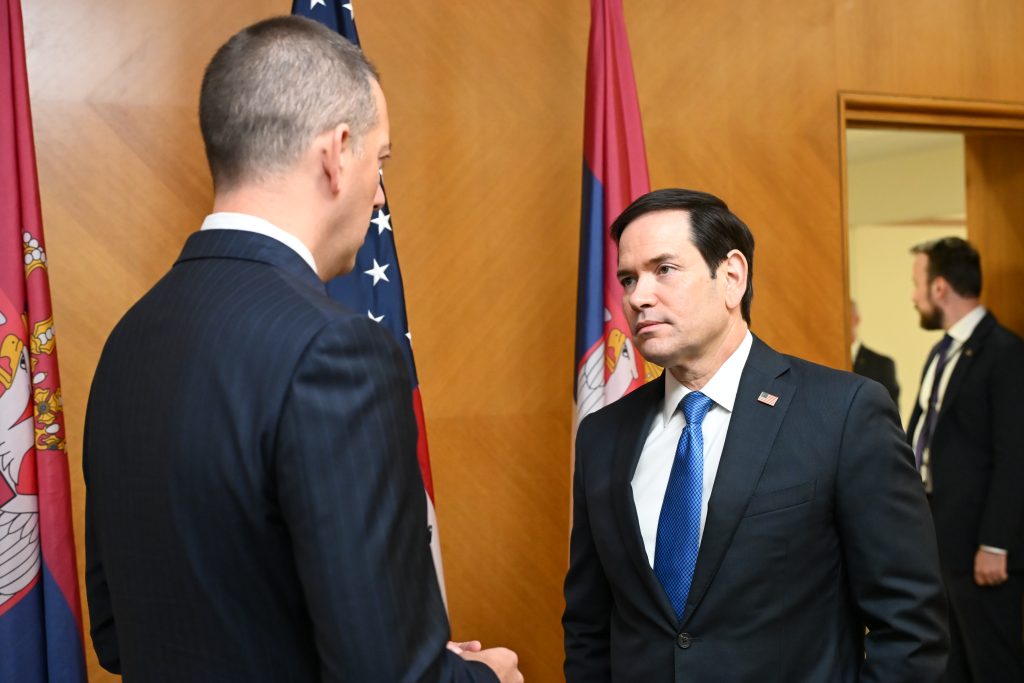
The inaugural US –Serbia Strategic Dialogue was launched on 17 July 2026 by American Secretary of State Marco Rubio and Serbian Foreign Minister Marko Đurić. These talks reaffirmed the two countries’ shared commitment to strengthening their bilateral partnership, the US Department of State said.
Among other things, the sides signed a Memorandum of Understanding on Energy Infrastructure and Regional Energy Security.
“Both Europe and the United States want to distance Serbia from Russia and to bring it closer to themselves. Additionally, the Americans particularly aim to push Chinese influence out of Serbia. The implementation of large-scale energy projects brings them closer to achieving these goals“, Adriano Milovan, analyst and journalist at Nacional.hr, notes for EWB”.
Igor Novaković, Senior Associate at the International and Security Affairs Centre (ISAC Fund), stresses for EWB that everything is still “on paper.” Therefore, states Novaković, “the final conclusion cannot be made yet”.
“This is a structured dialogue, which may or may not lead to a deeper US-Serbian partnership. The main challenge is that the other side, the United States, is currently operating on two channels. The first one is official, which goes through the State Department, while the second one involves unofficial lobbying circles close to American President Donald Trump and his loyalists. In other words, it may happen that a large portion of the agreements could primarily support the goals of this second channel”, Novaković remarks.
“Iron Gate III” would be very important to both sides
The US welcomed Serbia’s preliminary decision to proceed with the Iron Gate III hydropower project (Đerdap III), the first initiative identified under the bilateral Intergovernmental Agreement on Energy.
“The US and Serbia are finally establishing a strategic partnership, and one of the areas in which this partnership will be most visible is certainly energy. Partnerships that the US establishes with other countries as a rule, in addition to strengthening political and military cooperation, contain a substantial economic package, especially when it comes to the construction of transport, energy and IT infrastructure”, Adriano Milovan stresses.
Therefore, he says, the announcement that American companies could participate in the construction of the hydroelectric power plant Iron Gate III (Đerdap III) can be interpreted as the logical consequence and one of the most important components of this strategic partnership.
Milovan clarifies that Iron Gate III is a major project originally envisioned by the former Socialist Federal Republic of Yugoslavia.
“I dare to say that it is one of the greatest infrastructure projects in Serbia, and that it is much more important than Iron Gate I (Đerdap I), which was constructed in 1972. It is a brand new project, and it seems that it is also much more ambitious, since an integral part of it is the energy storage. The construction of Iron Gate III will further strengthen the energy position of Serbia and make it less exposed to the need for electricity imports during the periods of unfavorable hydrological conditions. Also, the country will have the possibility of greater export of electricity in hydrologically good, rainy years. In other words, Serbia’s energy position will be considerably upgraded”, he remarks.
The Iron Gate III project is still in its planning and preliminary evaluation phase. The Ministry of Mining and Energy of Serbia opened a public call to prepare the preliminary feasibility study, spatial plan, and environmental impact assessments.
So far, six American companies have responded to a public call to participate in the project, and Serbia and Romania signed a Memorandum of Understanding to exchange information. Also, Romania is conducting inter-ministerial evaluations regarding how the Serbian-based project will integrate with the region.
According to the media reports, the massive pumped-storage plant is tentatively scheduled for completion around 2038.
Forbes Serbia noted that the recently signed Memorandum of Understanding contains a clause on confidentiality of information, which implies that yet another large project in Serbia could lack sufficient transparency.
Igor Novaković underlines that there are concerns regarding the rule of law when it comes to such projects.
“A clear example of how the things can unfold is the legislative vote on the Southern Interconnection project in Bosnia and Herzegovina, which was problematic, to say the least”, Novaković notes.
Elaborating on the other economic impacts of the US-Serbia Strategic Dialogue, Milovan remarks that the US will also benefit significantly from Serbia’s gas supply, as the Americans are one of the most important gas suppliers for the European market, although they are not the only ones.
“There is no doubt that the American energy sector sees a great opportunity for its operations in linking Serbia with the Greek gas pipeline network. Serbia is now dependent on Russian gas, and the contracting periods are getting shorter and more uncertain. On the other hand, via the interconnection with the LNG terminal in Alexandroupolis, in Greece, one of the key European energy projects, as well as by linking with the Romanian gas pipeline network, Serbia will get exactly what it lacks now – diversification of gas supply and the possibility to choose”, he notes.
Foreign policy challenges
At the inaugural meeting of the Strategic Dialogue, the United States and Serbia also reaffirmed their shared commitment to preserving regional peace and security and pledged to deepen military cooperation. Serbia has requested the procurement of US defence equipment, a move expected to enhance interoperability between the two countries’ armed forces and build on the strong ties developed through bilateral and multilateral military exercises, as well as joint peacekeeping missions.
“The moment at which Serbia is starting the strategic dialogue with the US is sensitive. Both the EU and the USA want Serbia to be embedded into the Western political and economic structures as much as possible. It does not imply that Serbia will be forced to join NATO, but both the EU and America expect Serbia to clearly distance itself from Russia and China. Also, the EU itself considers the US as a leading ally, but since Donald Trump’s return to power, relations between Brussels and Washington have become significantly more complex”, Adriano Milovan warns.
He stresses that “Serbia should take care not to get caught between the American hammer and the European anvil”.
“If the EU and the US were to have different opinions on some key issues, like a war in the Middle East, again, they would wonder whether Belgrade sided with Brussels or with Washington, or, perhaps, it was playing its own game”, Milovan remarks.
In his opinion, by strengthening cooperation with Belgrade, Washington wants to become one of the leading actors in the region again, and indirectly influence events in the surrounding countries, especially in Bosnia and Herzegovina, Montenegro and North Macedonia.
“It is important to note that in the first place the US wants the stability of the region, and, in the second place, it does not want the region to slip into the embrace of Moscow or Beijing”, Milovan concludes.
According to Igor Novaković, the Strategic Dialogue will have consequences for the geopolitical positioning of Serbia in Europe and internationally.
“There will be consequences for relations with other ‘strategic partners‘, such as China, which implies that Serbia can get caught in the crossfire, as it happened when the country agreed in Washington to prohibit the deployment of 5G networks by untrusted suppliers” (a part of the 2020 Washington Agreement), particularly given the fact that Serbia is among the founders of the World Organization for AI Cooperation, initiated by China. Finally, there will be consequences for the process of EU integration of Serbia, particularly in the domain of the rule of law”, Novaković assesses.