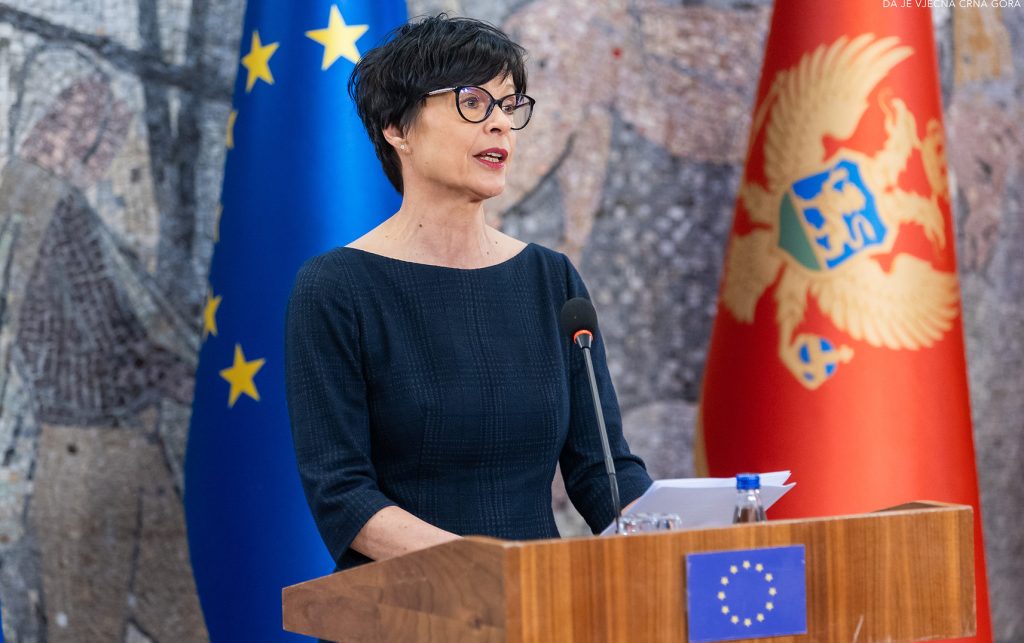
ZAGREB – European Commissioner for Enlargement Marta Kos said that geopolitical enlargement had fundamentally changed and that the enlargement process needed to change accordingly.
Speaking at the Croatian Ambassadors Conference in Zagreb on Tuesday, Kos outlined four areas in which the EU should adapt to future enlargement, including internal EU reforms, stronger safeguards against democratic backsliding, a more ambitious approach to gradual integration of candidate countries and transitional measures for new members, Euronews reports.
Kos described the current situation as a new “Helsinki Moment”, referring to the 1999 European Council meeting in Helsinki which paved the way for the EU’s major post-Cold War enlargement.
She pointed to Montenegro’s progress as the frontrunner in the accession process, Albania’s advances in meeting key rule-of-law benchmarks, technical progress made by Ukraine and Moldova, as well as Iceland’s decision to resume its accession process.
“The Commission will present its ideas on how the European Union must prepare as candidate countries approach the finish line of accession negotiations,” Kos said.
According to her, four issues need to be addressed in order to build consensus among EU leaders on accepting new member states.
The first concerns internal EU reforms. Kos argued that an enlarged Union would need to make its decision-making processes more efficient and flexible, but stressed that this could be achieved without changing the EU treaties.
Among the options she mentioned were reducing the number of policy areas in which a single member state can block decisions, making EU institutions smaller and making greater use of “enhanced cooperation”, which allows groups of member states to move forward in certain areas even when others are not ready to participate.
The second issue concerns stronger safeguards against democratic and rule-of-law backsliding after accession.
Kos said the EU needed mechanisms capable not only of preventing violations of its fundamental principles and values, but also of addressing them if they occurred after a country became a member.
“We must make sure we do not let in Trojan horses. Not today, not in 10 or 20 years from now,” she said.
Kos argued that stronger safeguards were necessary to build confidence among existing member states and could also make it easier for them to ratify future accession treaties.
The third area is a possible revision of the enlargement methodology through more ambitious gradual integration.
Kos said the EU should move away from the traditional “all or nothing” approach, under which candidate countries wait until full membership before gaining most of the benefits of integration.
“EU enlargement needs to evolve to respond to the realities of today,” she said, warning that accession processes lasting for decades create uncertainty that the EU’s geopolitical rivals can exploit.
“We need a more structured approach to bridge the time we no longer have. We need to look for more ambitious ways of gradual integration,” Kos added.
According to her, candidate countries can already benefit from some forms of integration before membership, including participation in the Single Euro Payments Area (SEPA) and connection to the EU energy grid, but Kos said these steps were “not enough”.
Kos highlighted the need for transitional measures to manage the impact of future enlargement on existing member states and the functioning of the Union.
She noted that the EU already had experience with far-reaching transitional arrangements during previous enlargements and stressed that future accession must also take into account the Union’s financial capacity.
“We must make sure that the EU budget can continue to finance our priorities,” Kos said.