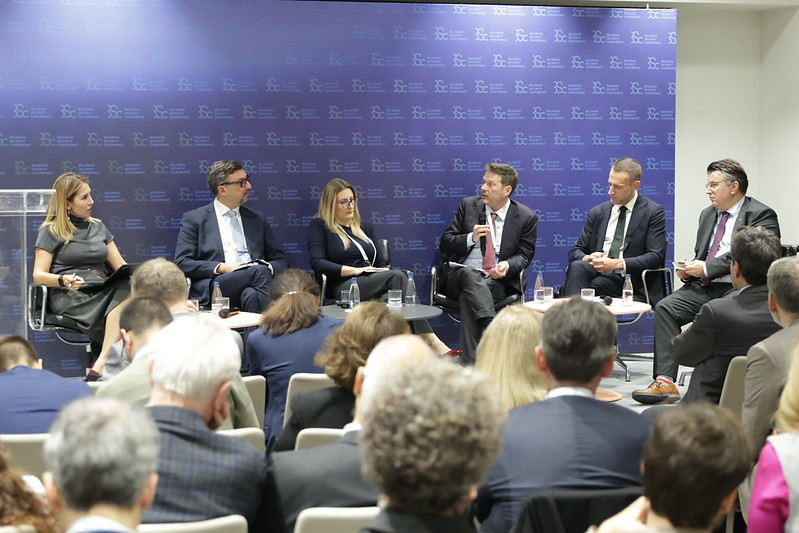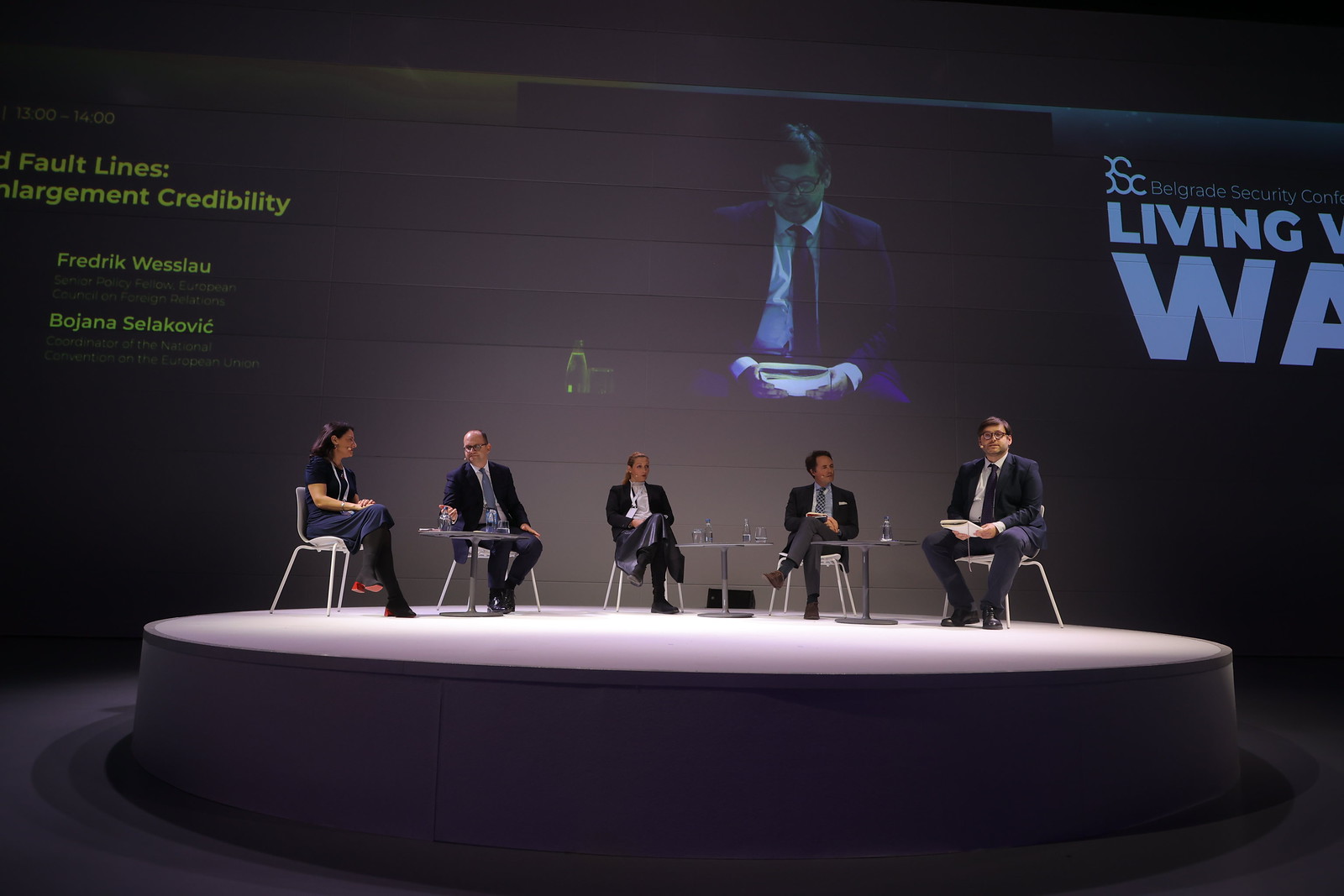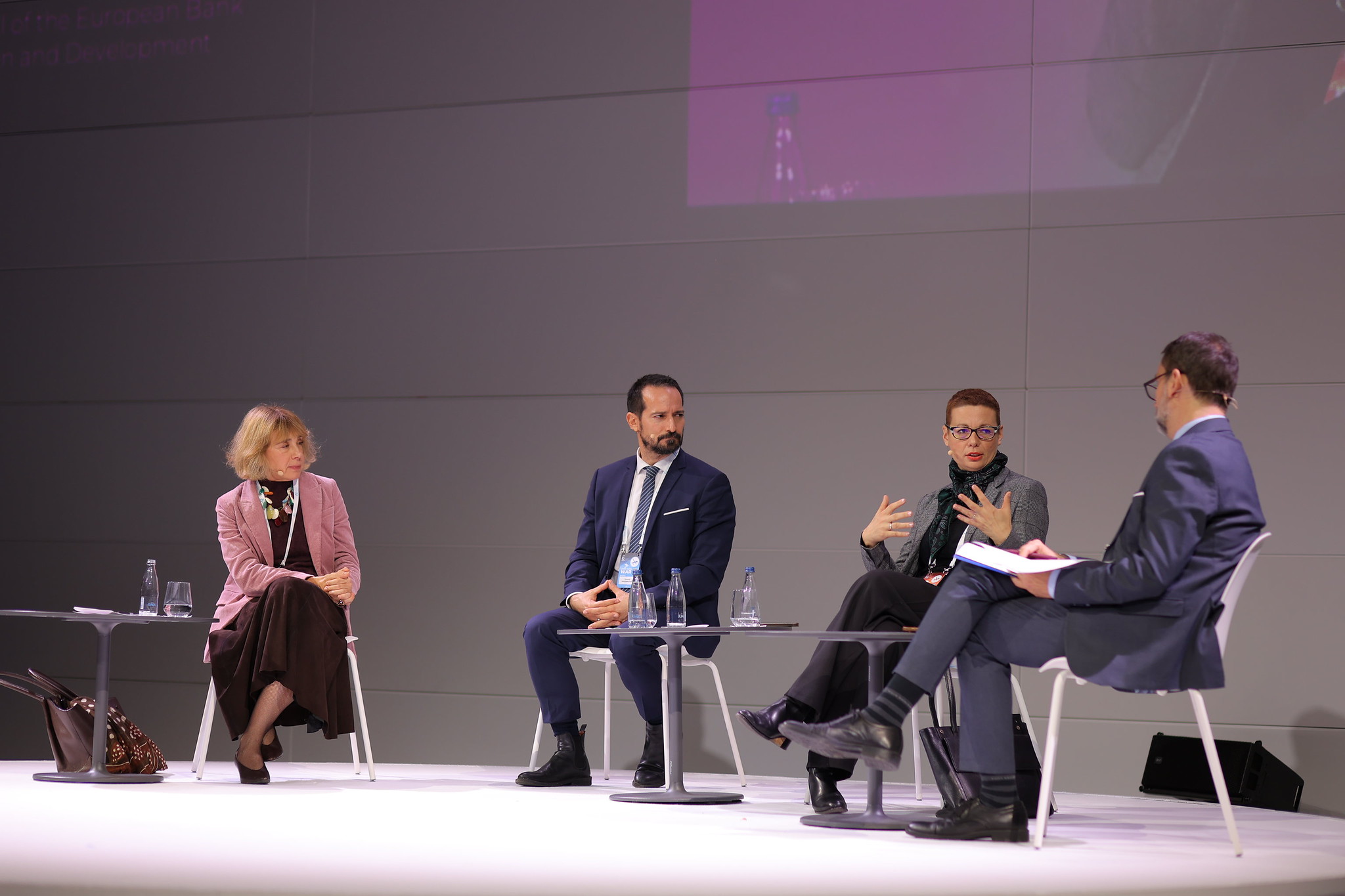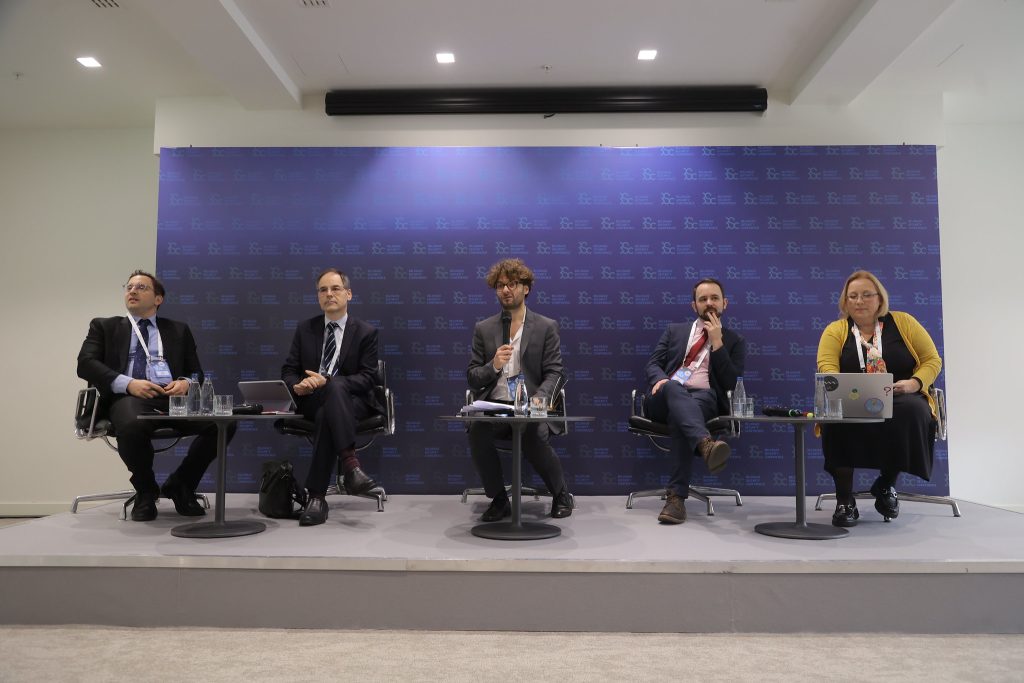
BELGRADE – A weak commitment of the European Union to enlargement would only encourage candidate countries to hedge their bets between global powers, and the Union’s economic weight in the region will not automatically become geopolitical influence, concluded speakers of today’s Belgrade Security Conference panel titled “2031: An EU’s Enlargement Odyssey”, presenting the findings of the GEO-POWER-EU project, which has charted possible futures for the European Union and nine candidate countries in 2031.
The Horizon Europe project GEO-POWER-EU presented on the panel draws on two years of research, including a survey of more than 9,000 citizens, over 100 interviews and more than 20 focus groups. Asked where the candidates will be in 2031, most of the audience chose the scenario in which front-runners advance while others fall behind.
Marcus How, Head of Research and Analysis at VE Insight, said the foresight exercise consulted 45 human experts, with 45 synthetic AI personas as a comparative layer. The experts were generally pessimistic, seeing business as usual, a process without much political will behind it, as the baseline. Another scenario was that the EU mistakes economic and institutional integration for political convergence, while candidates diversify their relations with Russia, China, Türkiye and the US.
The preferred scenario, a return to the transatlantic norm, was seen as very unlikely, since experts were not confident the EU or European NATO could fill the gap left by the US. The nightmare scenario was competitive fragmentation, in which powers compete through proxies and the region descends into short-termist chaos, regarded as worse even than an alternative Chinese order.
Unlike the experts, How noted, the AI did not consider a gradual unlocking of membership benefits and found it hard to imagine crisis situations.
Filip Ejdus, Professor of International Security at the Faculty of Political Science, University of Belgrade, explained that the strategy game, in which players took the seats of the EU, global powers and the candidates, was set between June 2028 and June 2029, when elections in the US and Germany are expected.
“This was not an exercise in prediction”, Ejdus said, adding that the aim was to identify plausible scenarios in order to shape them and by doing that, to shape future. One unexpected result was that once peace in Ukraine was reached, the EU lost its appetite for geopolitical enlargement.
According to Ejdus, the EU needs to become a more credible security actor and offer firm security guarantees, as weak commitment will encourage more hedging in Serbia and elsewhere. European geopolitics, he added, will also depend on the US presidential elections and on whether the populist wave is stopped in France and Germany.
Nikolaos Tzifakis, Professor of International Relations at the University of the Peloponnese, described the European Commission’s recent proposal as a step in the right direction and presented the GEO-POWER-EU team’s own proposal for reforming decision-making in accession negotiations. He explained that unanimity currently applies at dozens of steps in the process, which allows individual member states to block negotiations over bilateral issues unrelated to the accession criteria.
The team’s proposal starts from the premise that member states’ role is not the same at every stage or in every chapter. Unanimity would be kept for nationally sensitive questions, while in other clusters a Commission proposal would be considered accepted unless a qualified majority of member states opposed it within 90 days.
According to Tzifakis, this would effectively remove the veto from most of the process. Bilateral disputes would therefore lose their capacity for blackmail, and threats to block candidates would carry far less credibility. The process would become more transparent and remain technical, as candidates would know that meeting the benchmarks leads to progress.
Sonja Stojanović Gajić, Senior Research Fellow at the Center for Advanced Studies South East Europe, University of Rijeka, said the Commission’s new reporting on resilience focuses only on foreign interference, overlooking democratic oversight of the security sector. She named intelligence services and surveillance as the biggest unaddressed gaps.
She noted that Serbia now buys most of its weapons from China. “In the long term, we will never be rich enough to defend ourselves,” she said, pointing to neutral states such as Switzerland, Austria and Ireland, which develop NATO-interoperable forces through tailored partnership programmes.
How warned that candidates which diversify their partners could end up with technology, such as language models or cloud infrastructure, incompatible with EU regulation, adding that Montenegro will be the first test of how credible enlargement is.
Stojanović Gajić concluded by presenting the project’s Interdependence Database, which maps the candidates’ relations with five geopolitical actors since 2008. She warned that all EU crisis missions depend on NATO command structures, and that if Washington changed its approach to defence, the EU would be “nowhere close” to filling the gap.