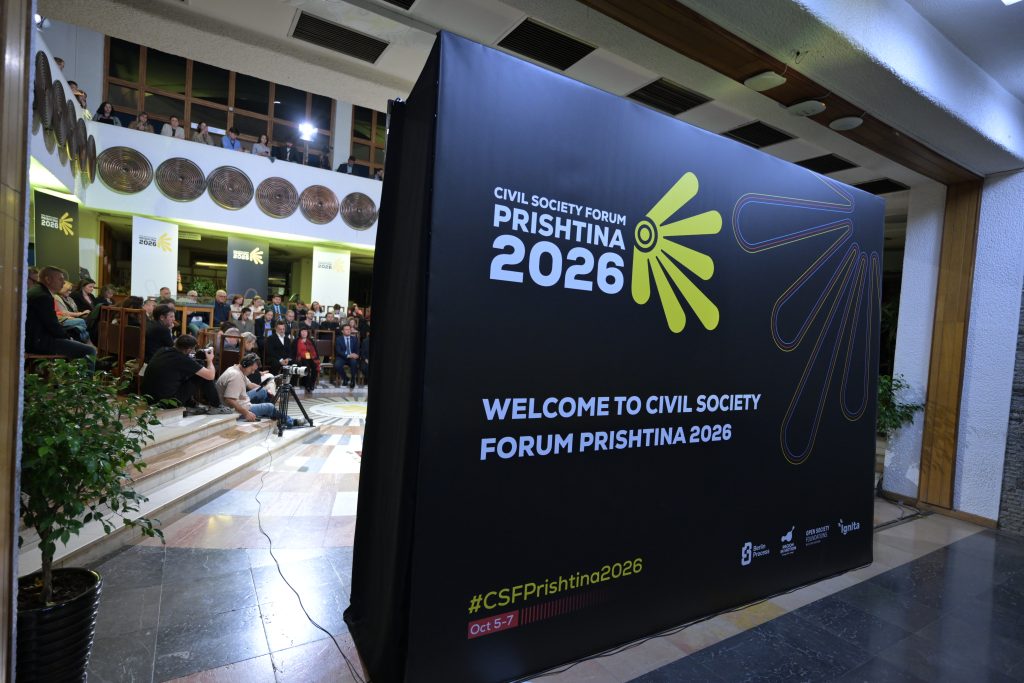
PRISTINA – The 2026 edition of the Civil Society and Think Tank Forum of the Western Balkans, under the motto “Proofs, Not Promises”, opened tonight in the capital of Kosovo. The event is organised by the Open Society Foundations – Western Balkans and the Government of Kosovo, and in cooperation with the Government of Montenegro within the framework of the Berlin Process Chairmanship.
Civil Society Forum is the official civil society platform of the Berlin Process, established in 2014 to advance regional cooperation, economic integration, and the European perspective of the Western Balkans.
The Forum will last until 7 October and will be structured around six thematic working groups, each tasked with developing policy recommendations.
The opening session, however, did not aim to develop recommendations. It took place in the National Library of Kosovo and featured a conversation between historian Edin Hajdarpašić and Valbona Zeneli, Nonresident Senior Fellow at the Atlantic Council, on the Balkans’ place in Europe’s imagination.
Andi Dobrushi, Director of the Open Society Foundations – Western Balkans, made an introduction to the conversation in his opening remarks, assessing that, for two hundred years, Europe has been struggling to find a way to describe the region.
“We have been described as a powder keg, the bridge between East and West, the crossroads, the backyard, the unfinished business. Every one of these sentences tells you more about the anxieties of Europe rather than the people that live in this region”, Dobrushi said.
He added that this is usually treated as a sort of failure, that the region cannot explain itself.
“Tonight, as a provocation, let me suggest the opposite – it is Europe that has never decided who we are to it”, Dobrushi said.
Quoting the work of Edin Hajdarpašić, Dobrushi said that Europe has treated the region both as a “brother” and as an “other” – family when the danger is near and foreigner when the budgets are counted.