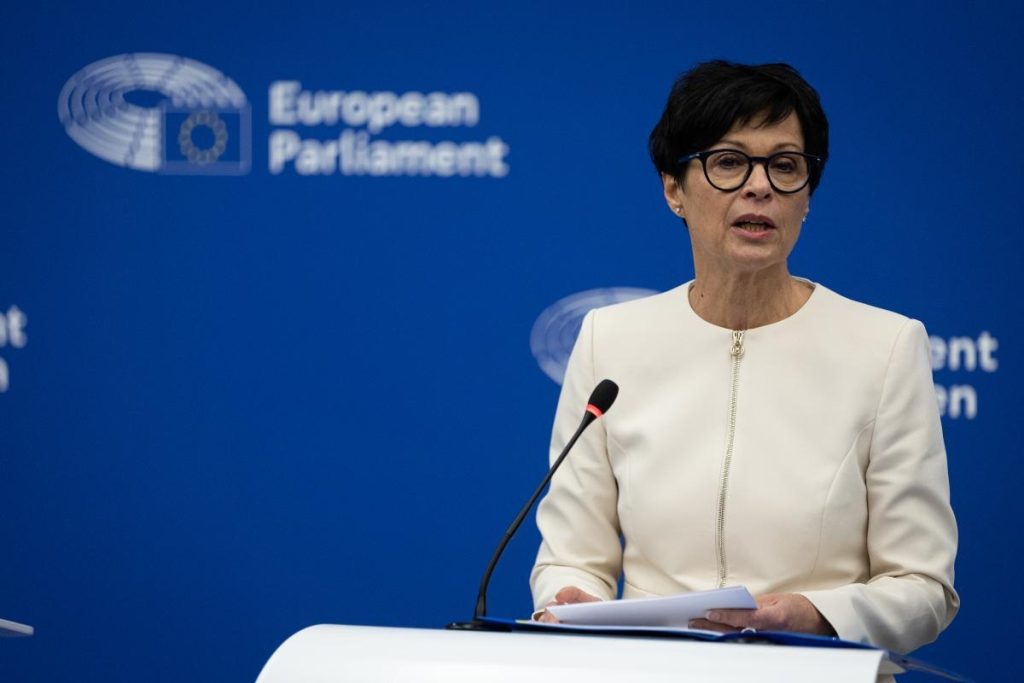
STRASBOURG – Fewer decisions requiring unanimity, new powers to withhold EU funding and restrict voting rights for new members that breach rule-of-law commitments – these are among the measures proposed by the European Commission to prepare the bloc for its next enlargement, unveiled by Enlargement Commissioner Marta Kos on Tuesday.
The Commission will also present roadmaps with indicative timelines for four frontrunners, Montenegro, Albania, Ukraine and Moldova, later this month. At the same time, Brussels is proposing a more ambitious approach to gradually integrating candidate countries ahead of membership, conditional on reforms and closer strategic alignment with the EU.
“A bigger Union needs to be a more flexible Union,” Kos said as she presented the proposals, arguing that an enlarged EU must be able to make decisions more efficiently.
The Commission wants to expand the use of qualified majority voting wherever existing treaties allow, reducing the number of areas in which a single member state can block decisions supported by the others.
Kos cited sanctions, measures against tax fraud and intermediate steps in accession negotiations as examples where unanimity could be reduced.
The proposals also envisage greater use of “enhanced cooperation”, allowing groups of member states to move ahead in specific policy areas while leaving the door open for others to join later.
New safeguards against democratic backsliding
A second pillar of the proposals focuses on stronger safeguards against democratic and rule-of-law backsliding by future member states after they join the EU.
In cases of serious breaches of commitments made during accession negotiations – particularly concerning the rule of law, democracy and fundamental rights – the Commission wants mechanisms that would make it easier to suspend EU funding or restrict voting rights.
The measures could also be triggered by serious violations of the principle of “sincere cooperation”, which requires member states to act in good faith towards one another and the Union.
“This is an insurance policy so we can react if needed,” Kos said.
She stressed that the safeguards would apply only in the event of breaches and would not mean permanently limiting the rights of new members.
“We do not want a two-tier membership,” Kos said, insisting that all member states, including newcomers, must enjoy equal rights.
The Commission also proposes that future members voluntarily commit not to use their veto to block subsequent enlargements over bilateral disputes – an issue that has repeatedly complicated the accession process in the Western Balkans.
Kos clarified that such a commitment would take the form of a voluntary declaration rather than a legally binding provision in the accession treaty.
Roadmaps for four frontrunners
On October 28, alongside its annual enlargement reports, the Commission plans to publish individual accession roadmaps for Montenegro, Albania, Ukraine and Moldova, which it has identified as the four frontrunners in the enlargement process.
The roadmaps will set out the next steps, concrete deliverables and tentative timelines, making the accession process more predictable while reflecting each country’s progress.
Kos argued that such plans would make sense at this stage only for candidates sufficiently advanced in their reforms and negotiations.
The selection also highlights the increasingly divergent trajectories of Western Balkan candidates. Montenegro and Albania are now among the four countries for which Brussels is prepared to offer a clearer accession timetable, while Serbia remains outside that group.
Montenegro is the most advanced candidate. According to Kos, it could complete the technical part of its accession negotiations by the end of 2026 or early 2027.
A working group is already preparing its accession treaty, which could be signed next year if negotiations and decisions by member states proceed as planned. That would leave the ratification process, which has typically taken between one and two years, as the final step towards membership.
Kos said the Commission supports Montenegro’s ambition to become the EU’s 28th member in 2028, provided it maintains its reform momentum.
The roadmaps will differ considerably, she added, noting that the other three frontrunners have not yet opened all their negotiating clusters.
Gradual integration with tougher conditions
The Commission is also proposing a more ambitious framework for gradual integration, particularly relevant to candidates still some distance from full membership. A detailed approach, tailored to each country’s readiness and specific needs, will be presented at the end of October.
Kos identified reform progress, strategic alignment with the EU and adherence to shared European values as conditions for gaining access to additional EU policies and sectors.
Asked whether the new approach could also apply to Serbia, given its low level of alignment with EU foreign policy, Kos returned to a metaphor she had used earlier to explain why accession roadmaps were not being offered to every candidate.
“If the car is moving. If the car is not moving or even is backsliding or going back, it makes no sense,” she said, having earlier described domestic reforms as the fuel needed to keep the engine running.
The exchange underscored the challenge facing Serbia, which has not opened a new negotiating cluster in five years and whose limited alignment with EU foreign policy remains a source of friction with Brussels.
Under the proposed framework, candidates meeting the conditions could gain access to additional areas of EU policy before membership, including energy, transport, artificial intelligence, security and defence.
Kos insisted that gradual integration was “not a substitute for full membership” but an “accelerator for enlargement”.
Existing examples include participation in the Single Euro Payments Area (SEPA) and efforts to reduce roaming charges. The new approach would go further, linking integration not only to candidates’ reform achievements but also to sectors where closer cooperation serves the EU’s own strategic interests.
According to the Commission’s assessment, the EU could accommodate new members in most policy areas without major changes, although some sectors would require adjustments.
Ukraine’s vast and highly productive agricultural sector presents a particular challenge. Brussels is therefore proposing targeted arrangements for sensitive agricultural products to ensure that Ukraine’s eventual accession does not adversely affect farmers in existing member states.
“Our assessment is clear: enlargement today is possible,” Kos concluded, while stressing the need for more efficient decision-making, leaner institutions and stronger tools to protect the rule of law.
The long-awaited Commission proposals are expected to frame the political debate on the next steps in enlargement through the end of the year, beginning with the meeting of EU leaders on October 15.