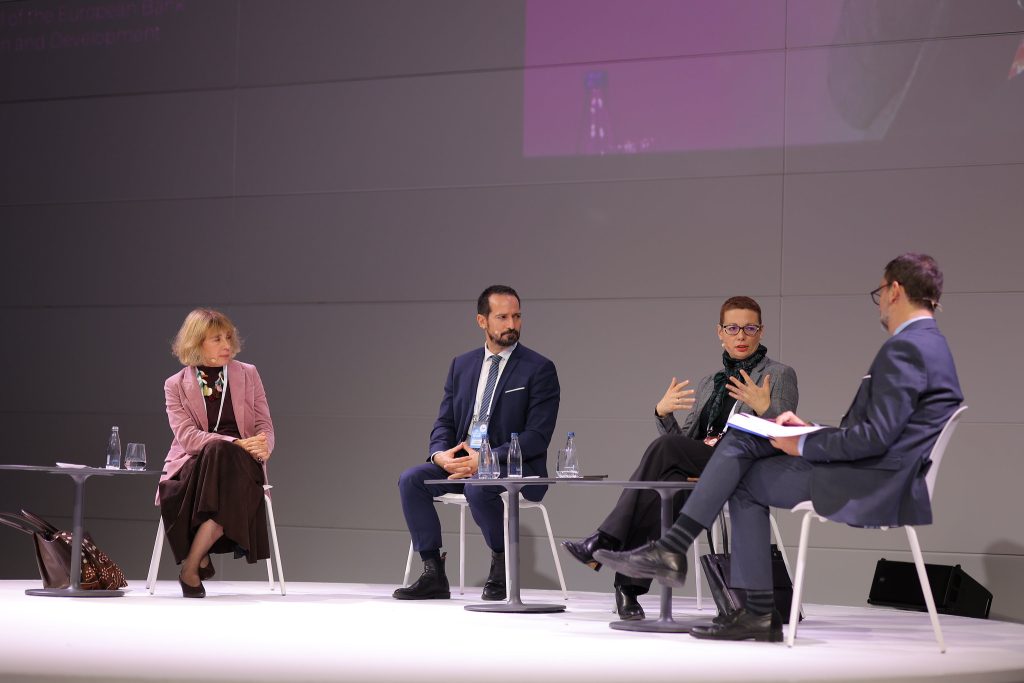
BELGRADE – Democracy prevailed in Serbia at the election on 25 October, which was won by the Student List. Now the incoming government has an opportunity to re-establish democratic institutions so that backsliding witnessed under the Vučić regime does not happen again, assessed the speakers at today’s Belgrade Security Conference panel dedicated to Serbia.
Describing the new political situation, Milica Delević, Secretary General of the European Bank for Reconstruction and Development and former head of the Office for European Integration of Serbia, said that the main achievement of the Student Movement is the mobilisation of the citizens who have become conscious that they have power over the government.
“This happened for the second time in my lifetime, and I hope that this time citizens will maintain that consciousness”, Delević said, referring to the year 2000 and the overthrow of Slobodan Milošević.
Comparing the two periods, Delević said that the influence of the European Union on the new government of Serbia was somewhat stronger in 2000 than it will be now, because the EU was, to some extent, transactional towards the regime of Aleksandar Vučić and did not recognise the craving for democratic values of Serbian citizens that fueled dissatisfaction with his rule.
However, it is now time to restart the EU-Serbia partnership and the European integration process of Serbia is expected to continue with new momentum and a sense of internal ownership of the issues of the rule of law, Delević added.
She assessed that there will also be expectations from the new government to make further steps in reconciliation and normalisation of relations with its neighbours, which is one of the primary logics underpinning the EU’s enlargement policy in the Western Balkans.
Commenting on what should be the priorities of the new government of Serbia, Tanasije Marinković, Professor of the Faculty of Law, University of Belgrade, assessed that this is a historic momentum to re-establish and consolidate democracy.
“We should understand the burden of the weight that is upon us to make sure that backsliding does not happen again”, Marinković said.
He said that he was not in favour of reversing the 2022 Constitutional changes in the area of the judiciary, even though the amendments introduced bad solutions. What is urgently needed, however, is the establishment of a prosecutorial police, which is not answerable to the minister of interior but to the prosecutor’s office.
Marinković also assessed that a reformation of election laws is needed to minimise the potential for abuses in the future, as well as professionalisation of public administration and public media.
According to Marinković, the previous government was conducting a “hybrid war” against its citizens.
“Daily media targeting of all those who were participating and were seen as leaders of the movement. We have witnessed physical brutalities… and a complete mobilisation of the state apparatus and obliteration of the border between party and government”, Marinković said.
What was encouraging, he assessed, was that citizens managed to overcome apathy and the belief that changes are not possible.
According to Gazela Pudar Draško, Director at the Institute for Philosophy and Social Theory at the University of Belgrade, the students succeeded because their demands were simple and inclusive, and their activism, especially at the local level, demonstrated to the people that they are serious about change.
Now that they have won, challenges of normalising the situation in the society of Serbia lie ahead.
“The majority of people in Serbia are not young demographically, and closing this polarisation gap means providing services to all people, not only those who voted for them”, she said.
Political culture needs to move away from the perception of the government as somebody who needs to take care of people, but this will take time.
According to Pudar Draško, the new government needs to be efficient in setting the groundwork for democratic renewal by focusing on areas including rule of law and education. These are the core areas in which there needs to be delivery on changes before proceeding to other issues, such as foreign policy.