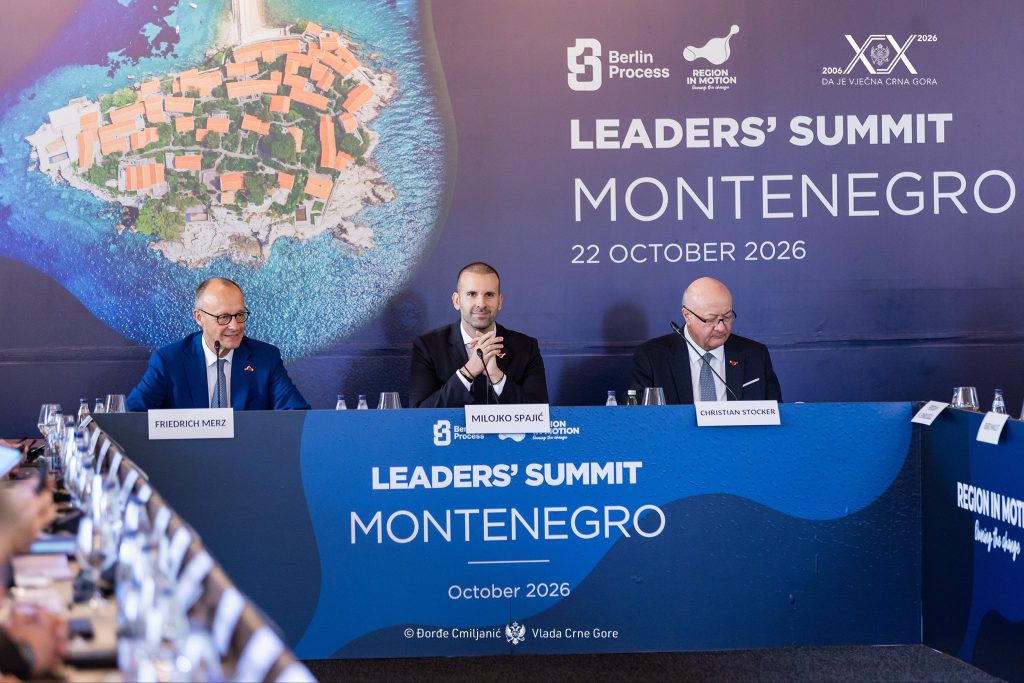
BUDVA – In his opening address to the Berlin Process Leaders’ Summit in Miločer, near Budva, German Chancellor Friedrich Merz said that Montenegro had made significant progress on its European path and that membership in the European Union was a realistic goal.
He pointed out that the country has almost completed the accession negotiations, stressing that reforms, political will and regional cooperation are key for the further progress of the Western Balkans, it was reported by RTCG.
The Berlin process was set up in 2014 as a platform to increase cooperation between the Western Balkans Six and the Berlin Process host countries as well as the EU. It is first and foremost a consistent and inclusive format for all 6 Western Balkan countries.
The final event of Montenegro’s chairmanship of the Berlin Process – the Leaders’ Summit – brings together all Western Balkan leaders, representatives of European Union member states and international organisations.
“You are showing progress and that accession to the European Union is indeed possible. You were determined and your efforts paid off. This is a region in motion, a region of change, but those changes must come from within. This is one of the fundamental ideas of the Berlin Process – to bring the Western Balkans together at the same table, to initiate and strengthen regional cooperation,” Friedrich Merz said.
He pointed out that since the meeting in Tivat in June 2026, progress has been made in strengthening the Berlin Process, as well as that joint work is being done on creating conditions for the enlargement of the European Union based on merits.
“Since we met in Tivat in June, we have put the Berlin Process back on track. Montenegro has almost completed accession negotiations and we are working together to enable merit-based enlargement. French President Emmanuel Macron and I jointly put forward proposals for enlargement, many of which were accepted by the European Commission. We thank Commissioner Marta Kos for this”, German Chancellor noted.
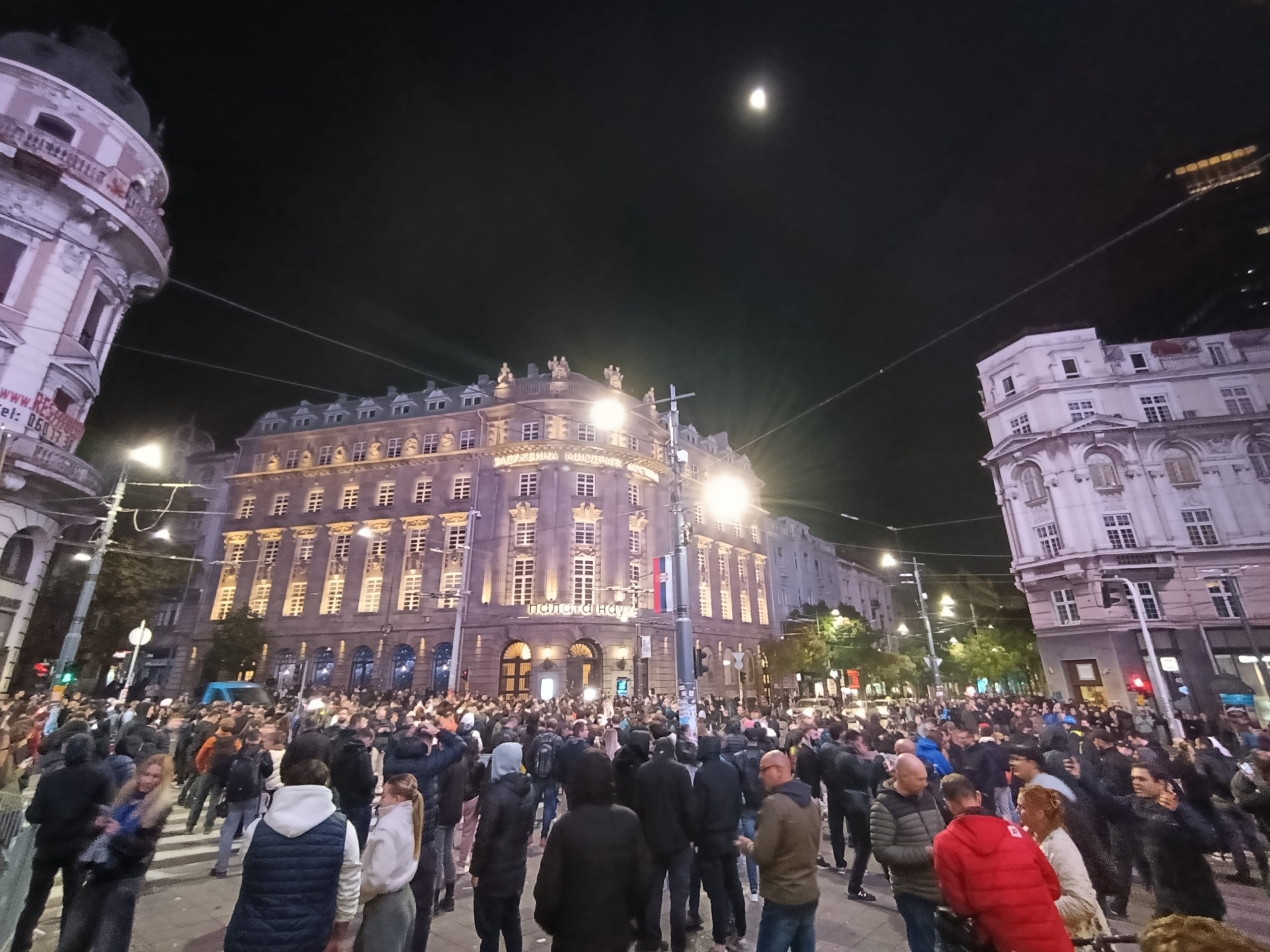
He stressed that for the continuation of European integration, it is necessary for the countries of the region to show readiness to implement reforms and political determination. Speaking about the protests and political tensions in the region, Merz pointed to the importance of preserving peace, rejecting violence and overcoming divisions.
“It is important that reforms and political will come from your side. The protests in the region remind us that we must continue to expand and strengthen peace. When we are faced with protests, whether in the European Union or elsewhere, violence must not be an option for either side” Merz said.
German Chancellor warned that unresolved issues from the past and political polarization are an obstacle to building a more stable and successful Europe.
“It is very difficult to move forward if the past keeps holding us back. Polarization will never lead to a more successful Europe. We have rejected the glorification of war criminals and, if we want a better future for our children, we must not add fuel to the fire. We must normalize the dialogue between Pristina and Belgrade”, Merz said.
He called for responsibility and concrete progress in resolving outstanding issues in the region, stressing that Germany remains committed to the Berlin Process and the European perspective of the Western Balkans.
“You can count on our support for the Berlin Process and we look forward to discussions with you,” Merz concluded.
Spajić: Montenegro determined to earn its place in the Union by implementing reforms
For his part, Milojko Spajić, Prime Minister of Montenegro, stated that the country “is determined to earn its place in the European Union through reforms and turn the progress it is making into an opportunity for the entire Western Balkans”, RTCG reported.
According to Spajić, “EU enlargement represents the reunification of the European continent, and the goal of regional cooperation is to create better living conditions, new jobs and prospects for young people”.
Spajić emphasized that Montenegro wants to continue contributing to the Berlin Process, with the ambition to do so soon as a full member of the European Union.
“Chancellor Merz, thank you for joining us. Germany’s commitment to the Western Balkans has maintained a fundamental European promise: that reforms, reconciliation and cooperation pave the way for a common future. Your presence further reinforces that promise. Twelve years after its launch, the Berlin Process continues to promote the idea that is at the very core of European integration: lasting peace comes when states build something together”, Spajić said.
He recalled the words of Robert Schumann that European unity will be built through concrete achievements that first create real solidarity.
Speaking about Montenegro’s presidency of the Berlin Process, Prime Minister underlined that the state approached this task responsibly, putting the common interests of the region ahead of narrow national priorities.
“Montenegro approached this presidency in good faith, putting the common interest of the region ahead of narrow national priorities. Through a programme of 25 events, including 12 at ministerial level, our goal has remained unchanged: to foster cooperation, strengthen togetherness and reaffirm European values as the foundation of lasting partnership. Our motto ‘ Region on the move. We take responsibility for the changes’ expresses exactly that responsibility”, Spajić remarked.
He stressed that Montenegro believes that the success of neighboring countries opens up additional opportunities for its development, which is why regional cooperation must bring concrete benefits to citizens and the economy.
According to him, through a common regional market and stronger connections with the European Union, it is necessary to enable faster flow of goods across borders, easier recognition of qualifications and access of companies to new markets.
“This requires economic reforms, strong institutions, fair competition and investments in skills, infrastructure and clean energy. Approaching European standards means that the European standard of living becomes available to families across our region. This means that young people can build their careers here, with confidence in their own future”, Prime Minister clarified.
In his opinion, such conditions represent the foundations of stability, but also of European security.
Referring to the war in Ukraine, Spajic reiterated Montenegro’s firm support for the country, its sovereignty and territorial integrity, stressing that borders cannot be changed by force.
He pointed out that Europe must show equal clarity and determination when it comes to enlargement policy, assessing that this is a historical process that goes beyond the institutional integration of states.
“Enlargement is the reunification of our continent. It is the extension of the promise of freedom, security and opportunity to Europeans whose place in our common home has not yet been realized. In a time of change, Europe has the confidence to make historic decisions. Its strength lies in the quality of life enabled by democracy, the rule of law and solidarity”, Spajić noted.
According to him, European values and achievements must be preserved, but also accessible to more citizens of the continent.
“We are determined to preserve this achievement and make it accessible to more Europeans. A credible, merit-based enlargement policy shows that Europe can act decisively to shape its future. Montenegro is determined to earn its place through reforms and to make our progress an opportunity for the entire region”, Spajić stated.
He stressed “that Montenegro’s commitment to the Berlin Process will not end with the completion of its presidency”, but that the country intends to actively contribute to regional cooperation in the coming years.
“Our commitment to the Berlin process goes beyond this chairmanship. We are determined to preserve its continuity, strengthen its importance and contribute to its work in the years to come, with the ambition to do so soon as a member of the European Union. We will transfer responsibility towards our neighbors to that membership”, Milojko Spajić said.
“Open issues with Croatia can be resolved”
Speaking at a press conference after the summit in Miločer, Friedrich Merz stated that it is realistic for Montenegro to become the 28th member of the EU by 2028.
He added that he had intensively discussed relations between Montenegro and Croatia with Croatian Prime Minister Andrej Plenkovic, expressing his belief that the remaining open issues would be resolved and that they would not be an obstacle to Montenegro’s European integration, RTCG reported.
“A country like Montenegro is a country that we can provide a concrete European perspective, that is, that it will become the 28th member of the European Union in 2028. I think it is realistic… I spoke with Croatian Prime Minister and we had intensive talks about Montenegro and Croatia. I am sure that the remaining issues can be resolved and that there will be no obstacles to Montenegro’s entry into the European Union”, Merz noted.
Speaking about the European perspective of the other countries of the Western Balkans, Merz pointed to the need for gradual accession to the European Union, remarking that some countries in the region are facing growing political tensions and open issues that make their progress difficult.
“The membership of the Western Balkan countries in the European Union is a geopolitical imperative, and the region must not become a place where great powers will clash over their influences… The region is facing blockades, and more political courage is needed. The dialogue between Belgrade and Pristina on the normalization of relations must come out of the deadlock, and in Bosnia and Herzegovina it is necessary to overcome the growing polarization and build bridges”, Merz stressed.
Prime Minister Milojko Spajić stated that the process of Montenegro’s negotiations regarding Croatia is very important and that it is possible to overcome these challenges.
He clarified that all positions for Chapters 23 and 24 in the negotiations on Montenegro’s membership in the European Union have been submitted, expressing hope that these chapters will be closed in December 2026.
Meanwhile, Austrian Chancellor Christian Stocker stated that bilateral issues must not hinder the EU enlargement process.
Stocker noted that the promise made to the countries of the region regarding EU membership must be fulfilled and that it would serve as tangible proof of the Union’s credibility.
“Through gradual integration, we want to bring all the countries of the Western Balkans closer to our single market in order to enable people to experience the benefits of membership in the European Union”, Stocker remarked.
The article has been updated.