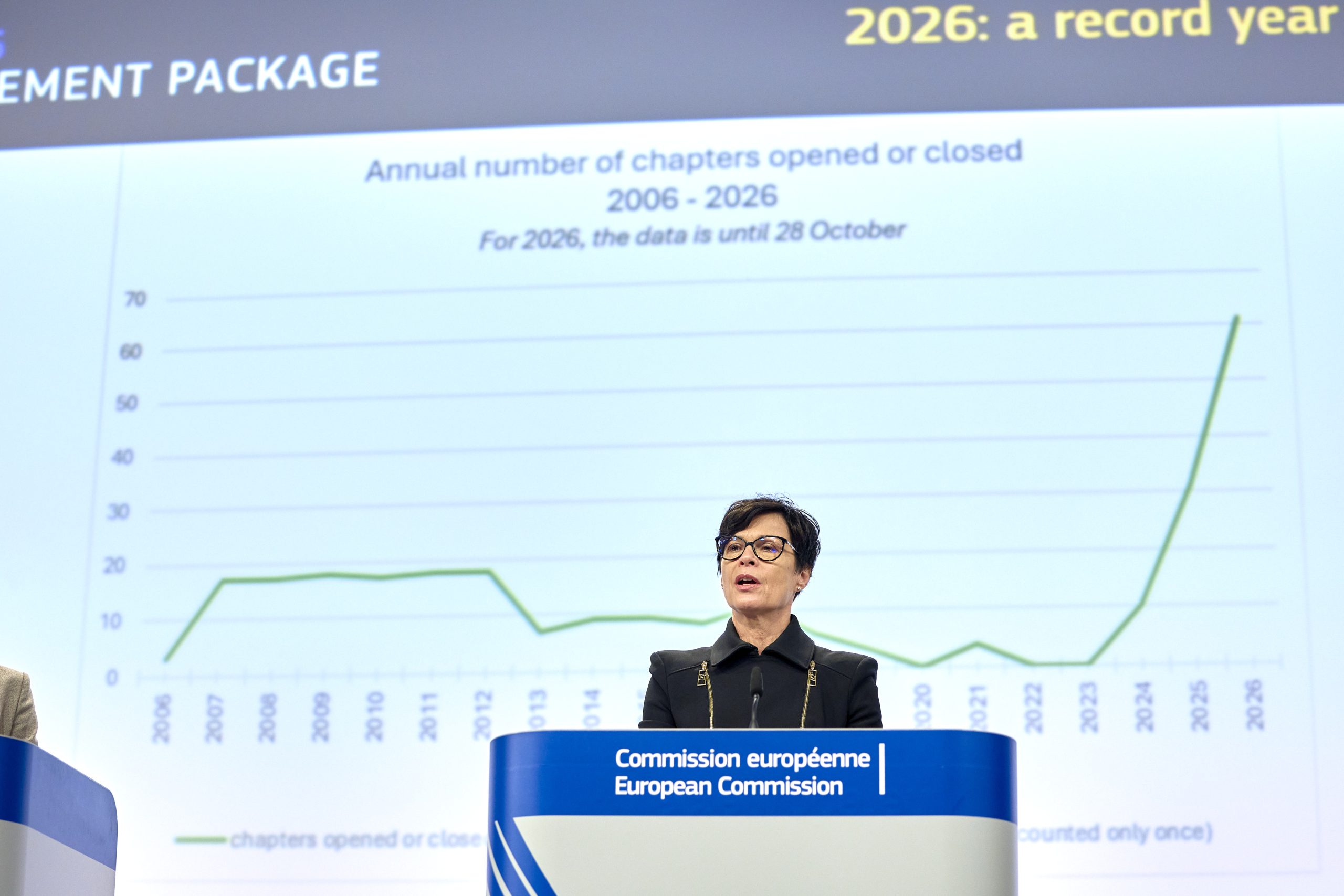
Serbia’s new government will inherit a stalled EU accession process. No negotiating cluster has opened in almost five years, and the European Commission’s latest report recorded backsliding in four areas. Serbia also risks losing more then 240 million euros in EU Growth Plan funding because the outgoing government failed to carry out reforms it had committed to under its Reform Agenda.
The incoming government has The incoming government has pledged to move ahead with EU integration. One of the foreign policy objectives in the Students’ List’s programme is to secure a positive Interim Benchmark Assessment Report (IBAR) for Chapters 23 and 24.
The European Commission confirmed to Savremena politika that Serbia could secure a positive IBAR before opening Cluster 3 or any of the other three clusters that have yet to open.
“Once the interim benchmarks for Chapters 23 and 24 have been met, the Commission would first submit a positive assessment to the Council of the EU. The EU member states would then have to endorse that assessment. A positive assessment of whether the interim benchmarks for Chapters 23 and 24 have been met does not depend on the opening of the remaining clusters,” the Commission said in a written response.
The Commission explained that it would present its report as soon as possible once Serbia had carried out the reforms needed to meet the 91 interim benchmarks across the two chapters. EU member states would then have to endorse the positive assessment and set the closing benchmarks for Chapters 23 and 24.
“Securing a positive IBAR would be an important milestone in Serbia’s EU accession negotiations. The IBAR covers a key part of the fundamentals of the accession process, namely the rule of law and fundamental freedoms. In practice, no further negotiating chapters can be provisionally closed until those interim benchmarks are met,” the Commission said.
It added that it had provided detailed guidance to the Serbian authorities for years through its regular dialogue with them and would continue to do so.
“As Commissioner Kos stressed after speaking by phone with a representative of the Students’ List, the Commission stands ready to work closely with the incoming government and support reforms in the rule of law, media freedom, the fight against corruption and the strengthening of democratic institutions. These issues are covered by the interim benchmarks for Chapters 23 and 24,” the Commission said.
How realistic is a positive IBAR?
Srđan Majstorović, Chair of the Governing Board of the European Policy Centre (CEP), believes a positive IBAR is within reach, although whether Serbia secures one will depend on several factors.
He points out that the interim benchmarks for Chapters 23 and 24 are directly linked to the platform on which the Students’ List won a decisive election victory. He therefore expects the incoming government to have the political will to pursue these reforms from day one. The strong support the list received at the polls, he adds, gives the new authorities an obligation to follow through.
“The other question is capacity. Can the new authorities organise themselves and bring together enough experts and public officials to carry out the necessary reforms? Expertise in the relevant ministries, courts and prosecutors’ offices has been significantly eroded over the past 14 years by hiring practices that disregarded professional qualifications and by undue political interference,” Majstorović said.
Asked about possible administrative or technical obstacles, Majstorović said the government could overcome them if it reached a clear political consensus and was firmly committed to meeting the requirements for EU membership.
“Other candidates with far more limited capacity than Serbia are already ahead of it in the accession process. Ukraine is the clearest example. It is at war and its resources are stretched, yet it has moved faster than Serbia because its leadership has shown an unequivocal political commitment over the past four years,” he said.
Majstorović added that Serbia has the expertise and capacity to catch up quickly with the frontrunners.
“Our expertise is currently scattered. We need to bring it together and focus it on the issues that matter most for the country’s future, which are also directly tied to progress towards EU membership,” he said.
In his view, the incoming government’s biggest challenge will be to establish the conditions needed to tackle corruption and organised crime effectively, including independent courts and an autonomous prosecution service.
“Under these circumstances, it will be very difficult to demonstrate that the interim benchmarks have been implemented effectively. Without that evidence, the negotiations cannot move forward. Yet these are precisely the issues on which the EU and Serbian citizens agree. That should create considerable scope for closer cooperation and stronger EU support,” Majstorović said.
What can the new government do in the short term?
Following the Students’ List’s victory, European Commissioner for Enlargement Marta Kos said the priority was to build trust between the incoming government and the EU institutions so that Serbia could break years of deadlock in its EU integration process.
“We need to build Serbia’s trust in the member states and in the European Union as a whole, as well as our own trust in the people of Serbia. I take that task very seriously and personally. If the first steps are to carry out the necessary reforms in areas such as the rule of law, judicial independence, independent media and the fight against corruption, that would already bring us closer to releasing the funds we have held back,” Kos said.
Majstorović said that as soon as the new government takes office, it should make clear that it is ready to move forward with EU integration and set out how it intends to deliver on its key priorities. These include building democratic institutions, tackling organised crime and corruption, and creating lasting conditions for free media to operate without interference, alongside reforms in other areas.
“The emphasis should be on these issues, where the interests of Serbian citizens and the EU are fully aligned,” he said.
Majstorović also believes Serbia still needs a negotiating team that brings together experts from within and outside the public administration and coordinates the work of the relevant ministries.
Earlier this year, the outgoing government set up an Operational Team for EU Accession, led by Danijel Apostolović, head of Serbia’s Mission to the EU. In its Serbia report, the European Commission found that the team had helped consolidate operational management but had also blurred the division of responsibilities between the minister for European integration and the chief negotiator.
Bojana Selaković, coordinator of the National Convention on the European Union, believes the incoming government should spend its first months implementing the Reform Agenda and clearing the way for Growth Plan payments to resume.
Selaković sees scope for faster progress on reforms the Students’ List has already announced, including completing the overhaul of electoral legislation and passing media laws.
“The focus must be on reforms. The change of government and the freeing of institutions from political control create the conditions for Growth Plan funds to be released. Serbia has received only around €160 million in initial pre-financing, and we are now at risk of losing a substantial amount of money intended for citizens if we fail to carry out the agreed reforms. If the incoming government sticks to the programme of the winning list, we will make rapid progress on the Reform Agenda and unlock those funds, much as Hungary did after Viktor Orbán left office,” Selaković told Insajder TV.
The new government’s credibility will also matter in relations with Pristina and Moscow
Asked whether Serbia could make significant progress towards EU membership without a change of course on relations with Russia or the dialogue with Pristina, Majstorović said both issues mattered for the accession talks. He argued that the incoming government could make a credible case for its position on both and set out how it intended to address them.
In Majstorović’s view, the incoming government will have a major advantage over the previous administration. Policies grounded in democratic principles will carry greater credibility. “Serbia’s position will no longer be dictated by the whims of one individual. All issues will be debated democratically within the institutions responsible for them, with all relevant actors taking part,” he said.
“I expect the EU to understand the circumstances in which the new government will operate and its priorities of building institutions and strengthening the rule of law as the foundations for democratic policymaking. The EU showed 14 years of patience with an authoritarian regime that spent years eroding democratic values. I expect it to show patience with the new authorities as well, as they seek to build a state on the same values that underpin the Union. That should provide a basis for future cooperation and help unblock Serbia’s accession talks,” Majstorović concluded.