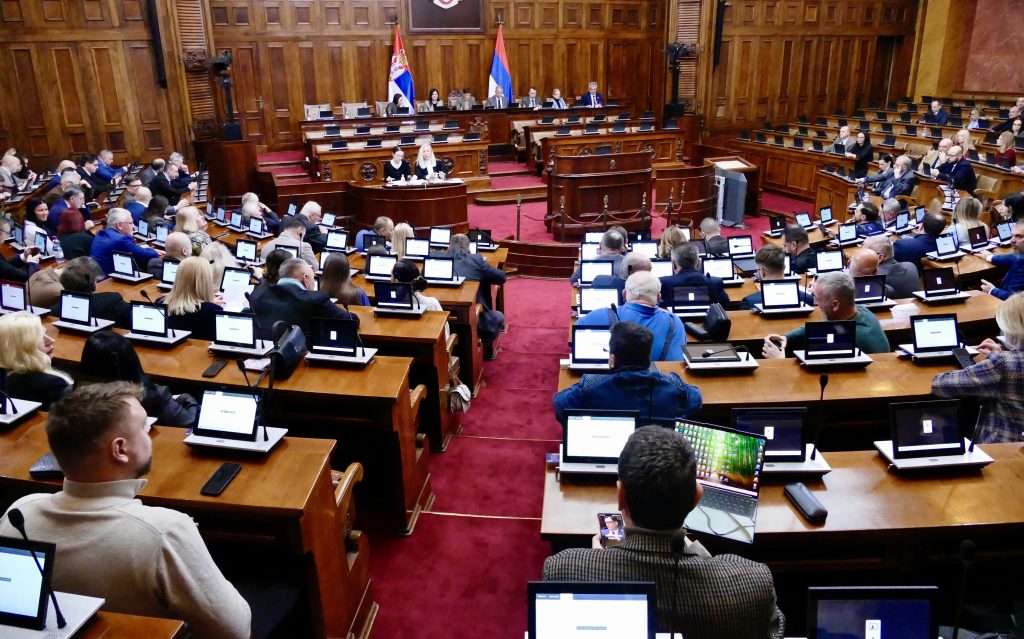
BELGRADE – Today, the National Assembly of Serbia adopted the amendments to the key judicial laws, proposed by an MP of the ruling Serbian Progressive Party (SNS), Uglješa Mrdić. The critics claim that these changes, adopted swiftly and without public consultations, will curtail the independence of courts and prosecutors.
The legal changes, among other issues, weaken the competencies of the High Prosecutorial Council, a body that elects public prosecutors and is responsible for maintaining their independence. The ruling party has recently criticised the work of the HPC, which is currently split into two factions, one of which is perceived to be closer to SNS.
In addition, amendments submitted by an MP of SNS, Olja Petrović, and accepted by Mrdić, will return 11 of the 20 prosecutors currently working in the Public Prosecutor’s Office for Organised Crime (TOK) to the prosecutor’s offices from which they had been temporarily transferred.
Once these amendments were publicly announced, TOK issued a statement, which assessed that the adoption of them would paralyze its work and “completely block the proceedings in the most complex and sensitive criminal proceedings”.
Last year, TOK charged former SNS government ministers Goran Vesić and Tomislav Momirović, who are suspected of corruption in the case of the reconstruction of the Belgrade-Budapest railway. Current minister of culture and high-ranking SNS member Nikola Selaković was also charged with falsifying documents and the abuse of office in the General Staff case.
These steps taken by TOK were the first time during the rule of SNS, which came to power in 2012, that either former or current government ministers were charged with corruption or abuse of office. In response, pro-government media launched a widespread campaign against TOK, while the work of the judiciary was heavily criticised by leading government figures, including President Aleksandar Vučić.
Uglješa Mrdić: “This is the first step towards returning the kidnapped judiciary to the state and people of Serbia”
Elaborating on the proposed amendments to the judicial laws, Uglješa Mrdić said that the adoption of a set of judicial laws is “the first step towards returning the kidnapped judiciary to the state and people of Serbia” so that it would no longer be run by “alienated centers under the control of foreign centers of power”, FoNet news agency reported.
According to Mrdić, these judicial laws “are also aimed at the greater independence of the prosecutor’s office and the independence of the judiciary, in accordance with the Constitution of the Republic of Serbia, as well as in accordance with domestic legislation”.
Explaining the proposal to amend the Law on Public Prosecutor’s Office, he stressed “the need to change certain decisions related to the competence for decision-making, for the referral of public prosecutors to other public prosecutor’s offices, as well as provisions on the number of mandates of Chief Public Prosecutors”.
He stressed that the amendments to the Law on Judges “enable the president of the court, after the expiration of his/her term, to be re-elected to the same office for another term”.
European Commission: “These changes could represent a significant step back in Serbia’s commitment to the EU accession path”
On the other hand, the European Commission told N1 that the amendments to the judicial laws, which were adopted by the Serbian Parliament today, “could represent a significant step backwards in Serbia’s path towards EU accession”.
“We are aware that the National Assembly of Serbia has adopted amendments to key judicial laws. We will now evaluate the content of the adopted legal texts. As we have already pointed out during this process, these changes could represent a significant step back in Serbia’s commitment to its EU accession path,” the European Commission said to N1.
The European Commission recently stated for Savremena politika that it “is familiar with the proposed changes of judicial laws”.
“When it comes to the latest amendments to judicial laws, there was no consultation with the Commission, and the process was hasty and non-transparent. In the area of the rule of law and fundamental rights, within its obligations in the EU accession process, Serbia is expected to align with European standards and strengthen the independence of the judiciary and the autonomy of the prosecutor’s office,” an EC Spokesman told.
Serbia adopted constitutional amendments in 2022 aimed at increasing the independence of the judiciary. At the time, these steps were welcomed by the EU.
Experts warn of “judicial backsliding”, opposition accuses the ruling party of retaliation against TOK
The Working Group of the National Convention on the European Union for Chapter 23 warned the public about the serious risks posed by the amendments to the judicial laws.
“Particularly problematic are those provisions relating to the extension of acting (ad interim) mandates in the management of prosecution offices and courts, as well as the abolition of the commission of the High Prosecutorial Council responsible for deciding on objections to mandatory instructions, thereby lowering standards guaranteed by the Constitution, particularly with regard to the autonomy of the prosecution service”, the press release notes.
The National Convention adds that “equally problematic is the fact that the amendments concerning the special prosecution unit competent for high-tech crime are being undertaken in order to establish control over its work, rather than to address the alleged ambiguities in the Law”.
For her part, Vida Petrović Škero, a former President of the Supreme Court of Serbia, believes that these amendments “represent a judicial backsliding”.
“In particular, I looked at explanations that are disastrous for any democratic order, a clear demagogy that serves the goals of individuals in this country. This has been systematically done to shift back the independence that prosecutors have been given by the Constitution and the law”, Petrović Škero told N1.
Pavle Grbović, an MP of the opposition Movement of Free Citizens, claimed that this package of judicial laws “leads to the abolition of the Prosecutor’s Office for Organized Crime”.
“You would prefer to abolish the Prosecutor’s Office for Organized Crime because you cannot forgive it for the charges against Nikola Selaković, but you must not do it because you are aware that you would bury Serbia’s European integration with it”, Grbović said during a discussion in the National Assembly.
Similarly, Marinika Tepić, an MP of the opposition Freedom and Justice Party, argued that these laws “are aimed at abolishing an independent Prosecutor’s Office and judiciary in Serbia. “
“We all know it was not written by Uglješa Mrdić… They were written by all those who work for Aleksandar Vučić, to prepare a shield so that people like Selaković would not be held accountable”, Tepić claimed.