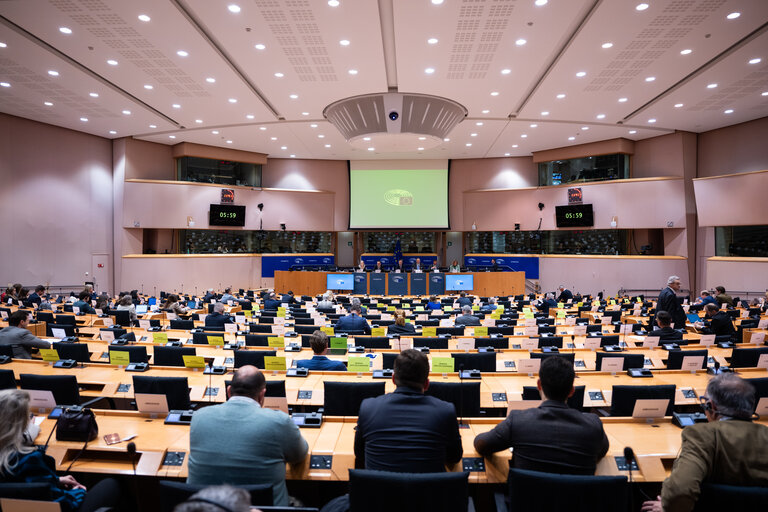
BRUSSELS – “EU enlargement is a strategic response to the evolving geopolitical reality and a vital investment in the Union’s security and stability”, notes the Committee on Foreign Affairs (AFET) of the European Parliament, in a Report adopted on 28 January, by 44 votes in favour and 11 against, with 8 abstentions. MEPs underline that the cost of non-enlargement “would exceed that of accession, risking the creation of geopolitical grey zones vulnerable to malign influence”.
The Report welcomes recent progress in the enlargement process, noting that several candidate countries have already set ambitious objectives for concluding negotiations. This should be encouraged when matched by tangible reforms, say MEPs calling on the European Council to match this momentum and remove obstacles on the EU’s side.
Reaffirming that the EU accession must remain merit-based and reversible, and that no country should be treated as part of a package, the Report stresses that there can be no shortcuts on EU values and fundamental principles. The rule of law, democratic reform, media freedom, minority rights, judicial independence and the fight against corruption must remain at the forefront of enlargement, alongside sustained support for civil society.
In addition, AFET highlights that alignment with the EU’s common foreign and security policy (CFSP) is a key indicator of a candidate country’s geostrategic orientation. MEPs note that the most worrying democracy backsliding is happening in the enlargement countries with the lowest CFSP alignment, and in countries whose EU accession process has effectively come to a standstill.
MEPs also call for strengthened monitoring of the implementation of reforms in the candidate countries under the “Fundamentals cluster”, plus reinforced support for pro-EU democracy civil society actors who are committed to reforms and European values, as well for “adequate pre-accession funding under the new multiannual financial framework and deeper cooperation on infrastructure, security, resilience and countering foreign information manipulation”.
According to the Rapporteur Petras Auštrevičius, a Member of the Renew Europe group in the EP, “the Report identifies EU enlargement as a geopolitical priority, as a more unified Europe strengthens the Union’s global influence”.
”To achieve this, the EU must streamline the accession process by addressing political blockages, particularly those relating to the intermediate steps such as the opening and closing of negotiation clusters and chapters. Our proposed solution is the increased use of qualified majority voting. At the same time, candidate countries must implement the required reforms consistently, as EU membership can only be secured through a strictly merit-based process”, Auštrevičius stated.