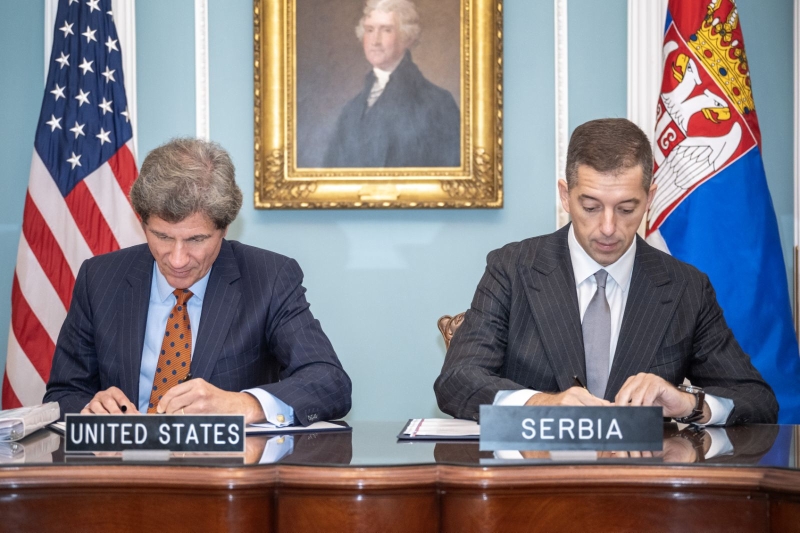
U.S. commitment to the Western Balkans has looked shaky under the second Trump administration. Washington has been vocal about pulling back its security commitments and shifting more responsibility to Europe, diplomatic posts remain unfilled, and the administration has drawn criticism for its uneven responses to illiberal actors in the region.
Despite this, U.S. investment in Western Balkan energy and infrastructure projects has held steady – and grown more strategic. What began as emergency aid to rehabilitate the sector after the wars of the 1990s has evolved into a concerted effort to strengthen energy security, deepen integration with European markets, and reduce reliance on Russia, a policy position now embedded in legislation.
Today, the U.S. government and private companies are channeling that commitment into concrete projects, spanning transport infrastructure, gas pipelines, and energy diversification. This activity underscores the region’s strategic importance to the U.S. security policy, analysts say.
But implementation of these projects has also raised questions about the broader challenges of delivering large-scale infrastructure in a region still grappling with limited state capacity, illiberal governance, and weak institutional oversight.
Relief to reform
Early U.S. involvement in the Western Balkans’ energy sector took the form of emergency aid and providing support to help meet humanitarian needs and providing fuel and electricity to stabilize basic services.
That assistance evolved into longer-term efforts to rehabilitate and regulate Western Balkan energy systems, with the goal of integrating the region’s energy markets with the European Union’s in line with the Energy Community Treaty. U.S. agencies such as the U.S. Agency for International Development (USAID), alongside European institutions and international financial organizations, was a central actor in implementing these reforms.
These efforts continued into the 2020s, with a growing emphasis on supporting regional integration, energy security, and supply diversification. In 2021, USAID launched its Energy Sustainability Activity program in Kosovo, an initiative designed to improve grid reliability, strengthen local institutions’ capacity to manage energy systems, and expand renewable energy investment.
In 2023, USAID and Greece signed a memorandum of understanding to deepen energy cooperation and integrate electricity markets across Greece, Albania, North Macedonia, and Kosovo.
The following year, USAID launched the Energy Policy Activity in Bosnia and Herzegovina, supporting market integration, clean energy investment, and development of the Southern Interconnection gas pipeline to reduce the country’s dependence on Russian supply.
This trajectory of U.S. investment was abruptly disrupted in early 2025. When Donald Trump returned to office, one of his first moves was to shut down USAID, which was critical to funding and implementing these projects. While some programs were folded into other parts of the government, the agency’s closure led to the cancellation or suspension of an estimated 83 percent of aid contracts, including many of those active in the Western Balkans.
The geopolitical stakes
While the shuttering of USAID has signaled a retreat from foreign assistance, investing in the region’s energy systems appears to remain a geopolitical and security priority for this administration.
Russia’s annexation of Crimea in 2014 forced Europe to confront its dependence on Russian-controlled pipelines and the leverage that afforded Moscow, prompting a push to diversify energy sources and routes. The 2022 full-scale invasion brought those concerns to a head, further spurring efforts to reshape trade routes and energy partnerships across the continent. Reducing reliance on Russian energy has since become an explicit priority for both Washington and Brussels.
The Western Balkans sit squarely within this landscape given the region’s unique position at the intersection of EU and U.S. interests and Russian and Chinese influence, and recent U.S. legislation reflects this reality, analysts say.
In late 2025, Congress passed the Western Balkans Prosperity Act as part of the 2026 National Defense Authorization Act. This legislation positions energy cooperation as a key pillar of U.S. policy toward the region, with a stated objective of expanding regional economic integration and reducing dependence on Russia.
Doing so signals that Washington views energy security in the Western Balkans as a matter of U.S. national security as well, wrote David J. Kostelancik for the Center for European Policy Analysis.
“Congress recognized a basic reality: countries that lack control over their energy are easier to pressure, manipulate, and destabilize,” Kostelancik wrote.
Commercial interests, strategic ends
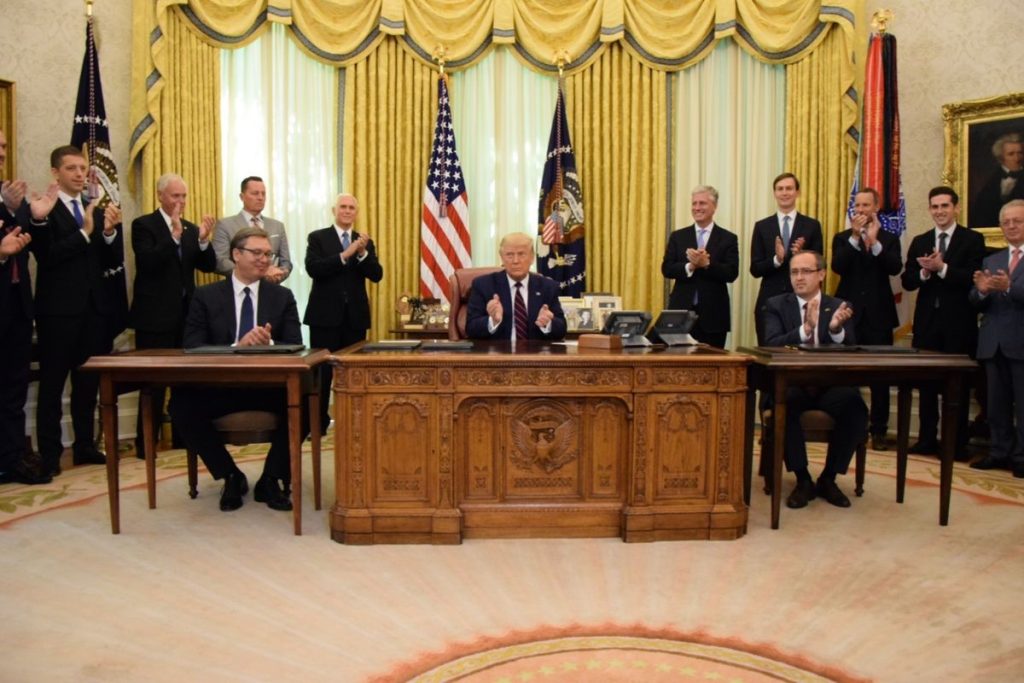
Recent U.S. engagement in the region has tracked with these policy priorities. In February, the U.S. The Department of Energy convened representatives from 12 countries, including Croatia, Serbia, Bosnia and Herzegovina, and Greece, to sign a joint statement committing to expanding energy cooperation and reducing dependence on Russian gas.
The agreement also aimed to facilitate U.S. liquefied natural gas (LNG) supplies to the region, which currently account for more than two-thirds of imports through Croatia’s Krk terminal.
Private American companies are also carrying out projects aligned with these strategic priorities. Their involvement is particularly visible in the development of regional transport corridors, infrastructure that analysts at the Pupin Initiative explain are the connective tissue between EU and Eurasian markets. By connecting to these corridors, Western Balkan countries become integrated into crucial global supply chains and trade networks, analysts say.
One such corridor is Corridor VIII. Part of the broader Pan-European Transport Network, the corridor would connect the Adriatic and Black Seas through Albania, North Macedonia, and Bulgaria, facilitating energy transport, trade, and military mobility while reducing reliance on Russian-controlled routes. In February, NATO officially designated it as part of the alliance’s critical military infrastructure.
Bechtel, a Virginia-based construction giant, is a central player in its development. In partnership with Turkish construction company ENKA, the American firm is building segments of the Corridor VIII motorway in North Macedonia, as well as a section of Corridor Xd, part of the Pan-European corridor connecting Austria, Hungary, Slovenia, Croatia, Serbia, Bulgaria, North Macedonia, and Greece. In Serbia, Bechtel is also developing the Morava Motorway.
Bechtel executive Justin Siberell was direct about the alignment between the company’s work and Washington’s goals: Corridors VIII and Xd, he said at a February panel hosted by the Atlantic Council, respond to the U.S. government’s desire to enable economic development and European integration in the Western Balkans.
This convergence of policy and private sector activity is reflected in other ongoing infrastructure projects in the region. In Bosnia and Herzegovina, where dependence on Russian gas remains high, the government recently moved to advance the Southern Interconnection pipeline project by proposing to award construction to AAFS Infrastructure and Energy, an American company. The pipeline would connect BiH to Croatia’s gas network and the LNG terminal on the island of Krk, providing access to non-Russian supply.
The contract was awarded following talks between the U.S. and BiH governments, during which it was agreed that the pipeline’s development would be led by an American firm – a decision that drew scrutiny for bypassing the process of open competitive bidding. U.S. officials publicly welcomed the move, while figures linked to Trump’s political circle traveled to Bosnia and Herzegovina in January to discuss the project on behalf of AAFS, framing it as a step toward strengthening energy security and reducing regional dependence on Russian gas.
Bespoke agreements and the governance problem
These U.S.-linked investments are not without controversy. Projects involving American companies have become flashpoints in broader debates about governance and transparency in the Balkans, with major energy and infrastructure deals dogged by concerns over opaque contracting and corruption.
One prominent example is the proposed Skavica hydropower dam in Albania’s Drin Valley. The project is intended to reduce the country’s reliance on imported electricity, expand renewable energy capacity, and stabilize supply amid increasing climate variability. A contract to carry out site investigations, construct access roads, and assess environmental and social impact was awarded to Bechtel in 2021, following the passage of a special law that named Bechtel as the contractor.
The project has drawn criticism on two fronts. Residents of the Drin Valley and environmental groups have raised concerns about the negative impacts the dam would have on local ecosystems and communities. But the special law enabling the project has also proven contentious, with analysts and watchdogs warning that the special law opens up the possibility of corruption. If the deal for the project has already been arranged, “then the environmental impact assessment is bound to come up with the ‘right’ answer, irrespective of its actual findings,” watchdog CEE Bankwatch Network writes.
Observers also argue that bypassing competitive bidding sidelines competition and increases the risk of inflated construction costs, as tenders require bidders to offer a fixed price for the work. “Bechtel’s selection without a tender practically guarantees that the dam would be overpriced,” said Andrey Ralev, who noted that as of November 2025, construction costs had risen to over $1.5 billion.
In 2023, the Albanian Helsinki Committee and environmental activists brought a complaint against the special law before Albania’s Constitutional Court. Though the court found it unconstitutional for failing to properly consult the public, it stopped short of repealing the law, ruling that the violations could be remedied through future public involvement.
Similar concerns have surfaced in Serbia. The Morava Motorway project, also led by Bechtel, drew scrutiny because Bechtel-ENKA was the sole bidder, selected through a “strategic partner” process rather than open competition. BIRN reporting has highlighted limited public access to information about the project and its rising cost, which has climbed to over 1.6 billion euros in loans, double the original estimate.
These concerns reflect long-standing conditions in infrastructure and public procurement in the Western Balkans, characterized by limited transparency and the use of executive discretion. Since the conflicts of the 1990s, many states in the region continue to grapple with patronage-based political systems. In this environment, tailor-made legislation has become a recurring feature of major investments, as well as a source of concern as these countries pursue democratic reforms and EU integration.
Transparency International warns that such laws have functioned as instruments of state capture in the Balkans, “created to serve only the interests of particular individuals, groups or companies, often at the cost of others, including the public.”
As U.S. engagement in the Western Balkans continues to expand, it remains entangled with familiar structural realities. Investment may be growing, but its outcomes are still shaped by governance environments where transparency is uneven and institutional capacity lags behind ambition.