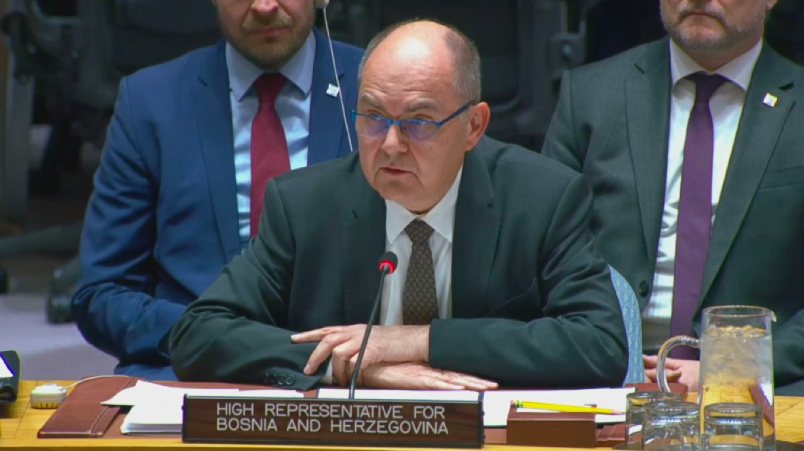
NEW YORK – Outgoing High Representative in Bosnia and Herzegovina Christian Schmidt said yesterday at the session of the United Nations Security Council that he will step down from the position in June. The debate on the situation in BiH was also marked by signals that the powers of the Office of the High Representative (OHR) could be reduced.
In his final address before the Security Council, Schmidt said the process of selecting his successor had already been launched and would be discussed at the next meeting of the Peace Implementation Council in June.
He assessed that Bosnia and Herzegovina was “at a crossroads between stability and stagnation”, warning that political blockages and the erosion of institutions posed the greatest threat to the functioning of the state.
According to Schmidt, the key priorities in the coming period are preserving institutions in line with the Dayton Peace Agreement, restoring the full functionality of state bodies, resolving the issue of state property, and introducing election technologies ahead of the 2026 general elections.
In the report, covering the period from 16 October 2025 to 15 April 2026, Christian Schmidt warned that disagreements over the Dayton Peace Agreement continue to affect BiH institutions and are “gradually leading to their deconstruction”.
Schmidt stated that the leadership of Bosnia and Herzegovina’s entity Republika Srpska continues to challenge the territorial integrity of Bosnia and Herzegovina, accompanied by “increasing confrontational political rhetoric”, which, according to the report, openly targets Bosniaks on ethnic and religious grounds.
He added that the paralysis of state institutions is being used as an argument for the devolution of competencies to lower levels of government and to support claims that BiH is not a viable states.
He particularly highlighted the refusal of the Republika Srpska authorities to appoint judges to the Constitutional Court of BiH, as well as their rejection of the court’s decisions.
Deputy US Ambassador the UN Tammy Bruce said that the new High Representative would have significantly fewer powers and would be tasked with transferring responsibility to domestic political actors, N1 reported.
Stating that BiH was gradually approaching the end of the period of international supervision, she said Schmidt’s departure in June would mark “the end of an era”.
“The OHR was never intended to be a permanent institution, and the success of the High Representative means leaving a significantly smaller scope of responsibility to his successor”, Bruce added.
Russian Ambassador to the UN Vasily Nebenzya called for an immediate abolition of the OHR, describing the institution as “privatized” and the main source of instability in Bosnia and Herzegovina.
He reiterated Moscow’s position that Schmidt had not be legally appointed because his nomination was never confirmed by the UNSC. He accused Western countries, primarily Germany, the United Kingdom and France, of interfering in the internal affairs of Bosnia and Herzegovina and argued that the Dayton Peace Agreement was being used as a tool of political manipulation.
China’s Deputy Permanent Representative to the UN Sun Lei reiterated Beijing’s position that Schmidt had not been confirmed by the UNSC and stated that the future of Bosnia and Herzegovina must remain in the hands of its peoples.
He stressed that China supports the sovereignty and territorial integrity of Bosnia and Herzegovina, as well as the principle of non-interference in the internal affairs of states.