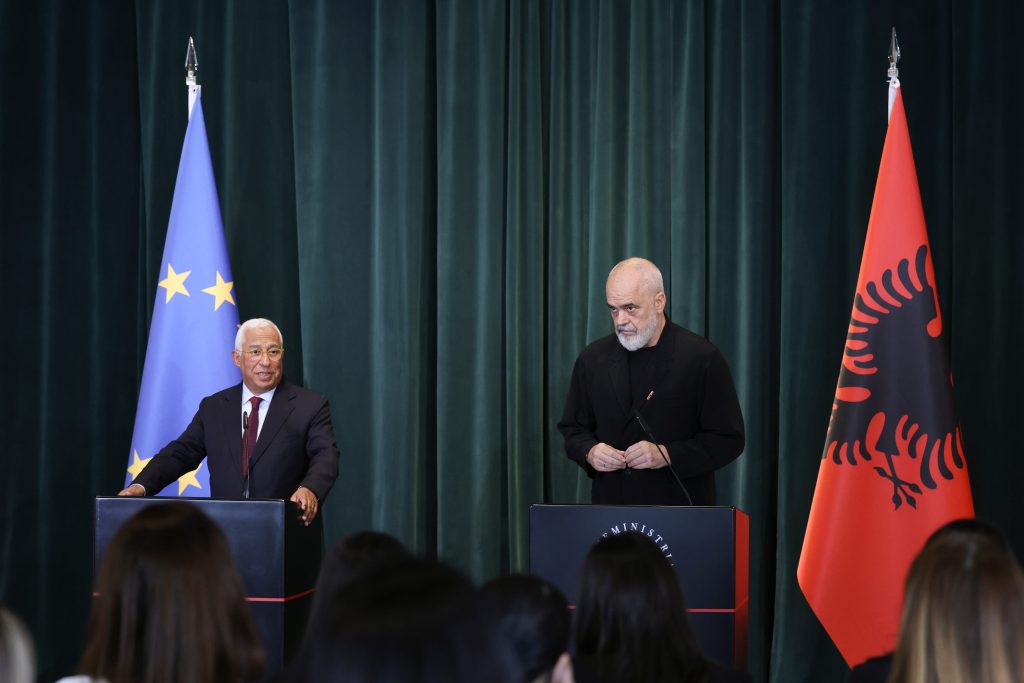
TIRANA / SKOPJE – European Council President António Costa visited Tirana and Skopje on Tuesday as part of his regional tour ahead of the EU-Western Balkans Summit, which will be held in Tivat on Friday.
Following a meeting with Albanian Prime Minister Edi Rama, Costa said that the EU enlargement is both an opportunity and a geostrategic necessity for Europe at a time of global geopolitical uncertainty and economic instability.
He said the summit in Tivat would be a clear sign of the EU’s determination to advance cooperation with the countries of the region and make use of the momentum in the enlargement process.
European Council President welcomed Albania’s determination and efforts to move forward in the European integration process, after the country received IBAR.
“This is a clear recognition by the member states of Albania’s commitment to further progress on its path towards EU membership, but it also marks the beginning of a demanding next phase in the process, focused on implementation”, he said.
Costa added that reforms are important for building strong democratic institutions in Albania, while continued and tangible political commitment to the rule of law and the protection of an independent and accountable judiciary are essential foundations for EU membership.
“I encourage you to step up efforts in the fight against corruption and organized crime. The EU remains the most reliable partner of the Western Balkans and Albania, its main investor and trading partner”, Costa said.
Prime Minister Rama said that it is the country’s duty to carry out all reforms necessary for membership in the EU, not only for the sake of integration, but also to strengthen independent institutions and improve the functioning of the state.
“We have tasks that we must fulfil, not because of Brussels, but to improve Albania’s independent institutions”, Rama said at a joint press conference, adding that the integration process is complex and accompanied by challenges.
Rama said he fully agreed with Costa on the necessary steps, including the closing of negotiating chapters and the strengthening of regional cooperation, describing the process as clear and without obstacles in the positions of the two sides.
Asked by journalists about the SPAK investigation, namely the review of property ownership in the Zvernec area, where a tourist resort is planned to be built by a company owned by the US president’s son-in-law, Jared Kushner, Rama stressed that any investigation into the transparency of ownership and financial resources is welcome, especially when it concerns major investments and projects with a public impact.
North Macedonia: Constitutional amendments remain the key roadblock
Later on Tuesday, António Costa travelled to Skopje, North Macedonia, where he met with the country’s Prime Minister Hristijan Mickoski.
In a joint press conference with Mickoski, Costa welcomed some of the recent reforms, including the adoption of roadmaps for rule of law and public administration reforms. However, he reiterated the EU’s position that adopting the agreed constitutional amendments agreed with Bulgaria in 2022 remains the necessary next step towards formally starting the accession negotiations.
“We are committed to supporting you further – both politically and financially. But ultimately, the power to shape your future is in your hands. The only way to make progress towards European integration is to engage in a constructive dialogue with your neighbours, take pragmatic steps to build trust and carry out the necessary reforms”, Costa said.
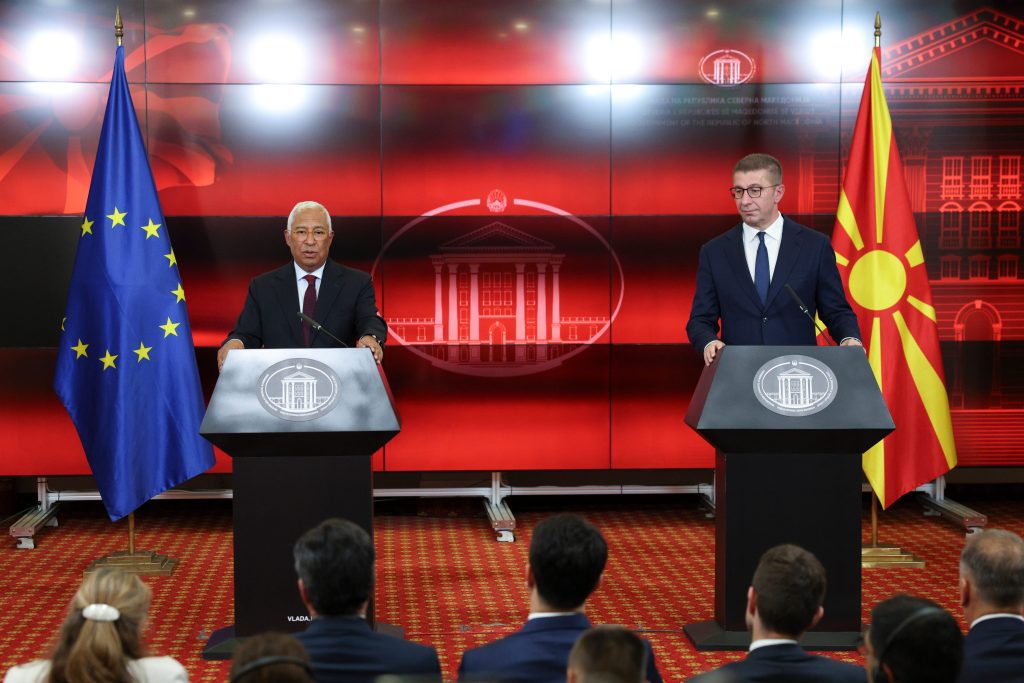
In his remarks, Prime Minister Mickoski stated that the country remains firmly committed to the European path, but that this requires “greater certainty, greater leadership, clarity and trust from the EU”, Telma reports.
After he became Prime Minister in 2024, Mickoski took the position that the constitutional reform would be implemented only after the EU provides guarantees that there would be no further bilateral conditioning on its EU path.
“We are not looking for privileges, we are not looking for relaxed rules, we are not looking for something that does not belong to others, we are looking for principles and a normal, credible and predictable process. We are looking for a process in which reforms, work, merit and fulfilled obligations will be truly valued,” said Mickoski.