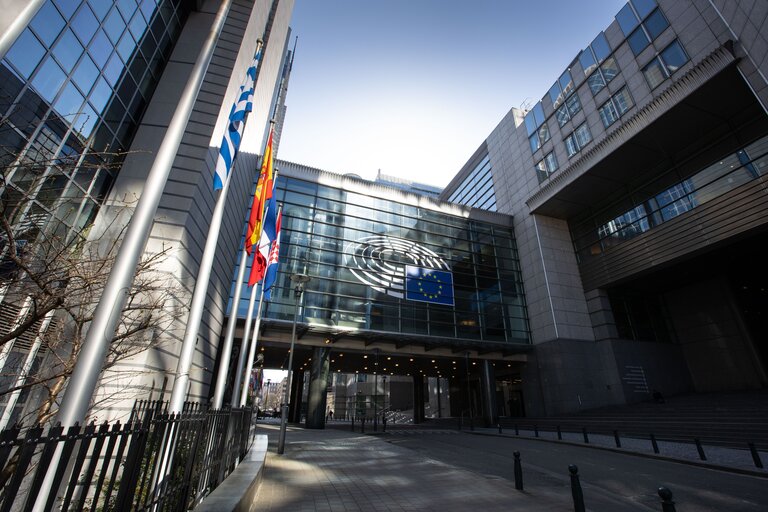
BRUSSELS – A merit-based process should remain at the core of EU enlargement, as there are many challenges in keeping this process fair and predictable, stated the speakers at a public hearing called “Western Balkans’ frontrunners: Lessons learnt from Albania and Montenegro and sustaining the enlargement process”, which was held today in the Committee on Foreign Affairs (AFET) of the European Parliament.
Experts on EU enlargement stressed that the EU institutions should remain focused towards proving full membership for the candidates which meet the criteria, as it is the only way to sustain the reform momentum, particularly in the two Western Balkan countries which are well advanced on the EU path.
According to Matteo Bonomi, Head of Europe Programme at the Instituto Affari Internazionali (IAI), the European Union has always combined geopolitical with merit-based enlargement, and there is a strong commitment among the population in Montenegro and Albania towards EU membership.
Bonomi noted that these countries have great technical ability to meet the accession criteria, but “establishing fully functional institutions is a much more difficult story and probably requires much more time“, whereas “if we look at the broader region, the picture is less rosy“.
He stressed that “a gradual integration cannot be a substitute for full EU membership“, and that the European Parliament also has an important role to play in preparing the EU for the enlargement.
Krisela Hackaj, Executive Director of the Cooperation and Development Institute, Albania, reminded that Montenegro has advanced furthest in opening and closing EU accession chapters, while Albania has accelerated its progress by opening all negotiating chapters and provisionally closed three of them.
She remarked that 2026 is a very dynamic year for EU enlargement, adding that the experience shows that “the accession process works if the prospect for EU membership is credible”.
In the opinion of Hackaj, enlargement is “fundamentally a long-term process of state and social transformation”, which also has to do with the implementation of deep economic reforms, i.e. the implementation of the European standards which would significantly improve the lives of the citizens.
Jovana Marović, an expert on EU-Montenegro relations, stated that, among other things, the European Union should present EU membership as a strategic investment, underling that that Montenegro is a country which has been “really delivering” in the accession process.
According to her, the country is facing hybrid threats as some states would not like to see Montenegro in the Union.
Marović remarked that “all the eyes are on Montenegro”, and that the EU should not introduce a so-called “second-rate membership”, or lower the accession standards, but design an accession treaty as a dynamic development and enforcement tool.
“The EU institutions, including the European Parliament, should send a message that only full membership is on the table, as any other option would mean a failure of the EU enlargement“, she concluded.