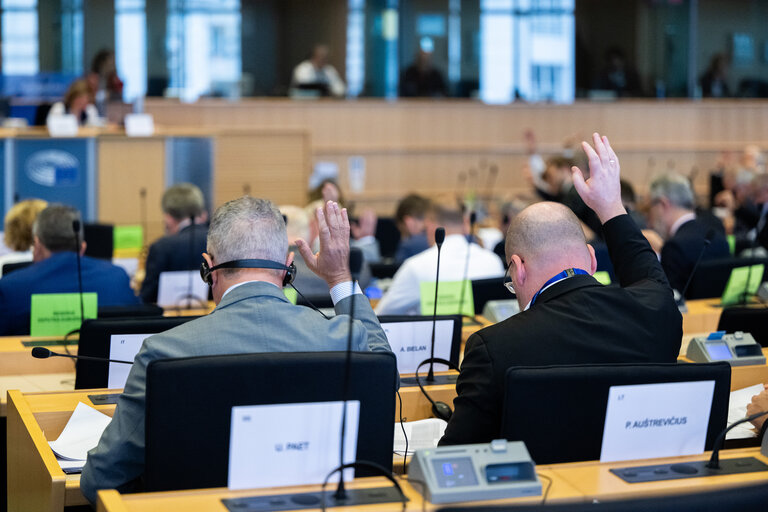
BRUSSELS – The European Parliament Committee on Foreign Affairs (AFET) adopted today reports on four Western Balkan countries – Serbia, Kosovo, Bosnia and Herzegovina and North Macedonia. The reports will now be tabled for a vote in the European Parliament as a whole.
The reports support the EU membership ambitions of the candidate and potential candidate countries, but also point out the ongoing challenges, including backsliding in Serbia, stagnation on the rule of law in North Macedonia and political deadlock in Kosovo and BiH.
The reports on Montenegro and Albania were adopted in May.
Serbia: Concerns about an “appeasing approach” by the Commission
In a report drafted by Tonino Picula (S&D), MEPs from the Committee on Foreign Affairs identify a persistent gap between Serbia’s legislative alignment with EU rules and the effective implementation of reforms. This, they say, continues to undermine Serbia’s progress towards EU membership.
According to AFET’s press release, MEPs argue that Serbia’s EU accession negotiations should only advance on the basis of measurable and sustainable progress in the rule of law, free and fair elections, the fight against corruption and organised crime, judicial independence, media freedom, public administration reform, and the improved functioning of democratic institutions.
Concerned about its “appeasing approach” towards Serbia, MEPs want the Commission to reflect any significant regression in the pace and intensity of reforms in Serbia in the financial support the EU provides under its pre-accession funding instruments.
They also say that constructive engagement in the normalisation of relations with Kosovo is a condition for support under the reform and growth plan.
MEPs deplore Serbia’s close ties with Russia, which raise concerns about the country’s strategic orientation. They stress that full alignment with the EU’s common foreign and security policy (CFSP) remains a non-negotiable requirement for accession, including alignment with the EU’s restrictive measures against Russia.
Expressing concern over the deepening political crisis in Serbia against the backdrop of the mass protests taking place across the country since November 2024, MEPs say that the best way to resolve the crisis is to hold genuinely free and fair elections.
Kosovo: Further delays of reforms risk the loss of significant EU funding
The report on Kosovo states that 2025 must be considered a “lost year” for Kosovo, as neither a functioning legislature nor a government could be established after the February 2025 elections.
On the other hand, MEPs also welcome the ratification of the agreements under the reform and growth facility on 13 February 2026, paving the way for substantial EU financial support for advancing reforms and accelerating economic convergence. At the same time, they warn that possible further delays risk undermining reform delivery and could lead to the loss of significant EU funding.
In a report drafted by Riho Terras (EPP), MEPs say Kosovo needs to accelerate the adoption and implementation of EU-related reforms, particularly in the areas of rule of law, fundamental freedoms, and the fight against corruption, especially high-level corruption. While welcoming the generally favourable environment for civil society organisations, MEPs are concerned about the limited progress in fighting organised crime.
MEPs reiterate their support for Kosovo’s EU membership application and call on the Council to grant candidate status once the criteria are fulfilled. They also urge the five EU member states that have not recognised Kosovo to do so without delay.
The AFET press release states that the normalisation of relations with Serbia and the implementation of the Brussels and Ohrid agreements remain essential for Kosovo’s European path.
Bosnia and Herzegovina: Support for OHR, regret due to perennial political divisions
The report on Bosnia and Herzegovina, drafted by Ondřej Kolář (EPP), urges political leaders to renew their commitment to EU membership and implement long-overdue reforms without delay. MEPs stress that accession efforts should strengthen political cohesion rather than deepen divisions. They also call for an end to obstructionism, politically motivated vetoes and divisive rhetoric, which hinder progress, and urges the Council of Ministers to appoint a chief negotiator for the EU accession talks.
The MEPs regret the perennial political divisions, hate speech, genocide denial, glorification of war criminals, secessionist efforts and state capture, warning that these trends undermine public trust, accelerate the brain drain and paralyse the country.
The report denounces ongoing engagement between Republika Srpska authorities and Russian officials and sanctioned entities, highlighting the risks to Bosnia and Herzegovina’s security and stability. MEPs also express concern over foreign interference and disinformation campaigns, particularly from Russia and Serbia, as well as the growing influence of other external actors.
Expressing regret at the resignation of High Representative Christian Schmidt, the MEPs reiterate their support for the Office of the High Representative and EUFOR Operation Althea, recognising their continued role in preserving peace and stability. The MEPs stress that any future transition regarding the Office of the High Representative must fully respect the country’s constitutional order, sovereignty and territorial integrity.
North Macedonia: Lack of progress since the last report
In the report on North Macedonia, MEPs stated they regret the lack of progress since the last report and stress that renewed political commitment and cross-party cooperation are urgently needed, not least to adopt the necessary constitutional amendments that would allow the opening of the first negotiation cluster, the AFET press release states.
While the country’s democratic institutions continue to function satisfactorily, political polarisation is ongoing and continues to delay key reforms and appointments, says the report drafted by Thomas Waitz (Greens/EFA).
The MEPs urge all political parties to move beyond heated rhetoric and cooperate on advancing the country’s European trajectory. They also note that comprehensive electoral reform is overdue.
Expressing concern over insufficient progress on judicial independence and anti-corruption efforts, the MEPs warn that corruption remains prevalent across many areas and point to the gap between investigations announced and final convictions in high-level corruption cases. They underline that sustainable economic growth depends on strengthening the rule of law and judicial predictability.
At the same time, they commend North Macedonia’s strong alignment with the EU’s foreign, security and defence policy.