On July 14, the United States entered strategic dialogue with Serbia for the first time. This decision initiates a major program of economic cooperation and investment in areas such as energy, infrastructure and business. Furthermore, the shift is representative of the general priorities of the second Trump administration.
Since January 2025, this administration has introduced a markedly different foreign policy approach for Serbia and the rest of the Western Balkans than the Biden administration and those before it. The focus has shifted to prioritizing economic partnerships, where the previous stance had been collaboration conditional on Serbia’s democratization, improvement of human rights issues, and crucially recognition of the independence of Kosovo.
Such US policies are worrying in a country where democratic backsliding and human rights abuses are powerful and intensifying forces. The current government of Serbia, led by Aleksandar Vučić and the Serbian Progressive Party (SNS) has increasingly disregarded human rights and plunged the country into authoritarianism over the course of 14 years of power.
Notably, the SNS has captured nearly all government institutions and independent media, glorified war criminals from the 90s wars, intensified nationalist rhetoric while discriminating against ethnic minorities, allowed corruption and organized crime to become heavily intertwined with government activities and officials, antagonized NGOs and any critics of the SNS, and engaged in widespread pollution and hazardous mining activities.
Most recently, when widespread student protests emerged after the collapse of a poorly reconstructed train-station canopy in Novi Sad in November 2024, resulting in the death of 16 people, the government imposed overwhelming violence, imprisonment, and exile toward the protestors.
The Trump administration, which came to office just three months after the canopy collapse and the beginning of the protests, is in a powerful position to sway the future of human rights and democracy in Serbia. A policy focused on economic cooperation without human rights conditionality is not the right path forward.
Nevertheless, this report demonstrates that while the Trump administration has undoubtedly introduced a foreign policy that further endangers human rights in Serbia than the policies previous administrations, the policy is also largely a continuation and intensification of the policy trends of previous administrations which increasingly failed to actually prioritize human rights over collaboration despite claiming to do so.
US foreign policy has had a strong involvement with Serbia ever since America ended the Kosovo War with the NATO bombing of Serbia in 1999. In 2000, the Democratic Opposition of Serbia (DOS), with large financial and tactical support from the US, ousted Slobodan Milošević from power, and the future of Serbian democracy and human rights seemed very optimistic.
During the 2000s, US policy in Serbia was directed towards helping Serbia achieve the democratic and political reforms necessary to join the European Union. Indeed, between 2001 and 2017, the United States sent almost $800 million to Serbia to aid in strengthening rule of law, justice systems, anti-corruption efforts, and economic development. Furthermore, the US has always maintained the stance that Serbia should recognize Kosovo’s independence—a policy which both supports a US ally and pushes back against extreme nationalism.
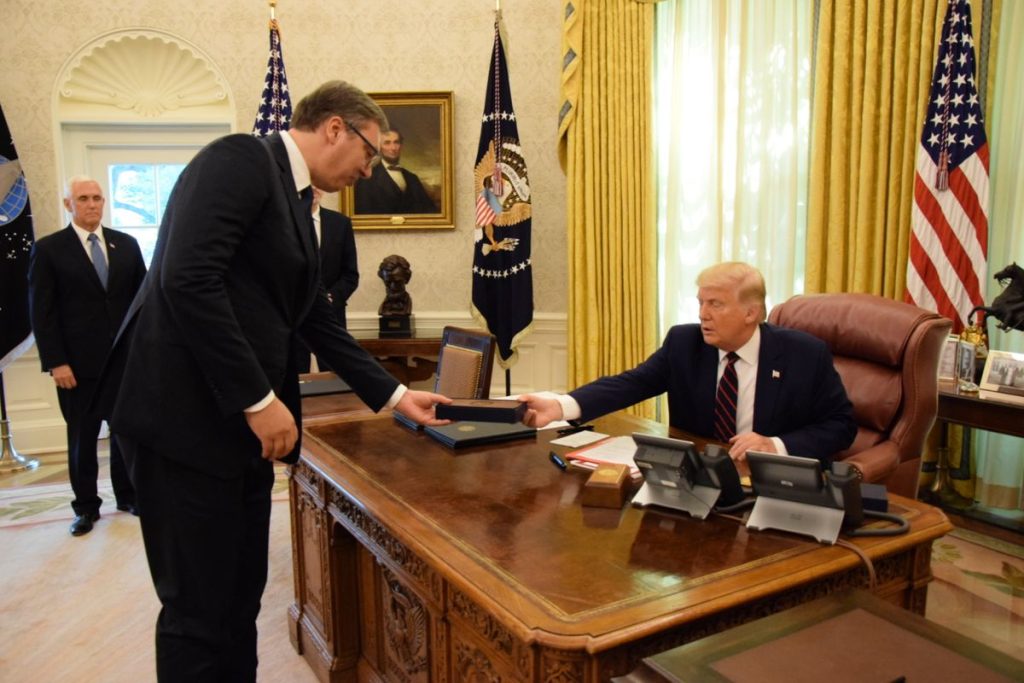
The SNS coming to power in 2012 was a threat to US democratization efforts, but the US continued to proceed with pragmatic cooperation and aid. In 2016, US and Serbian relations intensified, when Vučić canceled a planned trip to the US after a Serbian newspaper accused the US ambassador of rousing opposition to Vučić. However, relations soon smoothed over, when Serbia agreed to relocate two Guantanamo Bay inmates to Serbia and when Vucic traveled to the White House in 2017.
While the first Trump showed blueprints of the second, strategic cooperation was more narrow (focused on economic normalization between Serbia and Kosovo), and the status quo foreign policy approach largely continued. Up until 2025, as demonstrated by the 2021 “US Relations with Serbia” State Department page, the US stance in Serbia continued to be a push for human rights accountability alongside an agenda of nation-building and advancing EU candidacy.
The policy approach of the current Trump administration in Serbia seems to largely upend precedent. The approach for the Western Balkans as a whole is outlined in the “Report to Congress on United States Policy to Promote Regional Stability and Prosperity in the Western Balkans” from May 2026. In the second paragraph, the report makes clear the overall shift in priorities: “The U.S.-led nation-building era has passed. U.S. policy in the Western Balkans is not about rescue or reconstruction, but stability and mutually beneficial partnerships.” In other words, fostering functioning democracy and institutions has been replaced as a priority by strategic economic gain.
The report claims that the US will go about this new policy by encouraging local business efforts, reducing regulations, and involving US companies in a way that would be mutually beneficial to the people of the Balkans and the US. However, there is a serious worry that these partnerships will exploit the Balkans in a way that heavily benefits the US disproportionately.
Furthermore, the report underscores the vitality of further drawing Serbia away from Russia and China, and the need to eliminate the region’s energy dependence on Russia and dissipate the influence of Chinese soft power. All of these policies necessitate increasing US proximity to the ruling powers in the Balkans, and thus decreasing opposition to human rights abuses.
The actions that Trump has taken towards Serbia advance the goals of this report. Most notably, Trump has heavily pushed for the removal of Russian gas from Serbia. In January 2025, the US sanctioned NIS (the biggest gas company in Serbia), which is controlled by the Russian company Gazprom. Through these sanctions, Trump aims to redirect Serbian energy dependence to US run companies. On the one hand this policy would reduce Russian influence in Serbia, which could push Serbia closer to the EU.
However, this move also poses two major problems. First, US involvement with Serbian energy would mean transactional deals with the Vučić-run government, thus legitimizing the government and abandoning any framework of human-rights conditionality. Furthermore, massive non-renewable energy projects would push Serbia farther from the EU accession requirements. Human rights reform would be de-incentivized in a situation where EU accession seems farther away.
However, the shift in Trump’s foreign policy actually has deep roots in the policy of previous administrations. Despite the outward focus on human rights, the US foreign policy approach, especially during the first Trump and Biden presidencies, did not involve a real way to punish the worsening human rights abuses, beyond verbal critiques.
Meanwhile, strategic economic partnership had become a central part of US policy, and was treated as something that could occur alongside democratization instead of occurring conditionally upon democratization. Edward Joseph explains how The US and EU employed a double standard in the Balkans, where Serbian actions were often condoned or ignored, and the rest of the Balkans were held to stricter standards of accountability. Despite its official stances, the US has repeatedly dismissed the complaints of activists and urged them to comply with the government.
Furthermore, the US has introduced sanctions against other regional autocrats—such as the Bosnian Serb leader Milorad Dodik in 2017 and 2022–they have never sanctioned Vučić or the SNS. Despite publishing lengthy yearly reports on human rights in Serbia and funding NGOs through USAID, this failure to concretely punish Vučić’s regime sends the message to Vučić that authoritarianism can continue.
It is not hard to see why the US has continued with such relaxed measures. First of all, it is difficult to compel Serbia to recognize Kosovo when five EU countries do not recognize it themselves, and when EU candidacy is one of the main forces pushing Serbia towards democracy. Furthermore, Vučić has spent his presidency carefully balancing Serbia between the West, Russia, and China.
US administrations have repeatedly feared Serbia growing closer to Russia, and conciliatory policies aim to woo Vučić away. In doing so, the US has avoided antagonizing Serbia over domestic issues. The 2022 “Integrated Country Strategy” for Serbia repeatedly mentions the necessity of reducing Russian influence in Serbia, and just like the Trump administration, finds one of the main solutions in eliminating energy dependency. While this report calls for a shift to renewables, (Trump advocates for oil and gas), both aim to align Serbian energy with “U.S. investors.”
Finally, Serbia provides major economic opportunities as the largest economy in the Western Balkans, and the US has consistently worked to increase the influence of US firms in the region. Indeed, objective 2.3 of the “Integrated Country Strategy” is to create “a more transparent environment for U.S. firms to compete on a level playing field in the Serbian market.” While this objective is styled as an anti-corruption goal, it also demonstrates the US motive in maintaining and increasing US business involvement and investment in Serbia regardless of human-rights reform.
In this way, Trump’s current focus on economic and anti-Russian alignment is in many ways a public announcement of a previously unacknowledged trend. At the same time, there are concrete ways in which Trump’s actions do increase the threats to human rights in Serbia. First of all, simply publicizing a human rights agenda is consequential. The United Nations Development Program finds, “Better respect of human rights translates into more freedom, more prosperity, more security and more international interaction in the long term.” During previous administrations such as Biden’s, regular reports on human rights in Serbia were produced by the State Department. For example, the 2022 Country Reports on Human Rights Practices: Serbia concludes:
“Significant human rights issues included credible reports of: torture or degrading treatment at police establishments; harsh prison conditions; serious problems with the independence of the judiciary; serious restrictions on free expression and the press, including violence, threats of violence, and unjustified arrests and prosecutions against journalists; serious government corruption; lack of investigation of and accountability for gender-based violence including domestic or intimate partner violence, sexual violence, and early marriage among Romani children; trafficking in persons; and crimes, including violence, targeting lesbian, gay, bisexual, transgender, queer, and intersex individuals.”
The Trump administration has directly attacked such monitoring efforts. Human Rights Watch details that the administration downplayed and distorted human rights abuses, especially in allied governments, in the 2024 Country Reports—the organization cites El Salvador as a specific example. Such distortions affect Serbia as well, where Trump is also currying favor.
Furthermore, The 2024 Country Report on Serbia which was published in August 2025 (after Trump took office), while including lengthy sections on freedom of press, abductions, and torture, does not include a discussion of government corruption, lgbtq rights, womens rights, or domestic abuse. The 2023 report on the other hand covered all of these topics at length.
Another deeply troubling measure taken by the Trump administration is the dissolving of USAID. According to US government data, Serbia received almost $45 million of aid in 2024. About $22 million of those funds were directed towards “democracy, human rights, and governance,” while another $10 million went to “program support,” helping to fund the NGOs that fight the corruption and abuses of power conducted by the Serbian government. Removing this funding both limits the means for institutional reform within the Serbian government and also guts the power of the organizations serving as a front line of defense against ongoing human rights abuses.
US sanctions on ICC judges also impedes human rights reform in Serbia by damaging the livelihoods of the judges who have the power to hold those committing abuses accountable. Donald Trump first introduced sanctions against ICC judges in February, 2025 with Executive Order 14203, “Imposing Sanctions on the International Criminal Court. The Executive Order states that sanctions are a response to “illegitimate and baseless actions targeting America and our close ally Israel.”
A total of 11 judges and prosecutors have been sanctioned since this order, and face many restrictions, including lost access to US financial services, the freezing of US assets, and US travel bans. These sanctions weaken the power of yet another institution capable of promoting human rights in Serbia.
Finally, as another indicator of cooperation with autocratic leaders in the Western Balkans, the new Trump administration lifted sanctions against former Republika Srpska leader Milorad Dodik and 47 of his associates and related entities on October 29, 2025. The decision reversed multi-year penalties originally imposed for corruption and actions threatening the stability of Bosnia and Herzegovina.
While current US foreign policy for the most part intensifies an increasing disregard for human rights in Serbia, there are some areas in which it has the potential to improve human rights. One area of optimism is the aggressive stance against organized crime. The “Report to Congress” names organized crime groups in the Western Balkans as major threats to U.S. security and promises to “dismantle these networks wherever they operate.” Actually fighting organized crime would mean fighting the corruption that permeates the Serbian government, and thus respond to the calls of the student protesters.
However, in Serbia specifically, real efforts at undertaking this goal are not evident. Ironically, a hotel project led by Jared Kushner, the Special Envoy for Peace and son-in-law to Trump, was even recently found to be sped along by corrupt government officials. Furthermore, countering organized crime in Serbia has long been a goal of US administrations, but the presence of such activity remains incredibly strong.
Another optimistic aspect of the report is that the first listed priority is “maintaining stability.” The outbreak of another war would be detrimental to regional stability and to US economic interests, and thus the administration is invested in calming ethnic divisions and supporting the Dayton Peace Agreement and Kosovo’s independence. While these stances do not help with issues such as freedom of speech, police violence, and government corruption, they do prevent the more extreme human rights abuses that would result from another war and renewed ethnic violence.
However, upholding domestic and regional stability without strong democratic institutions is referred to negatively as stabilitocracy. One of the biggest criticisms towards foreign policy in the Balkans (specifically EU policy) has been that the EU has promoted stabilitocracy while endangering human rights and rule of law in the region. Finally, aggressive dismantling of Russian and Chinese influence could result in Serbia aligning more with EU and democratic values.
And beyond executive policies, there are signs that US politicians may want to take a heavier hand on Vučić and the SNS. Most notably, a bipartisan group of US Congress members submitted a bill on August 27 under the name of the Serbia Act. Sponsored by Republican Joe Wilson and Democrat Bill Keating, the bill aims to introduce sanctions and travel bans on those undermining the stability of the Western Balkans and territorial integrity of its states as well as those undermining democracy or contributing to corruption or human rights abuses. This bill could very well be the beginning of a shift in Washington to an agenda of real accountability for human rights abuses in Serbia.
Ultimately, the Trump administration’s foreign policy agenda is endangering human rights in Serbia and throughout the Western Balkans. However, it is not doing so in a way that is a complete aberration from the effects of the foreign policy of previous administrations. In many ways, the policy vocalizes many of the stances which had previously been present only behind the scenes: namely economic partnership without human rights conditionality.
And just as previous foreign policy has increasingly employed vocal warnings where concrete action is lacking, so does Trump seem to have failed to fight organized crime in the way his policy claims he will. At the same time, he has committed some serious steps backward, most majorly in his canceling of USAID and his refusal to monitor issues such as women’s rights, LGBTIQ+ rights, and corruption. Whether or not Trump’s policies end up decisively impeding human rights struggles in Serbia as compared to prior US policies, what is certain is that the US has consistently failed to apply sufficient standards and accountability in Serbia on human rights.
The fact that human rights protection is no longer a priority for the US administration is evidenced by the continued failure since 1999 to remind the authorities in Belgrade to punish the killers of three US citizens—the Bytyqi brothers. At the same time, Goran Radosavljević “Guri”—a retired Serbian police officer suspected of involvement in the murder, has frequently been seen alongside Serbian government officials over the past year and a half, particularly in the occupied “Pionirski Park,” which is considered a hub for violent supporters of Serbia’s ruling regime.
Views expressed in the Opinion section belong to the authors and do not necessarily reflect the views of European Western Balkans.