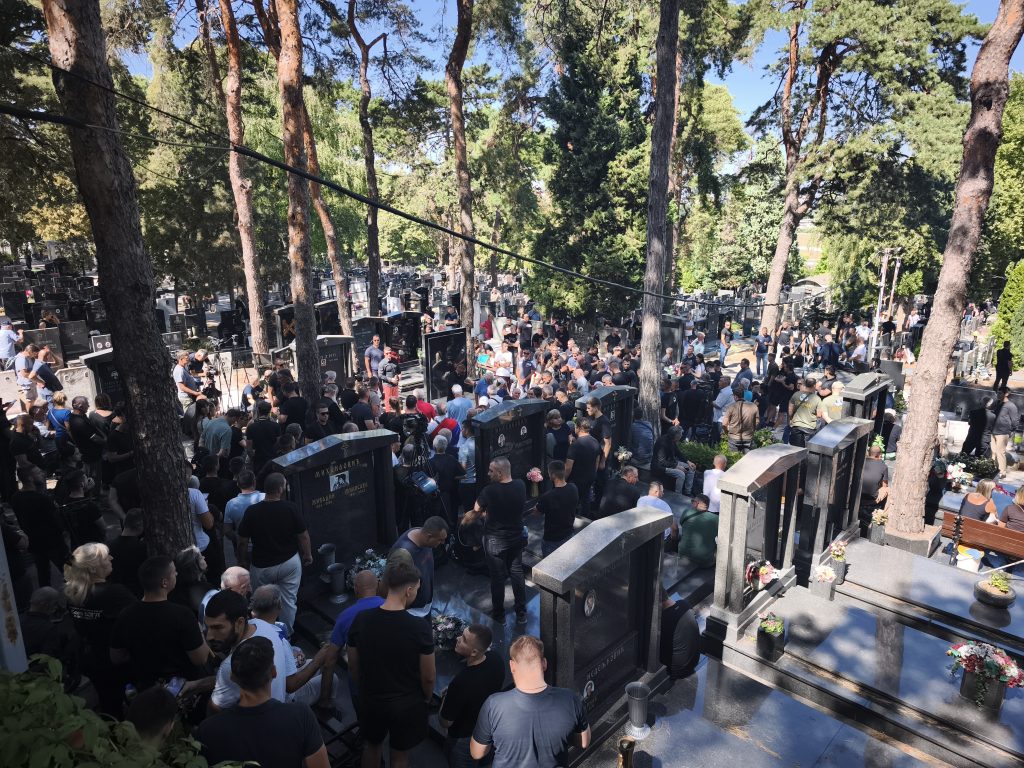
BELGRADE – Convicted war criminal Ratko Mladić was buried today at Topčider Cemetery in Belgrade, with the full military honors. The coffin was covered with the flags of Serbia and Republika Srpska, and escorted to the grave site by an honorary unit of the Serbian Army, after which honorary firing and farewell speeches were held.
The funeral service for Mladić, the wartime commander of the army of Republika Srpska, sentenced to life imprisonment by The Hague Tribunal for genocide and other war crimes during the war in Bosnia and Herzegovina, was served in the Church of St. Luke, in the presence of state officials of Serbia and Republika Srpska. The service was led by the Patriarch of the Serbian Orthodox Church Porfirije. He said in a speech that “Ratko Mladić’s name will remain deeply woven into the memory and prayers of most of the Serbian Orthodox people”.
Minister of Culture Nikola Selaković, Minister of Justice Nenad Vujić, Minister of Public Investments Darko Glišić, Minister of Defence Bratislav Gašić and Minister without portfolio Nenad Popović expressed condolences to members of Mladić’s family at the church. Funeral service was also attended by the Serb member of the Presidency of Bosnia and Herzegovina Željka Cvijanović, Prime Minister of RS Savo Minić, President of RS Siniša Karan, Speaker of National Assembly of RS Nenad Stevandić, Banja Luka Mayor Draško Stanivuković, as well as the President of the Alliance of Independent Social Democrats and former RS President Milorad Dodik.
Among the attendees were the Russian Ambassador to Belgrade Aleksandar Bocan-Kharchenko, as well as the BiH Ambassador to Serbia Aleksandar Vranješ, as well as the President of the opposition New Democratic Party of Serbia Miloš Jovanović. A large number of citizens were gathered in front of the Church of St. Luke.
The Prosecutor’s Office of BiH has received several thousand electronic messages from citizens, due to publications and comments on social networks and in the media that refer to the glorification of Ratko Mladić, it was reported by media.
Denis Džidić, Executive Director and Editor of BIRN BiH, said that the problem is not the lack of a legal framework, but the application of it.
“A large number of applications are due to the denial of genocide and glorification of convicted war criminals, but there is a very small number of indictments, whose purpose and function would be deterrent”, Džidić noted.
Mladić, as a wartime commander of the Army of RS, was convicted of genocide in Srebrenica in July 1995, for the persecution and forcible transfer of Bosniaks and Croats throughout BiH, sniping, shelling and terrorizing civilians during the siege of Sarajevo, as well as for taking UN peacekeepers hostage during the NATO bombing.
Mladić died on 27 August, in the UN special detention unit in the Hague, where he was serving a life sentence. His body was transported to Belgrade by a plane on 3 September, transferred to the Military Medical Academy, as the family asked for an autopsy.
A memorial service, attended by the officials of RS and Serbia, was held for Mladić at the Army House in Belgrade, on 5 September.