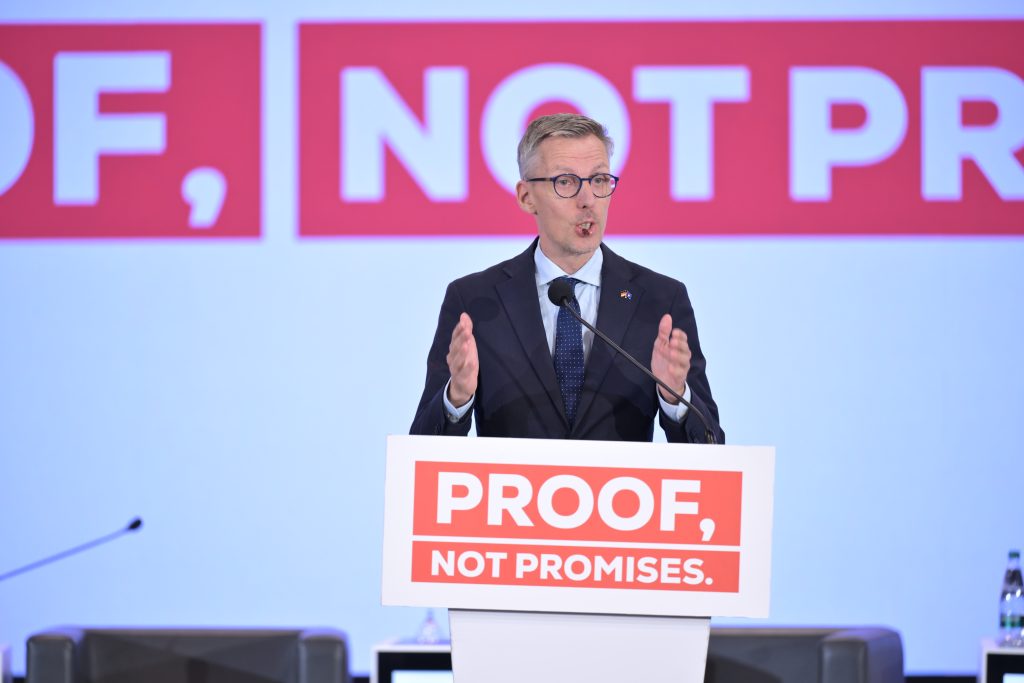
PRISTINA – At uncertain times like these in the world, there is a temptation to prirotise stability – but stability without values is weak and will eventually fail, said Lars Castellucci, German Government Commissioner for Human Rights Policy and Humanitarian Assistance, at the Civil Society Forum in Pristina.
Castellucci delivered a keynote speech at the official opening of this year’s edition of the Civil Society Forum, which has been a part of the Berlin Process since its launch in 2014.
“For the Western Balkans, the fundamentals are not boxes to be ticked, they are the essence of the EU accession progress”, Castellucci said, adding that progress on the rule of law in the region has been uneven.
He also reflected on challenges in facing the past crimes in the region, although Western Balkan leaders adopted a declaration on war crimes in 2018 in the context of the Berlin Process. In this context, Castellucci condemned the funeral of Ratko Mladić that took place in Belgrade last month with elements of state honours.
The Commissioner also said that the German government supported the Kosovo Specialist Chambers since they were founded, stressing that the first-instance verdict delivered last month against Kosovo Liberation Army (KLA) leaders was not against KLA itself or its aim of an independent Kosovo.
Castellucci concluded that there is no fast-track integration of the Western Balkans into the European Union that will bypass the rule of law.
Seizing the opportunity
In his opening remarks, Andi Dobrushi, Director of Open Society Foundations – Western Balkans, which is organising the Forum in partnership with the Kosovo government, highlighted the increased pace of EU enlargement.
“The finish line is in sight for Montenegro, and crossing it would send a signal to the entire region… Albania opened chapters at a pace that would sound like a joke three years ago”, Dobrushi said.
This still only covers two out of six countries in the Western Balkans, which is a good start, but not enough, he added.
“Whether the door of the European Union remains open depends on the voters in the 27 candidate countries”, Dobrushi said, mentioning elections in Spain in November, and in France, Poland and Italy next year.
Prime Minister of Kosovo Albin Kurti also addressed the participants of the Civil Society Forum. He assessed that Kosovo has made progress in the fundamentals of the EU accession process and expressed his view that minority rights should be a part of the Berlin Process as well.
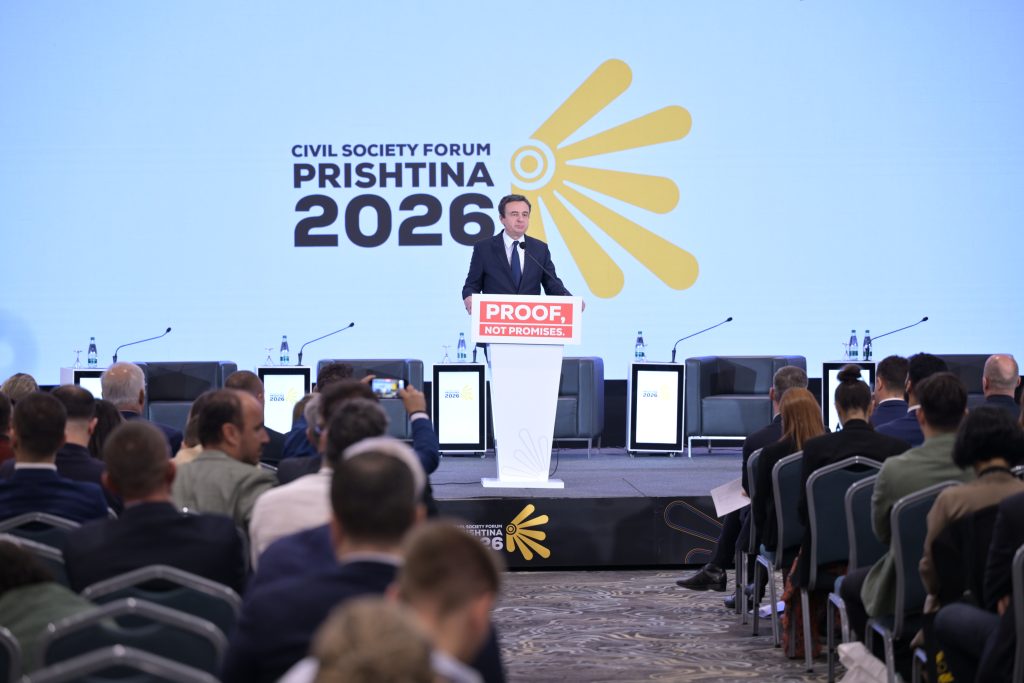
“We applied for EU membership almost four years ago and have made undeniable progress, yet Kosovo remains the only country in the region that is not a formal EU candidate. I hope this will change by the next CSF”, Kurti said.
Predrag Zenović, Chief Negotiator of the Government of Montenegro with the European Union, reiterated his country’s goal to close all negotiating chapters by the end of this year but said that Montenegro does not want to be an exception in the region.
“If Thessaloniki gave our region an EU perspective and the Berlin Process has shown that our region can keep moving and solve problems together, now in Pristina, our responsibility is to turn these commitments into reality”, he said.