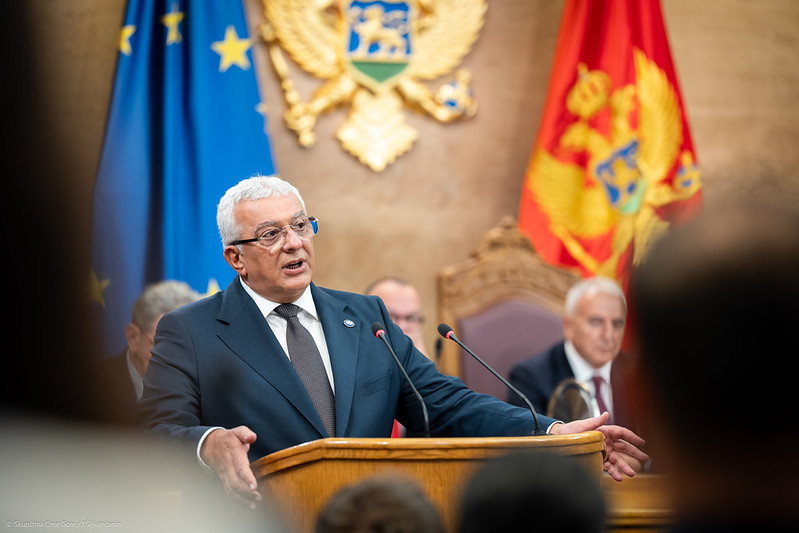
PODGORICA – Montenegro’s Parliament has rejected an opposition motion to dismiss Speaker Andrija Mandić, submitted after he offered condolences to the family of Ratko Mladić, convicted of genocide in Srebrenica and other war crimes.
In a secret ballot, 37 MPs voted to dismiss Mandić, while 41 voted against.
The opposition submitted the motion after Mandić announced on 27 August that he had offered condolences to Darko Mladić following the death of his father, Ratko Mladić. Mandić later said he had acted in accordance with custom and that there was nothing objectionable in his message.
During yesterday’s debate, which lasted several hours, opposition MPs described the vote as a test of the parliamentary majority’s commitment to European values and respect for the judgments of international courts.
Andrija Nikolić, head of the parliamentary group of the opposition Democratic Party of Socialists (DPS), said Mandić had crossed a line by offering condolences and that the need to preserve the stability of the parliamentary majority could no longer justify shielding him from political accountability.
“Andrija Mandić is a politician of the past,” Nikolić said, arguing that he could not represent a Montenegro aspiring to European Union membership.
Former Prime Minister Dritan Abazović, leader of the opposition United Reform Action (URA), supported Mandić’s dismissal, saying MPs were effectively deciding whether they considered Mladić a hero or a war criminal.
He added that he would be prepared to support Mandić remaining in office if the Speaker clearly stated that Mladić was a war criminal.
Opposition made support for constitutional amendments conditional on a vote
A previous parliamentary session on Mandić’s dismissal, scheduled for 24 September, could not take place due to a lack of quorum.
The opposition subsequently announced that it would withhold support for constitutional amendments important to Montenegro’s EU accession process until Parliament allowed a debate and vote on Mandić’s dismissal.
The proposed amendments would introduce mandatory integrity checks for nominees for prime minister and ministerial posts before they could be elected to office.
Under the proposed amendment to Article 103 of the Constitution, the President would be able to nominate a prime minister-designate only after an integrity check had been completed. Anyone who failed to meet the statutory requirements would be ineligible for nomination. The same rule would apply to prospective ministers.
A second amendment concerns the immunity of members of the executive. It would specify that the prime minister and ministers do not enjoy immunity for criminal offences involving abuse of public office. The government says the change is intended to strengthen accountability among senior officials and combat corruption.
The amendments are important for Chapter 23, which covers the judiciary and fundamental rights and is one of the key chapters in the EU accession process.
According to the daily Vijesti, 13 October is the deadline for initiating the constitutional amendment process concerning integrity checks. Failure to do so could prevent Montenegro from closing Chapter 23 by the end of this year as planned. If the proposal is rejected, the same constitutional amendment cannot be resubmitted for one year.
Johan Sattler, Head of the EU Delegation to Montenegro, said yesterday that the proposed integrity checks reflected a “well-established European standard” and urged the government and opposition to reach a compromise. He warned that Montenegro should avoid jeopardising its progress as it approaches the final stages of EU accession negotiations.