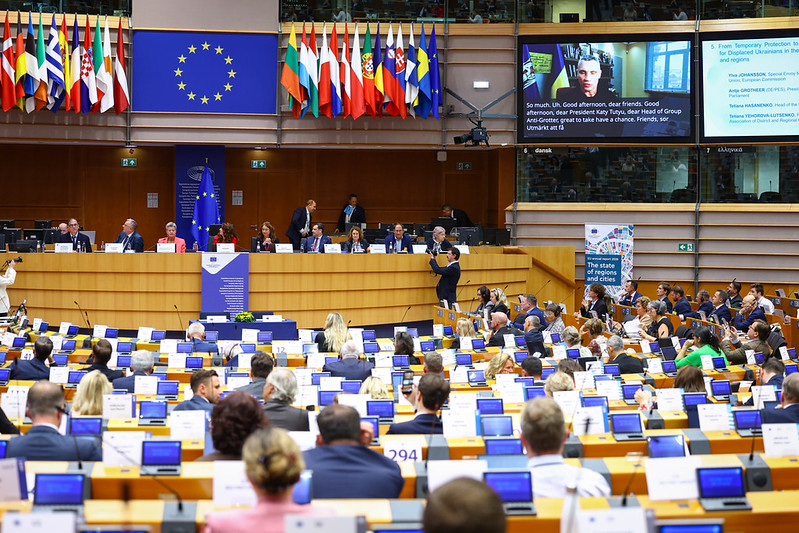
BRUSSELS – The European Committee of the Regions (CoR), an EU advisory institution gathering regional and local politicians from EU member states, unanimously adopted a resolution in Brussels yesterday condemning the glorification of war criminal Ratko Mladić in Serbia, it was reported by Hina.
The initiative for the resolution on the urgent need to protect European values in the Republic of Serbia and condemn the glorification of convicted war criminals was launched by nine Croatian members of the CoR, which has a total of 329 politicians from 27 EU countries.
“There is no EU without European values. By paying tribute to Ratko Mladić, Serbia is severely violating these values, said Nikola Dobroslavić, a former member of the Regional Assembly of Dubrovnik-Neretva county, during a speech at the CoR.
He recalled that the Bosnian Serb commander was sentenced to life in prison at the International Court in The Hague for the 1995 Srebrenica genocide.
“This resolution condemns the celebration of war crimes as anti-European and anti-civilization behavior and calls for measures against Serbia”, Dobroslavić said.
He stressed that Serbia still has the support of the European Committee of the Regions on its European path, but it cannot join the EU if it behaves like this.
Joško Klisović, a councilor in the Zagreb City Assembly, also stated in his address that Mladić was convicted because he committed the most serious crimes in BiH and Croatia.
“It is shameful and unacceptable for the authorities in Serbia to participate in, tolerate, and encourage the paying of state and military honors to war criminals. It is an insult to the victims and an insult to European values, which undermines any sincere reconciliation effort in our region. Europe must not remain silent”, Klisović said.
Croatian members of the European Committee of the Regions also expressed dissatisfaction with “the mild reaction of the European Commission to the tributes paid to Mladić in Serbia and Republika Srpska”.
The European Committee of the Regions stated that it would send the Resolution to the European Commission, the European Parliament, and the European Council.