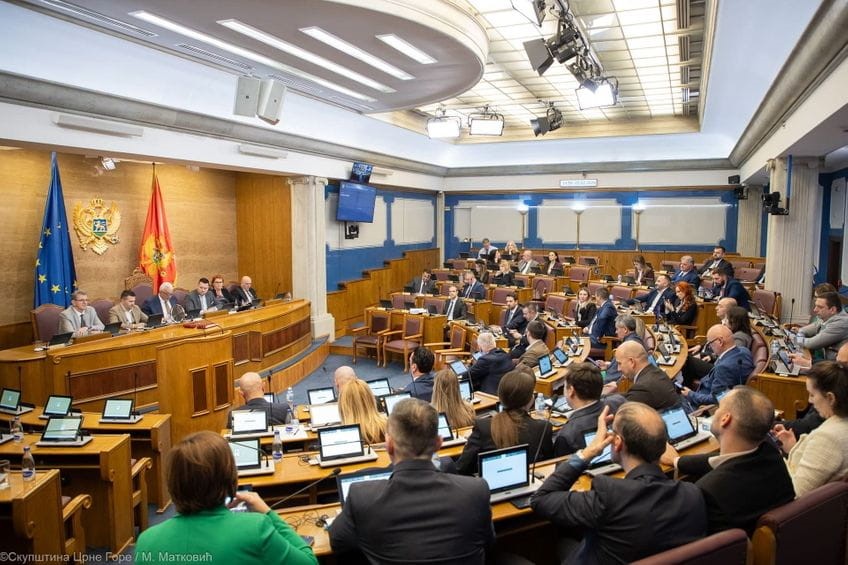
PODGORICA – Members of the Montenegrin Parliament will begin today the debate on two government-proposed amendments to the Constitution, which require a two-thirds majority of MPs for adoption. The first proposal revises the composition and election methods of the Judicial Council and Prosecutorial Council, while the second redefines the constitutional framework of the Central Bank of Montenegro (CBCG).
Amendments to the Constitution are one of the final benchmarks for closing Chapter 23, which, along with Chapter 24 (justice, freedom and security), is crucial for completing Montenegro’s accession negotiations with the EU, Vijesti reported.
The amendments aim to reduce political influence by altering the selection criteria and composition of both the Judicial Council and the Prosecutorial Council. These changes are designed to align with European standards and recommendations from the Venice Commission.
The second proposal focuses on the status, independence, and operational framework of the Central Bank of Montenegro, to meet European Central System requirements.
A new proposal concerning the Judicial and Prosecutorial Council was established by the Government on 19 February, when the previous proposal was withdrawn from the procedure in the parliament.
The Government said that, regarding the composition of the Judicial Council, the amendments imply that the majority should be made by judges who are elected by all judges and that the Minister of Justice should not be a member of the Council.
The changes stipulate that the members of the Prosecutorial Council from the ranks of the prominent lawyers should be elected by qualified majority, and that the protective guarantees for the composition and manner of the election of the Prosecutorial Council should be at the level of constitutional provisions in accord with the current legislation.
Assembly Speaker Andrija Mandić said the first vote on the amendments to the Constitution would take place on Monday, 6 July. If approved, a parliamentary committee will draft the amendments, followed by a public consultation lasting at least one month, CDM clarifies.
Head of the EU Delegation to Montenegro, Ambassador Johann Sattler described the upcoming votes as crucial rather than routine, saying Montenegro has a historic opportunity to complete EU accession negotiations. He stressed that securing a two-thirds majority for constitutional reforms, judicial appointments, and electoral legislation is essential for advancing EU membership.