PRISTINA – Twelve years after its founding in 2014, the Berlin Process is facing questions about its future role as the gap between frontrunner countries in the Western Balkans – Montenegro and Albania – and the rest is growing, while trust between countries in the region is in decline.
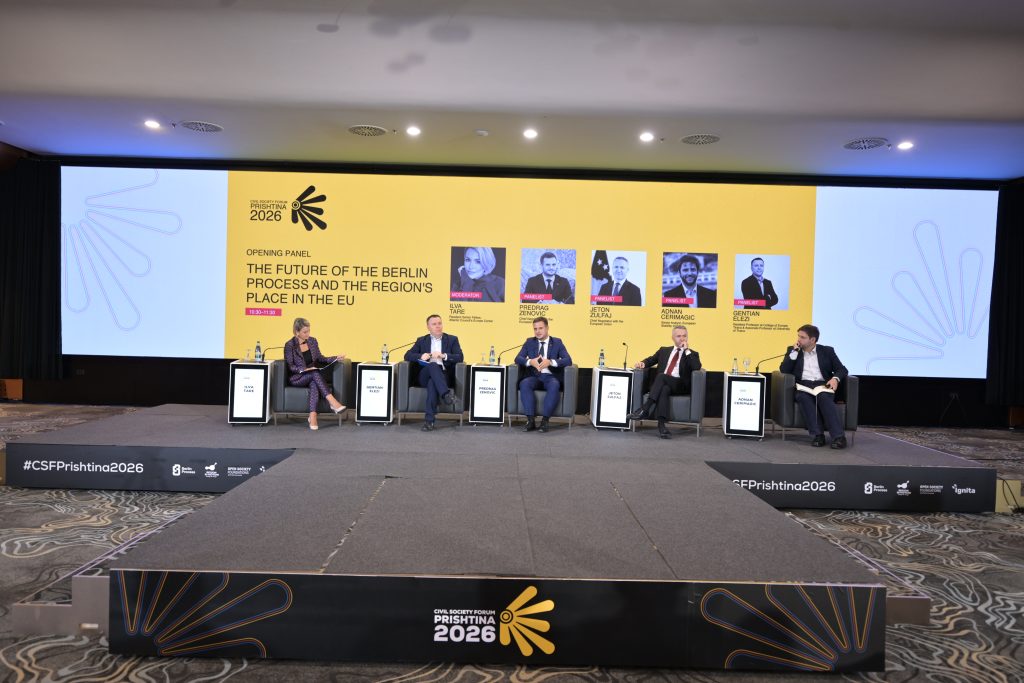
The first panel of the 2026 Civil Society Forum – itself a platform launched in the context of the Berlin Process – tackled these issues. There were differing levels of optimism about the role that the process, initiated by former Chancellor Angela Merkel when the EU enlargement was explicitly off the table for a foreseeable future, can play moving forward.
“The Berlin Process was a continuation of all the important elements of the integration process without having Brussels in mind… Berlin Process was there when there was not even a promise from the EU that these (enlargement) processes would start to unfold”, said Predrag Zenović, Montenegro’s Chief Negotiator with the European Union.
However, now things have changed due to geopolitics and a clearer strategy of the European Union when it comes to enlargement, which will, in Zenović’s view, resolve contradictions and “false” dilemmas between enlargement and the Berlin Process.
His colleague Jeton Zulfaj, Kosovo’s Chief Negotiator with the EU, expressed hope that the Berlin Process will be re-energised in the future, pointing out that some of the agreements have not been fully implemented, including travel between Kosovo and Bosnia and Herzegovina and education agreements which would enable young people to study on equal terms across the region. This, in Zulfaj’s view, is hurting the reconciliation processes in the region.
Adnan Ćerimagić, Senior Analyst at the European Stability Initiative, assessed that, in the context of Montenegro and Albania becoming frontrunners for EU membership, the Berlin Process has a role of keeping together what is “left” of the region.
He emphasised that the political environment in which the Berlin Process was launched was quite different in 2014 than it is today, since, at the time, there was initiative, whether sincere or not, on the part of Aleksandar Vučić and Edi Rama, then Prime Ministers of Serbia and Albania, to advance regional integration.
“To be honest, today, I feel that Berlin Process is not working well because we do not have Western Balkans Six, for the reason that we have two frontrunners, and other countries use the Berlin Process as a platform for a blame game”, Ćerimagić said.
Later in the conversation, Ćerimagić added that the ecosystem of regional organisations such as RYCO, ICC and CEFTA can, in a sense, play the role of the Berlin Process if that initiative did not exist, but that their success depends on the success of the least successful member – and that there is again a problem of the lack of trust between some countries of the region, which even see each other as a security threat.
Gentian Elezi, Resident Professor at the College of Europe Tirana and Associate Professor at the University of Tirana, said that, while in 2014 the founding of the Berlin Process was marked by a pessimistic atmosphere about the enlargement, there is more optimism now and the Berlin Process has a role to play – if it is transformed.
“It can now be used to walk all the Western Balkan countries through the EU door, because we now have much bigger differentiation in the region due to the progress of Montenegro and Albania”, Elezi said, adding that the Berlin Process can reach areas with its instruments that the EU cannot.