The leaders of the European Union and Member States sharply condemned Serbia for giving a state-assisted funeral with military honors to convicted war criminal Ratko Mladić. According to the official statements, glorification of such people, historical revisionism, or genocide denial violates fundamental European values and has no place in countries aspiring to become EU members.
The funeral of Mladić was formally organized by his family, but the Serbian government provided logistical backing, transport support and security. Justice Minister Nenad Vujić initially announced that Mladić would receive state and military honors, but President Aleksandar Vučić later said the family would determine the arrangements.
Nevertheless, several high-ranking Serbian ministers, including the ministers of justice, defense, culture, and public investments, attended the funeral, alongside Vučić’s son. Vučić chose not to attend the funeral personally, but stressed that he “did everything necessary and possible so that the burial would be conducted in a dignified, serious and responsible way”.
The body of Mladić, who had been serving a life sentence in the UN detention unit in the Hague, was flown from the Netherlands to Serbia by the Serbian government plane on 3 September.
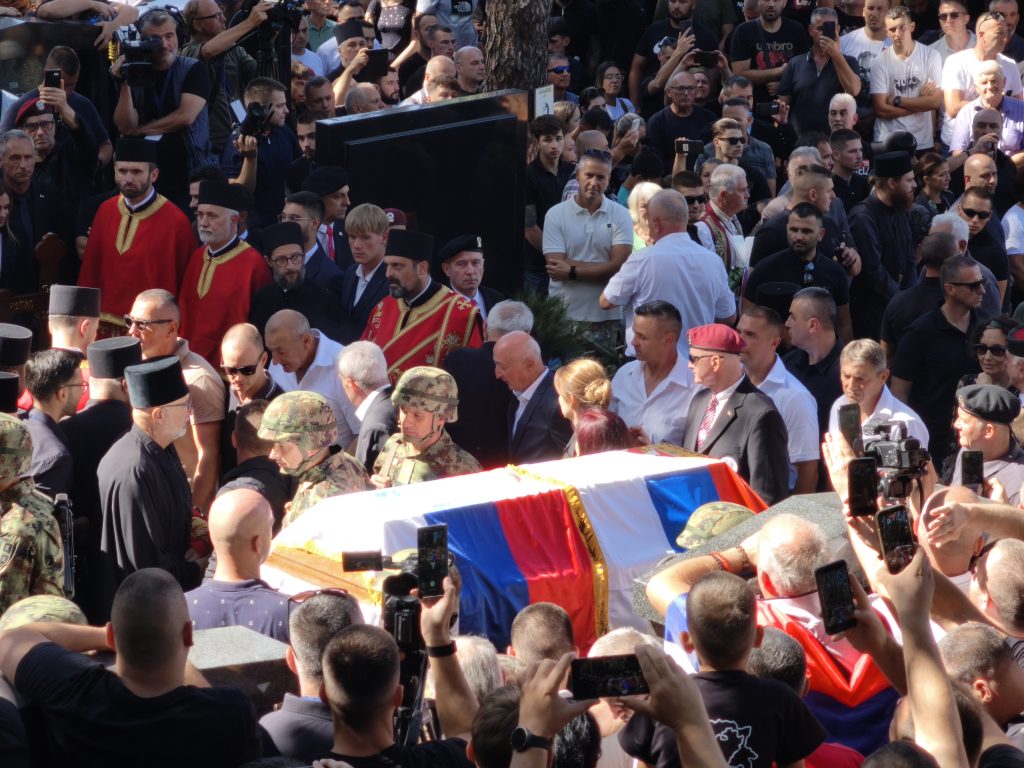
The coffin was accompanied on the flight by Mladić’s son and a granddaughter, as well as by Serbian Justice Minister. It was draped in the flags of Serbia and Republika Srpska and carried off the aircraft by Serbian army soldiers.
A memorial service, attended by the officials of RS and Serbia, was held at the Army House in Belgrade, on 5 September.
The funeral service for Mladić was held on Monday, in the presence of state officials of Serbia and Republika Srpska. The service was led by the Patriarch of the Serbian Orthodox Church, Porfirije. The coffin was escorted to the grave site by an honorary unit of the Serbian Army, after which honorary firing took place.
Condemnation from senior EU officials, with some saying it was not strong enough
Marta Kos, EU Commissioner for Enlargement, stated on 4 September that she decided to postpone her previously planned visit to Serbia, due to the glorification of Mladić. Kos added that the “EU path requires confronting the past, genuine reconciliation and respecting the victims of war crimes”.
In reaction to Kos’ statement, Aleksandar Vučić later said that her explanation was “stupid”.
On the day of the funeral, European Commissioner Spokesperson Paula Pinho initially downplayed the event by stating that Mladić “was not buried with state honors”.
This approach was strongly criticised by parts of the public in the Western Balkans. Adnan Ćerimagić, Senior Analyst at the Berlin-based European Stability Initiative, described it as a “symbol of EU’s weakness, of its lack of leverage in Serbia, and of the collapse of whatever remains of enlargement policy beyond Montenegro and Albania”.
On 8 September, Pinho partially adjusted her tone, stating that “the images from funeral spoke more than a million words”, and that the “level of official support, including the participation of army personnel and government ministers, demonstrated a failure to confront a dark chapter in Europe’s recent history”.
In addition, Pinho told Klix.ba that the EC is now “looking into and exploring options” regarding potential next steps or diplomatic consequences for Serbia’s actions.
Also on Tuesday, Presidents of the European Commission and European Council, Ursula von der Leyen and António Costa, issued statements labelling the images from the funeral of Mladić “shocking”. According to them, “the elements of official support and the presence of some senior Serbian officials at the funeral are deeply regrettable”.
The organisation of the funeral was also condemned by EU Foreign Policy chief Kaja Kallas and European Parliament Rapporteur for Serbia, Tonino Picula.
The statements were still assessed as too mild by a part of the public. Srđan Majstorović, Chairman of the Governing Board of the Belgrade-based European Policy Centre, pointed out on X that the “regime that facilitated and heavily exploited the occasion” was not mentioned explicitly, and that there was also no mention of suspending meetings with ministers and officials “who supported genocide by their attendance”.
Individual Member States also critical
In a rare instance of public reactions to the developments in Serbia, individual EU Member States also condemned the actions of the Serbian officials regarding the funeral of Ratko Mladić, some of them warning that they damage Serbia’s chances of joining the European Union.
Maxime Prévot, Foreign Minister of Belgium, said that “it is shameful and disrespectful for the victims and their families” that Mladić received honours for his funeral.
“It’s a step distancing Serbia from the EU’s fundamental values of respect for human dignity, human rights and the fight against impunity – going in the opposite direction of what is expected from an the EU candidate country”, he stated in an X post.
Natalie Kauther, Director for the Western Balkans at the German Foreign Office, stated that “pictures of high-ranking representatives of an EU candidate participating in glorifying Mladić are deeply disturbing and contradict the most fundamental values”.
Tom Berendsen, Foreign Minister of the Netherlands, said that “the honours bestowed upon Mladić in Belgrade by the state is incompatible with European values and deeply hurtful to victims and their families”.
Foreign Ministers of Sweden, Austria and Lithuania also condemned the funeral.
Consequences for the EU path of Serbia?
At this moment, it is hard to say what impact these developments will have for the EU accession process of Serbia, which has effectively been stalled for years due to political and reform deadlocks.
In July 2026, the European Commission recommended EU Member States to approve the opening of Cluster 3 to Serbia, arguing that Belgrade has made sufficient progress for this step. However, some Member States still opposed it, voicing concerns about the rule of law, and the insufficient alignment of Serbia with the foreign and security policy of the Union, including the non-imposition of sanctions on Russia. The decision was thus not made.
Having in mind the fact that Serbia is heading towards a snap parliamentary election, which is announced for October, it was already uncertain whether Cluster 3 would be opened before the vote takes place.
Also, Serbia has received just one payment from the EU Growth Plan for the Western Balkans so far, unlike Albania, Montenegro and North Macedonia, which received two or three. Serbia officially submitted its fourth payment request in July 2026, but the disbursement of funds can be expected only if the European Commission confirms the fulfilment of the preconditions, which include the overall alignment with fundamental EU values.
Finally, it has not been confirmed yet whether Ursula von der Leyen will visit Serbia during her planned Western Balkans tour in October 2026. The European Commission stated that the itinerary is still being finalised. This is another occasion in which the upcoming elections and possibly Mladić’s funeral will influence the ultimate decision.